 SGNUTRI


제품 검색
알룰로스는 설탕인가? 희귀 단당류 분석
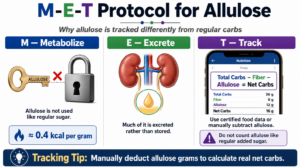
Chemically speaking, allulose is indeed a sugar. If you ask: Is allulose a monosaccharide? The scientific answer is yes-it is a simple sugar with a single molecular structure (the epimer of fructose). However, if you really want to find out whether allulose is sugar or not, it is not enough to look at the chemical structure. From a metabolic point of view, your body does not treat it as sugar at all. After it enters the blood, it completely ignores your metabolic system and walks 1 circles with urine. It neither prevents blood sugar from soaring nor requires insulin. What’s more interesting is that this rare molecule can also “black into” your gastrointestinal receptors, naturally triggering satiety hormones. It is not only a “little sweet” without calories, but also a metabolic tool that takes the initiative. Today, let’s 1 the clinical truth of D-psicose.
The A- C- F Metabolic Matrix: Why Does Your Body ‘Reject’ This Sugar?
The molecular structure of allulose is destined for its unique fate in the body. To understand why the FDA can legally approve it not to be included in the “total sugar” and “added sugar” of the nutrition label, we have to use the “A-C-F metabolism matrix” (absorption, transformation, fermentation) to make 1.
Absorption (Absorption): Run fast, but useless.
About 70% to 84% of the allulose you eat will be quickly absorbed into the bloodstream by the small intestine. But unlike ordinary glucose, it doesn’t carry the molecular key that opens the “glycolytic pathway. So, your cells can’t physically use it for energy.
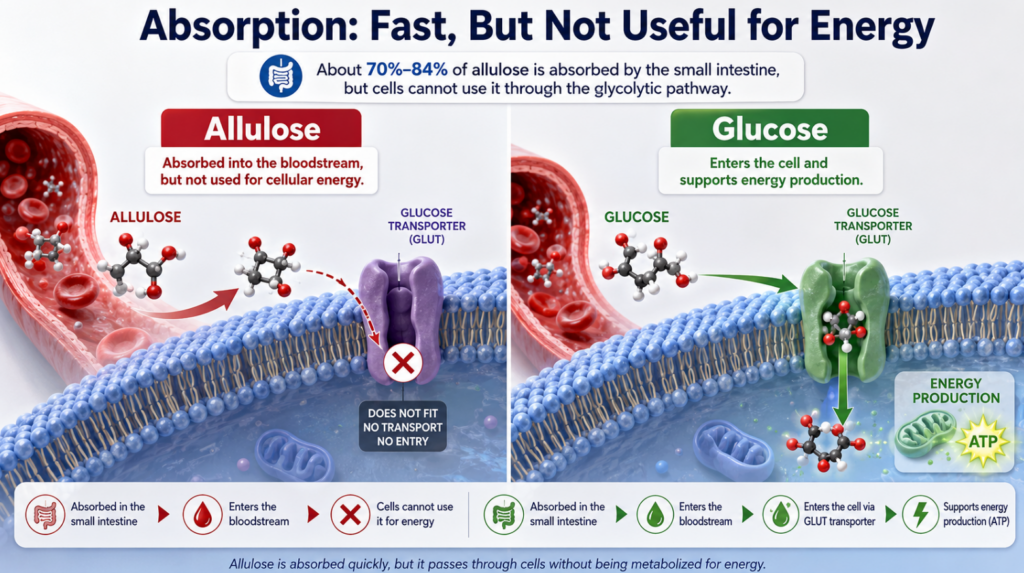
Conversion (Conversion): Zero demand for insulin.
After eating allulose to measure blood sugar, you will find that the line on the monitor is too flat to be flat. Since the body can’t metabolize this rare sugar, the pancreas naturally doesn’t care about it and doesn’t secrete insulin in response. A large number of dynamic blood glucose meter (CGM) data hammer: its glycemic index (GI) is the right 0.
Fermentation (Fermentation): Spare your stomach.
The remaining 16% to 30% of allulose will slip into the large intestine, but here’s the point-it doesn’t ferment. Sugar alcohols such as maltitol and xylitol ferment crazily as soon as they enter the intestinal tract, making people seriously flatulent. Allulose cleverly avoids bacterial fermentation and is simply too gentle on the stomach compared to sugar alcohols.
More than Sweet: Hidden GLP-1 Triggers
Allulose can actually “shout from a distance” with your intestinal neuroendocrine system “. Clinical observations in 2023 found that D-psicose is not a zero-card sugar that is mixed with death. It is actually a quite active signaling molecule.
Stimulation of autocrine GLP-1 and CCK.
As soon as allulose enters the digestive tract, it immediately binds to specific sweet receptors (T1R2/T1R3) on enteroendocrine L cells. This 1 combination does not matter and directly triggers the body’s natural release of glucagon-like peptide -1(GLP-1) and cholecystokinin (CCK). You know, those modern weight-loss drugs that are now in a mess are targeting these two hormones that make people feel full!
Suppresses the postprandial blood sugar of other carbohydrates.
If you eat allulose with regular starchy foods, it can also actively suppress blood sugar that should have soared. Reality tests have shown that adding 5 grams of allulose to 1 high-carbon meal can inhibit the activity of alpha-glucosidase (the enzyme responsible for breaking down complex carbohydrates), thereby slowing down the body’s overall absorption of glucose. speed.
Guide to Practical Operation and Pit Avoidance: Dose Trap and Baking Turn-over Site
Food factories blow allulose every day to replace white sugar 1:1 perfectly, resulting in countless home baking enthusiasts and ketogenic parties flipping wildly in the kitchen. To play with this monosaccharide, you need to master some hard-core skills.
Maillard reaction opened the “accelerated hanging”.
Allulose is extremely fast to color and requires a much lower temperature than sucrose or erythritol. If you take pure psicose and bake it at the usual ketogenic cake temperature (350 °F/175°C), it will definitely be a tragedy that is blackened and bitter on the outside and not ripe on the inside. Remember to lower the oven temperature by at least 25 °F (about 15°C) and cover with tin foil halfway through.
The “superposition” trap of the stomach and intestines.
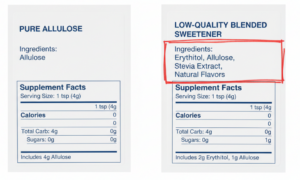
Although allulose doesn’t ferment very much by itself, if you mix it with a large dose of erythritol, your bottom line of gastrointestinal tolerance will be instantly broken down. In order to balance the sweetness and coolness, the formulator especially likes to mix the two together. This specific mixture, as long as you eat more than “0.4 g/kg body weight” at a time, there is a high probability that you will have diarrhea (osmotic diarrhea). Don’t worry about how to blow on the package, the amount of allulose eaten at a time should be controlled within 15 grams.
| 미터법 | 알룰로스 | 에리스리톨 | Sucrose |
|---|---|---|---|
| 열량 | Approximately 0.2–0.4 kcal/g | Approximately 0.2 kcal/g | Approximately 4 kcal/g |
| 혈당 지수 | Near 0 | 0 | Approximately 65 |
| Baking Browning Rate | High; browns faster than sucrose | Very low; limited caramelization | Moderate; standard browning reference |
| 냉각 효과 | Minimal | Strong cooling sensation | Minimal |
| Max Single-Dose Tolerance | Recommended limit: 15 g per serving | Individual tolerance varies; larger doses may cause GI discomfort | No specific osmotic-diarrhea threshold; intake is generally limited for metabolic reasons |
| Combined GI Warning | Allulose and erythritol mixtures above 0.4 g/kg body weight may increase the risk of osmotic diarrhea | Allulose and erythritol mixtures above 0.4 g/kg body weight may increase the risk of osmotic diarrhea | 해당 없음 |
Clinical Data Tell the Truth: Allulose vs Erythritol
The health circle always likes to compare allulose with erythritol. But if you look at the physiological data, these two are not chemicals of the same sect at all.
Chemical classification is crucial.
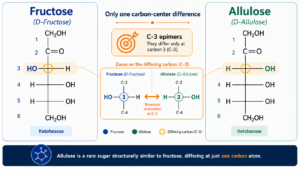
Allulose is a rare monosaccharide, while erythritol is a sugar alcohol. Erythritol has an obvious “cool feeling” in the mouth (because it absorbs heat when dissolved in saliva), and it can’t bake caramel no matter how it is baked. What about allulose? Its properties, solubility and cooking behavior are exactly the same as real sugar, nonsense, because it is structurally sugar-only the hydroxyl on the third carbon atom is reversed.
The recent “cardiovascular safety storm” has nothing to do with it.
Some time ago, a study warned that erythritol may be related to abnormal blood clots, causing panic. But it’s all the sugar alcohol metabolic pathway to blame. Allulose follows a completely different pharmacokinetic route (excreted intact through urine and not dealing with platelets at all), so there is no scientific basis for those cardiovascular concerns about sugar alcohols to be put on D-allulose.
사람들이 자주 묻는 질문 (FAQ)
Is allulose monosaccharide or disaccharide?
It’s a monosaccharide. It is a monomolecular sugar containing 6 carbon atoms. Except for a different position of hydrogen and oxygen pairing, its physical structure and fructose are simply simple sugars carved out of the same mold.
Since it is carbohydrate, why does allulose not raise blood sugar?
Although it can enter the bloodstream, your body does not have the specific enzymes that can break it down into energy. It goes through the motions in the blood and then passes through the urine intact, with no effect on blood sugar levels.
Will eating allulose make me return ketone?
No, it won’t. Because it can provide almost zero metabolic calories (1 gram is only 0.4 calories), and it does not require insulin to come forward, so it can keep you in a strict ketogenic state.
Does it cause fatty liver like fructose?
Absolutely not. Although it is a “relative” (epimer) of fructose, it does not synthesize fat in the liver. Clinical trials have instead shown that allulose may help upregulate the enzyme pathway responsible for burning fat in the liver, acting in the exact opposite way to fructose.
알룰로스는 인공 감미료인가요?
Not counting, it’s a rare, naturally occurring sugar. Like figs, raisins and maple syrup, there are tiny traces of allulose. The commercial allulose sold on the market is made by enzymatic conversion of natural plant fructose, and is definitely not a product synthesized from non-food chemicals like sucralose or aspartame.
Does allulose feed harmful bacteria in the intestines?
No, it won’t. Pathogens and yeasts in the intestinal flora can’t ferment allulose at all. It skips the fermentation phase of the lower digestive tract, so there is no need to worry about it causing small intestinal bacterial overgrowth (SIBO) or Candida infections.
How much allulose can I eat most per day?
Based on clinical tolerance studies, the recommended maximum daily intake is “0.9 g/kg body weight” and should be taken in multiple doses. For ordinary adults, as long as the single intake is controlled within 15 grams, it can perfectly avoid the small embarrassment of minor gastrointestinal discomfort.
관련 권장 사항
-

알룰로스는 탄수화물인가? 순 탄수화물 영향 분석
156알룰로스는 탄수화물인가요? 네, 하지만 순 탄수화물 함량은 0입니다. 혈당과 케토 식단 영양소 비율에 미치는 실제 영향을 알아보세요.
세부 정보 보기 -
포도당은 순수한 물질인가요?
614포도당은 순수한 물질인가요? 그렇습니다. 포도당은 고정된 화학식(C6h12o6)을 가진 순수한 화합물입니다. 여기에서 화학적 증거를 알아보세요.
세부 정보 보기 -
알룰로스는 뒷맛이 날까요? 100% 솔직한 리뷰
248알룰로스는 뒷맛이 있을까요? 100%에 대한 저희의 솔직한 리뷰를 읽어보시고, 가짜 혼합 제품을 가려내는 법과 전문적인 베이킹 팁을 알아보세요.
세부 정보 보기 -
알룰로스는 좋은 설탕 대체제일까요? 사용 전 꼭 읽어보세요
170알룰로스는 좋은 설탕 대체제일까? 디저트가 타는 것을 방지하고 효모가 영양 결핍에 빠지는 것을 막기 위해 S.R.C. 베이킹 공식을 마스터하세요.
세부 정보 보기