 SGNUTRI


البحث عن المنتج
Corn Maltodextrin: Source, De And Product Identity
A package marked “corn maltodextrin” seems to identify the ingredient clearly: maltodextrin made from corn. Yet “corn” only tells you the source of the starch. It does not tell you how far that starch was hydrolyzed, what grade the resulting powder meets, or what it will do in a formulation. Corn starch can be the starting point for more than one ingredient.
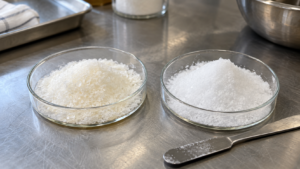
One corn-source maltodextrin grade offered by Sogao is specified at DE10–15. It is a white to pale yellow powder with a mildly sweet taste. Those details describe that particular grade. They are not a universal DE range, color, or dissolution profile for all corn-source maltodextrins.
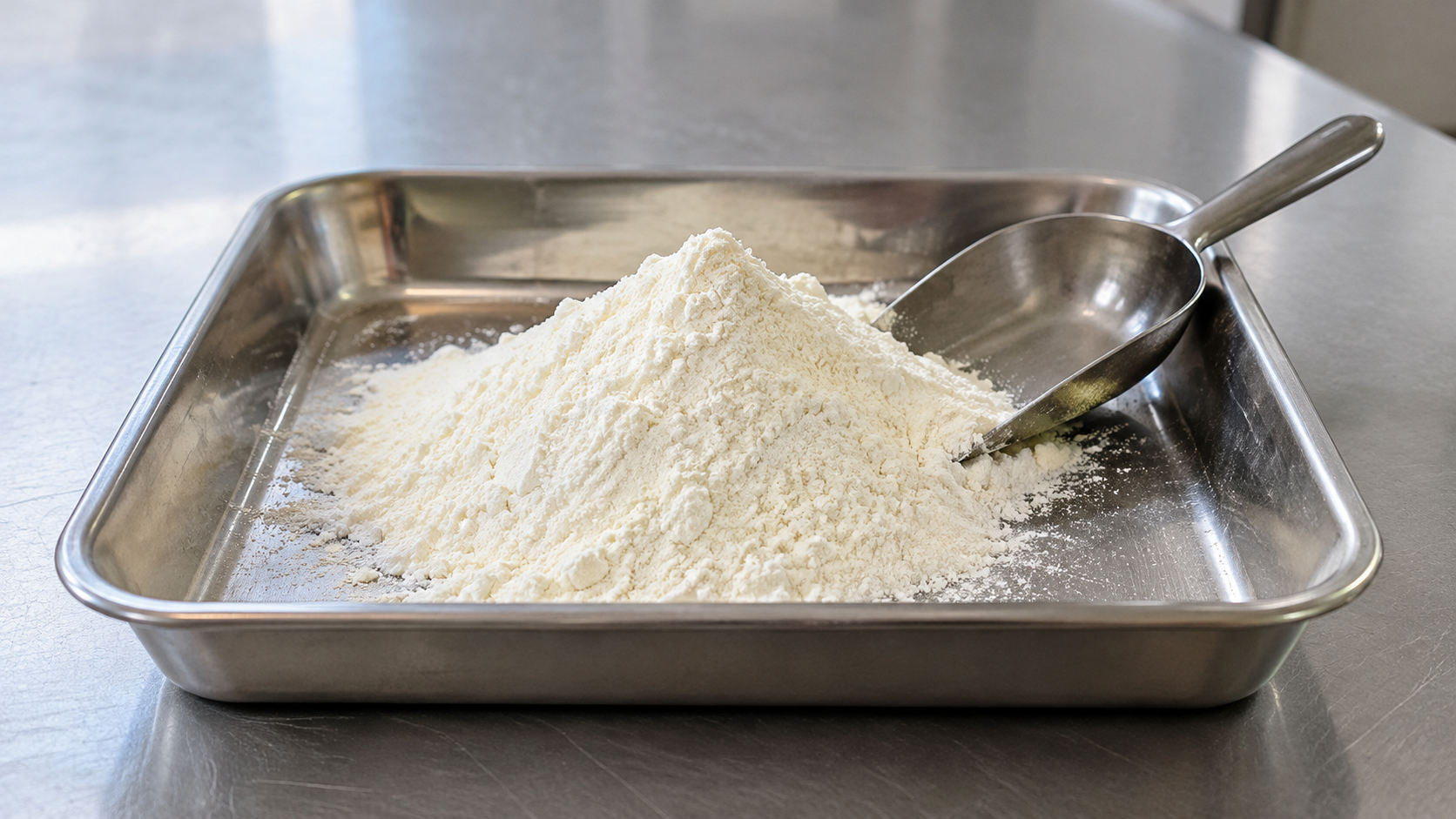
Corn identifies the source, not the original starch
Maltodextrin is made by controlled partial hydrolysis of edible starch. The finished ingredient is a mixture of glucose oligomers and polymers of different chain lengths. Corn starch can supply the starting material, but a corn plant or its starch does not already contain an identical, ready-to-isolate maltodextrin. “Made from corn” and “is corn starch” describe different things.
Other suitable starches, including potato, rice, wheat, and tapioca starch, can also be used. A label that says only “maltodextrin” therefore does not establish a corn origin. A “corn” source claim needs to match the particular product specification and ingredient traceability; the appearance of the powder cannot establish that origin.
DE, or dextrose equivalent, indicates reducing power relative to glucose. A higher DE generally reflects more extensive hydrolysis and a shorter average chain length. DE alone, however, does not specify the complete molecular distribution or a fixed sweetness or viscosity. The DE10–15 range belongs to the Sogao grade described here; it is not a standard DE range for every corn maltodextrin.
A shared starch route can lead to different products
Corn syrup can also be produced from corn starch, but that does not make it interchangeable with corn maltodextrin. Maltodextrin and glucose syrup differ in the extent of hydrolysis, sugar composition, and product form. Under the relevant US definitions, maltodextrin has a DE below 20, while glucose syrup has a DE of at least 20. Another Sogao glucose syrup is specified at DE45–53 and is a colorless, viscous liquid, visibly different from its DE10–15 corn-source maltodextrin powder. The source of that particular glucose syrup is not specified as corn, so it should not be presented as an example of Sogao corn syrup.
Glucose syrup is an aqueous mixture containing glucose, maltose, and longer-chain carbohydrates, rather than pure liquid glucose. As a liquid, it also contributes water to a formula, whereas maltodextrin powder has a different solids and solution profile. Any substitution has to account for the actual DE, sugar composition, water content, and intended function. Ordinary corn syrup does not automatically become high-fructose corn syrup simply because it comes from corn. A defined fructose component depends on the relevant isomerization and product specification.
What a particular grade can do
Maltodextrin can supply solids and bulk or act as a carrier. It may also help with dispersion or texture, depending on its DE, molecular distribution, concentration, temperature, and the food system. The listed applications for Sogao’s DE10–15 corn-source grade include powdered drinks, confectionery, baked foods, dairy and meat products, seasonings, nutrition drinks, and energy bars. A listed application does not establish identical performance in every formulation.
Maltodextrin is generally relatively low in sweetness. It can provide solids or serve as a carrier, but it is not a high-intensity sweetener and cannot, by itself, reproduce all of sucrose’s sweetness. A suitable maltodextrin can also serve as a wall material or carrier in spray drying. Encapsulation efficiency, powder yield, and reconstitution still depend on the core material, DE, feed solids, and drying conditions. Corn origin alone does not establish suitability for every such process.
The Sogao DE10–15 grade also specifies a minimum solubility of 98%. That specification does not promise an instantly clear solution at every water temperature, concentration, or mixing condition. Particle size and other ingredients can affect dispersion and the state of the solution. The figure identifies a product specification, not a guarantee of instant dissolution in any finished food system.
Source is not a nutrition or certification claim
Ordinary digestible maltodextrin mainly supplies carbohydrate. Its glucose chains do not make it dietary fiber, nor do longer chains by themselves prove slow digestion or sustained energy. Resistant maltodextrin and resistant dextrin differ from ordinary products in their indigestible components and the evidence needed for labeling. A fiber declaration depends on the composition of the specific resistant product and the applicable labeling basis.
Corn origin also does not by itself establish that a product is organic, non-GMO, healthier, gluten-free, or free from cross-contact. Those claims require evidence for the particular product and production line. For an ingredient labeled only “corn maltodextrin,” the remaining questions are whether it is an ordinary or resistant product and which DE, form, and intended use its actual grade supports.
التوصيات ذات الصلة
-

الديكستروز والمالتوديكسترين: النسبة المثلى لنمو العضلات
1281اكتشف النسبة المثلى بين الدكستروز والمالتوديكسترين لتحقيق أقصى نمو للعضلات. قم بإعداد أفضل مشروب لك بعد التمرين اليوم.
عرض التفاصيل -
ما هو الفرق بين الألياف الغذائية والألياف القابلة للذوبان
1202تعرّف على الفرق بين الألياف الغذائية والألياف القابلة للذوبان وكيفية عملها وفوائدها الصحية الفريدة.
عرض التفاصيل -
Allulose comes from: Natural Sources and Production
360Learn where allulose comes from, how fructose becomes allulose, and why natural traces differ from commercial products.
عرض التفاصيل -
Allulose vs. Erythritol: Please select according to the formulation requirements
329Use allulose compared to erythritol to evaluate formula role, blend type, and food use.
عرض التفاصيل