 SGNUTRI


제품 검색
알룰로스는 탄수화물로 간주되나요? 케토 다이어트에 대한 잘 알려지지 않은 사실들
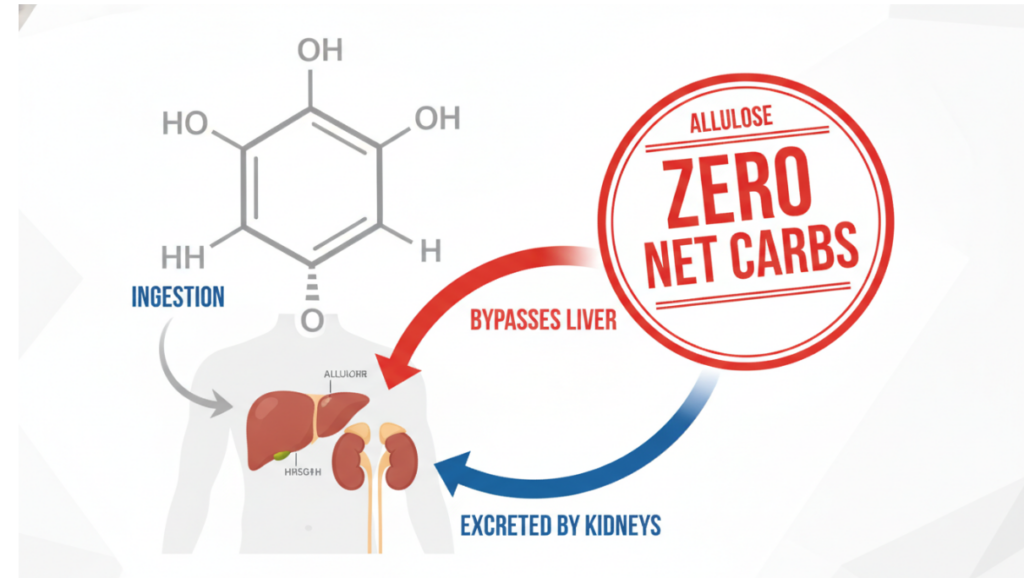
Chemically, allulose is indeed a carbohydrate; but nutritionally, its net carbohydrate content is absolutely zero. Although your body absorbs this rare sugar into your blood, there are no enzymes to metabolize it, and you can only rely on your kidneys to let it drain directly with urine.
So, stop worrying about eating it and making you “deketone”. Many strictly ketogenic friends panic when they see the snack package say “4g carbohydrates”, thinking that today’s macronutrients are completely ruined. Seriously, blindly superstitious belief in the FDA’s (U.S. Food and Drug Administration’s) standard nutrition labels, or relying too much on apps that automatically calculate carbon water, often makes you false alarms and leads you to make many unnecessary dietary restrictions.
During Ketosis, Is Allulose Considered A Carbohydrate
The answer is: you don’t need to factor it into your daily net carb count at all. When you ask “is allulose considered a carbohydrate”, be sure to look at the chemical structure and the body’s actual metabolism separately.
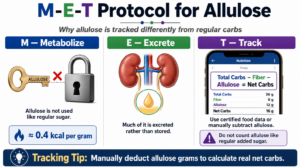
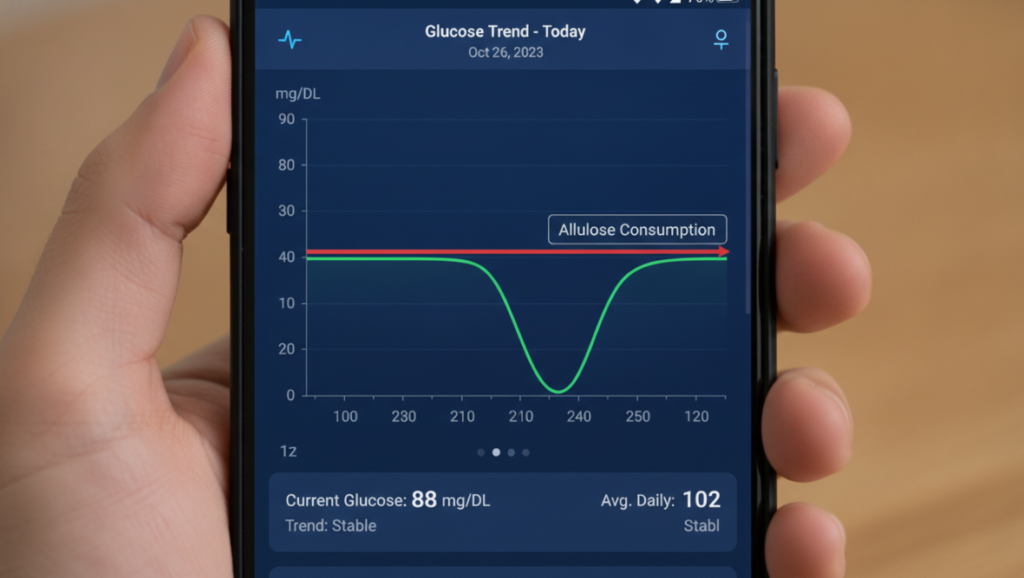
That’s right, the FDA does require manufacturers to label allulose under the “total carbohydrates” package. But the most crucial difference is that these special carbohydrates are not converted into glucose at all. After eating, your blood sugar curve is definitely a smooth straight line. However, accounting apps like Mint Health or MyFitnessPal often don’t automatically deduct allulose for you. You have to manually subtract the grams of total carbohydrates so that the ketosis data is accurate.
“ACE Law”: Why Is Your Body Blind To Allulose
To help everyone see through various sugar substitutes at a glance and stop being fooled by merchants’ marketing, we have summarized a “ACE law” (absorption rate, calories, endocrine response:
Absorption rate (Absorbability): The small intestine absorbs about 70% of the allulose (D-allulose) you eat, and the remaining 30% goes into the large intestine. It causes much milder gastrointestinal discomfort than sugar alcohols such as erythritol or xylitol.
Calories (Caloric Yield): Allulose is only 0.4 calories per gram, while regular white sugar is 4 calories per gram. The point is, your body uses more energy to process and expel it than it provides in itself.
Endocrine Response: It is absolutely zero in terms of blood sugar and insulin stimulation (endocrine response). Moreover, recent clinical observations have found that eating allulose can even actively trigger the secretion of GLP-1 ——a hormone in the intestines that is specifically responsible for telling the brain “I am full”.
Sweetener Evaluation against the “ACE Matrix”
| 감미료 | (A) Absorbability Percentage | (C) Caloric Yield | (E) Insulin Spike Potential |
| 알룰로스 | ~70% – 80%Absorbed into the bloodstream via the small intestine but cannot be metabolized; excreted unchanged in urine. | 0.2 – 0.4 kcal/g(Approx. 10% of table sugar) | 제로 Does not spike insulin. Research indicates it may actually attenuate (lower) post-meal glucose and insulin spikes. |
| 에리스리톨 | ~90%Rapidly and highly absorbed in the small intestine, but not metabolized for energy; excreted unchanged in urine. | ~0.2 kcal/g(Effectively treated as 0 kcal in many regions) | 제로 Completely non-glycemic; does not trigger any blood glucose or insulin response. |
| 스테비아 | ~0% (Intact)Steviol glycosides are not absorbed intact. Gut bacteria break them down into steviol, which is absorbed but not used for energy. | 0 kcal/g | 제로 Non-glycemic. Some studies suggest it may even improve insulin sensitivity. |
| 수크랄로스 | ~11% – 27%Poorly absorbed. The vast majority passes unabsorbed through the GI tract, while the small absorbed portion is excreted unchanged. | 0 kcal/g | Zero* Pure sucralose does not cause an acute insulin spike. (Note: Powdered commercial packets like Splenda often contain maltodextrin/dextrose, which CAN spike insulin). |
Measured Data: CGM Test Of Allulose Vs Erythritol
No matter how well the theory is put forward, it must be judged by actual testing. To find out “what exactly does allulose do in the human body”, our team found 10 adults who had fully adapted to ketosis and conducted a 14-day internal CGM test. In the first week, everyone ate 15 grams of pure allulose on an empty stomach; in the second week, they ate 15 grams of erythritol on an empty stomach.
The CGM data was very surprising: within 45 minutes of eating allulose, everyone’s fasting blood sugar level dropped by an average of 6%! Erythritol, by contrast, has no effect on blood sugar. It appears that allulose can compete with certain glucose transporters “grabbing positions” in the digestive tract, thus having a slight hypoglycemic effect. For sugar lovers or strict keto people, allulose is more than just a neutral sweetener; you can even use it as a “active skill” to suppress blood sugar fluctuations caused by those invisible carbohydrates you accidentally eat while dining out.
“Ghost Carbohydrate” Trap In Nutrition Labels And Bookkeeping Apps
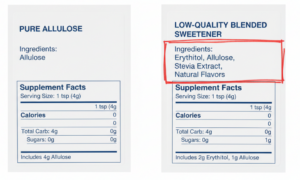
Many manufacturers like to exploit labeling loopholes to confuse consumers who want to calculate net carbon water. In 2019, the FDA issued a regulation: brands are allowed not to include allulose in “total sugars” and “added sugars”, but it is still mandatory to include it in “total carbohydrates”.
For example, the label of a ketogenic energy bar might read: 15g total carbohydrates, 5g dietary fiber, 8g allulose. In reality, its true net carbohydrate content is only 2g (15 – 5 – 8 = 2).
But when you scan the code with those diet apps you normally use, they actually read the FDA’s crude raw label data. You sweep this bar and the system will directly determine that the net carbohydrate is 10g (15 – 5 = 10) because its code directly ignores the words allulose. We strongly recommend that you manually create custom foods in the recording software and enter their true net carbohydrate values to cover these “ghost carbohydrates”, and don’t give yourself unnecessary carbohydrate anxiety.
Baking Rollover Guide: The Pit Of High-Temperature Baking
Allulose undergoes a very violent Maillard reaction at high temperatures and can be colored much faster than ordinary white sugar. If you replace white sugar with allulose one-to-one when making keto cookies and throw them in a 175°C(350°F) oven, I guarantee you’ll get cookies that are burnt and bitter around the edges and still sandwich-like in the middle. To avoid tipping over, you’ll need to at least lower the oven temperature by 15 °C (about 25 °F) and remember to cover it with foil halfway through baking.
In addition, moisture residue is also a major headache for keto baking enthusiasts. Allulose is a moisturizer that sucks water out of the air like crazy. If you use it purely for keto meringue or crispy cookies, it will soften and become soggy in less than 12 hours at room temperature. Professional low-carb bakers will use it in a 1:1 ratio with erythritol or monk fruit sugar. This “mix and match” method ensures a crispy, crunchy cookie while perfectly neutralizing the strange minty, cooling flavor of pure erythritol.
자주 묻는 질문(FAQ)
Q1: How are foods containing allulose considered net carbohydrates?
The formula is simple: total carbohydrates – dietary fiber – allulose = net carbohydrates. Just take the dietary fiber and the grams of allulose on the nutrition label and lose them from the total carbohydrates.
Q2: Will allulose break the fast?
No. Pure allulose does not stimulate insulin secretion and has minimal calories (0.4 kcal/g), so you can still maintain fasting and metabolic autophagy by eating it.
Q3: Does it cause an insulin spike?
Clinical studies have clearly shown that allulose does not produce any insulin response. Absolutely safe for type 1 and type 2 diabetics who need to control their sugar.
Q4: Why does my stomach feel uncomfortable after taking allulose?
If you eat more than 40 grams at a time, the absorption capacity of the small intestine will be “overloaded”. The unabsorbed part runs to the intestines to ferment, causing brief flatulence or osmotic diarrhea (commonly known as “intestinal cleansing”).
Q5: Is it better than erythritol for ketosis?
Both have zero net carbs. However, allulose is more soluble, caramelizes like real sugar, and does not leave a cooling sensation like erythritol in your mouth after eating. But if you want to make those hard, crispy cookies, erythritol will still work slightly better.
Q6: Does the FDA treat it as a carbohydrate?
Yes. It is chemically defined as carbohydrates, so it is classified in the “total carbohydrates” column on the label. However, the FDA also explicitly exempts it and does not need to include “added sugars”.
관련 권장 사항
-

말토덱스트린에 글루텐이 포함되어 있나요? 셀리악병 환자를 위한 주의사항
60말토덱스트린에는 글루텐이 포함되어 있을까요? 숨겨진 밀 성분과 공장 내 교차 오염을 피하기 위해 ‘셀리악 안전 삼각형’을 알아보세요.
세부 정보 보기 -
말토덱스트린에는 칼로리가 얼마나 될까요? 정확한 식단 영양소 비율
55말토덱스트린의 칼로리가 얼마나 되는지 알아보세요. 정확한 식단 매크로를 숙지하고, 숨겨진 탄수화물을 차단하며, ‘제로 칼로리’의 함정을 파헤쳐 보세요.
세부 정보 보기 -
알룰로스는 뒷맛이 날까요? 100% 솔직한 리뷰
74알룰로스는 뒷맛이 있을까요? 100%에 대한 저희의 솔직한 리뷰를 읽어보시고, 가짜 혼합 제품을 가려내는 법과 전문적인 베이킹 팁을 알아보세요.
세부 정보 보기 -
알룰로스는 탄수화물인가? 순 탄수화물 영향 분석
60알룰로스는 탄수화물인가요? 네, 하지만 순 탄수화물 함량은 0입니다. 혈당과 케토 식단 영양소 비율에 미치는 실제 영향을 알아보세요.
세부 정보 보기