 SGNUTRI


제품 검색
Allulose vs. White Sugar: Differences in Formulation
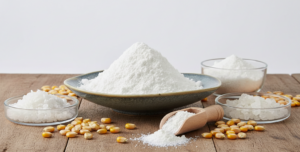
Although allulose and white sugar both provide sweetness, if you were to substitute one for the other in a formulation, the impact would go far beyond just sweetness. Once the raw materials are changed, both the product’s form and the quality of the final product will be affected; consequently, the nutritional label data and the performance of the formulation in actual production will also differ significantly.
Once the sweetness changes, it affects the whole.
At the same weight, allulose is not as sweet as sucrose. Therefore, it’s difficult to achieve the original level of sweetness simply by substituting ingredients in a one-to-one ratio by weight. But when you try to boost the sweetness, you have to recalculate the proportions of solids, moisture, browning, and the final texture and mouthfeel in the recipe. Even if you go to great lengths to match the original sweetness, the finished product may still not perfectly replicate the original.
Also, don’t blindly trust any so-called “fixed substitution ratio,” because product forms vary widely, and formulations differ greatly. Crystalline allose, aloxone syrup, and those compounded with other sweeteners simply cannot apply the same conversion criteria.
When reading nutrition labels, you should consider the specific product form.
Take the nutrition composition table in the U.S. market as an example. The calories of traditional monosaccharides and disaccharides are basically calculated at 4 kcal/g, while allulose can be calculated at 0.4 kcal/g. By this standard, 100 grams of pure allulose contains only about 40 kilocalories. However, it should be noted that this conversion factor is not universally adopted internationally. If it is syrup, compound sweetener or tableted candy, it is definitely not possible to directly use the data of “100 grams of pure psicose” to mechanically copy it.
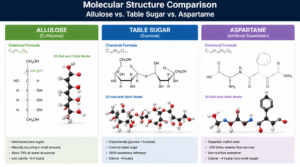
From a compositional standpoint, allulose is a monosaccharide and a carbohydrate; it is neither dietary fiber nor a sugar alcohol. According to the current implementation tolerance of the US FDA, it has to be counted as “total carbohydrates (Total Carbohydrate)” on the nutrition label, but not as “total sugar” and “added sugar”. The concepts of low calorie, zero sugar and zero total carbohydrate are not to be confused. What the product can claim in the end depends on the amount of food you eat in a single serving, the complete formula structure, the form of the product, and the specific legal restrictions of the target sales place.
Different food categories involve vastly different process considerations.
For baking, blending drinks, boiling syrup or making frozen desserts, the requirements for the dissolution speed, graininess, moisture content and operation methods of the raw materials are completely different. Allulose is indeed a good sweet raw material and sucrose, but whether it is good or not must be evaluated in a specific food system.
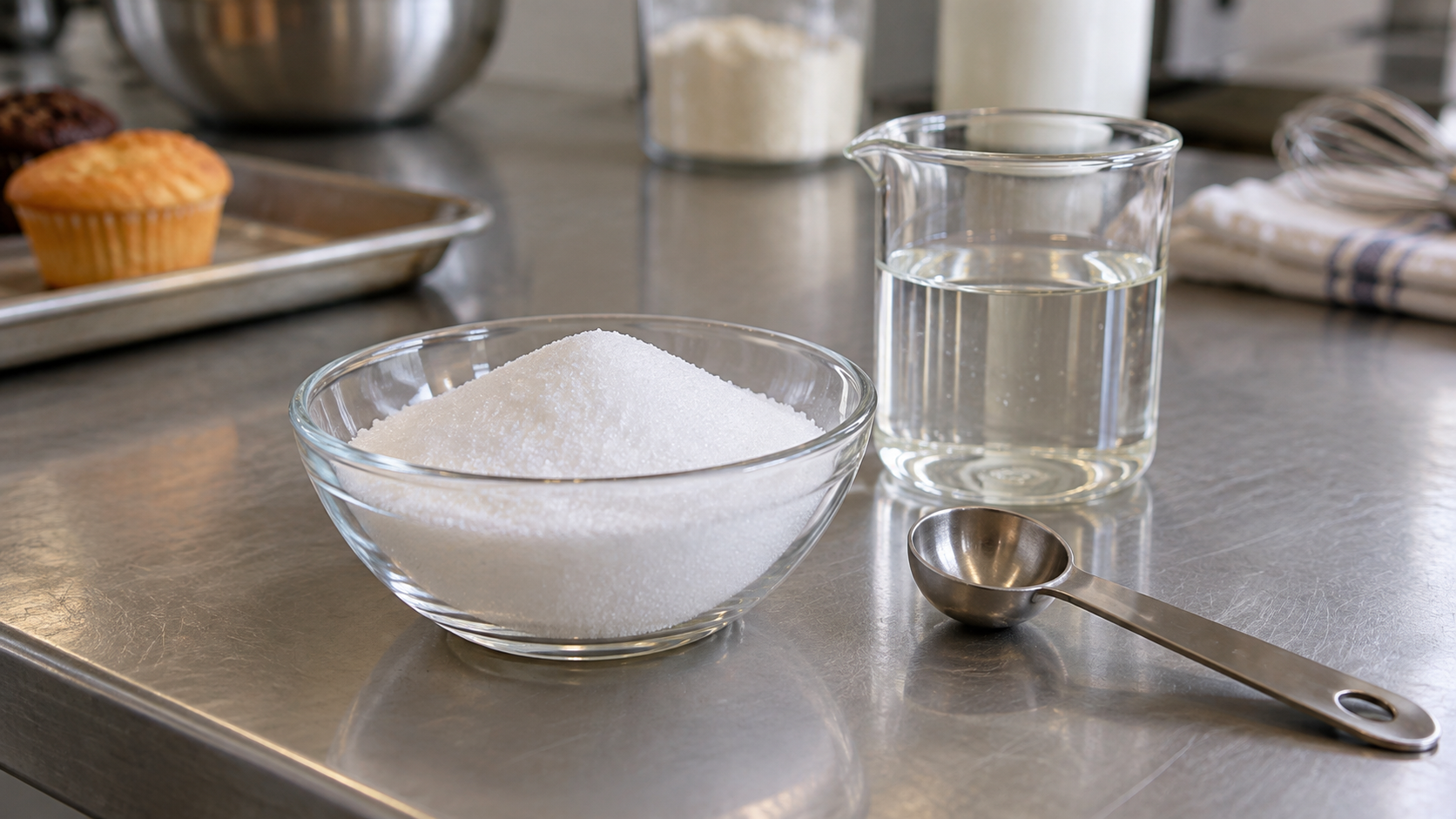
For example, if your product needs attractive Maillard reaction (coloring), needs darker color, or wants to make frozen food softer (lower freezing point), allulose is definitely a bonus. But on the other hand, if your formula requires not to change color and avoid browning as much as possible, allulose will become a stumbling block in the process because of its strong reducing sugar reaction.
관련 권장 사항
-

-
알룰로스는 천연 감미료인가, 인공 감미료인가? 진실은 무엇일까
1158알룰로스는 천연 성분인가, 인공 성분인가? 이 희귀한 당의 안전성과 케토 다이어트에 미치는 이점에 대한 진실을 알아보세요.
세부 정보 보기 -
-
수크랄로스의 부정적인 영향은 없나요?
917장 문제와 DNA 손상부터 대사 위험에 이르기까지 수크랄로스의 숨겨진 부작용에 대해 알아보세요. 섭취량을 최소화하는 것이 장기적인 건강을 위해 필수적인 이유를 알아보세요.
세부 정보 보기