 SGNUTRI


제품 검색
Is Allulose a Fiber? How It Truly Affects Your Digestion
From a chemical perspective, allulose is simply a carbohydrate, so it is by no means “dietary fiber.” Interestingly, from a practical standpoint, some of the allose you consume is transported directly to the colon, where it undergoes fermentation. This has piqued the curiosity of many researchers: could allulose be a prebiotic? Indeed, the portion that your body does not absorb performs the same function as a prebiotic.
When people check the nutrition labels on keto snacks, many are left baffled: why does a “sugar” end up behaving like fiber once it’s in your stomach? This misunderstanding often leads to overeating without realizing it, resulting in uncomfortable bloating and even frequent trips to the bathroom. In today’s in-depth article, we’ll take a closer look at the mathematical tricks behind the “net carbs” label, examine what allulose actually does in your stomach, and show you how to set a daily “safe intake limit” to protect your digestive system.
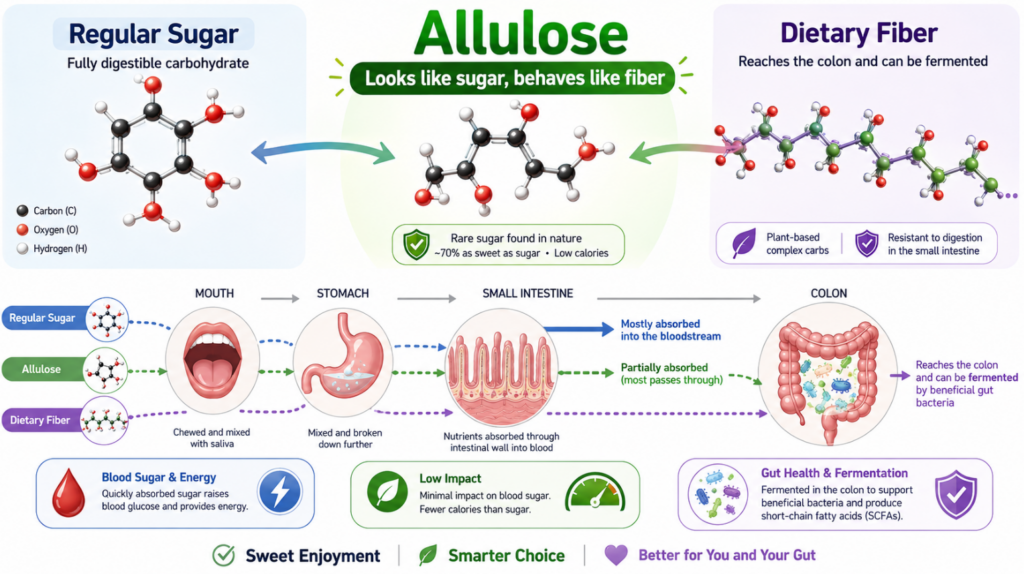
Addressing the Core Issue: Is Allulose Really a Prebiotic Fiber?
With this type of sugar substitute, the legal definition and its actual behavior in the digestive tract are entirely different matters. In the FDA’s classification in the United States, allulose is strictly categorized as a simple monosaccharide. True dietary fiber, on the other hand, consists of complex carbohydrate chains that human enzymes cannot break down at all. Therefore, if you ask from a molecular‑structural perspective whether allulose is a prebiotic fiber, the answer is unequivocally: no.
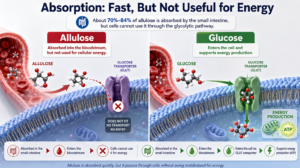
But your colon doesn’t care about any legal definitions. Approximately 70% of ingested allulose is absorbed into the bloodstream and subsequently excreted in the urine. Where do the remaining 30% go? They make their way all the way to your colon “unchanged.” As soon as the beneficial bacteria in the gut detect these undigested alluloses, they treat them like a feast and promptly begin fermenting them, producing short-chain fatty acids that are beneficial to the body. This fermentation process precisely and fully meets the definition of “prebiotics.” In other words, even though you haven’t actually consumed any fiber, you still genuinely reap the benefits of “feeding” your gut microbiota.
Exposing the FDA’s “Net Carbs” Smokescreen: Why Labels Keep Misleading You
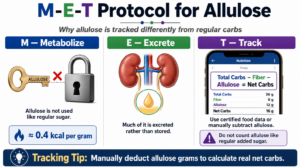
On the market, the packaging of many keto-friendly foods often plays with a kind of mathematical formula, subtly misleading consumers into mistakenly believing that allulose is a type of fiber. How do manufacturers calculate “net carbs”? They start with the total carbohydrate content, then subtract dietary fiber and sugar alcohols.
A turning point came in 2019, when the FDA issued a landmark regulation: because allulose does not cause blood sugar spikes, food manufacturers are permitted to exclude it from the “total sugars” and “added sugars” declarations on nutrition labels. Now the brand is thrilled and has promptly started deducting both allulose and fiber when calculating net carbs. Imagine this: when you pick up a protein bar and see on the label, “minus 10 grams of fiber, minus 5 grams of allulose,” your brain will naturally group these two together. It is precisely because of this legal labeling loophole that the vast majority of ordinary buyers naturally assume: since it can be deducted, allulose must also be an indigestible type of dietary fiber.
The C.M. B. Digestive Paradox Matrix: What’s it doing in your stomach?
To fully understand how the body deals with this sugar substitute, you have to separate its chemical properties from the digestive process. The following C.M. B. matrix can clearly tell you why a little “sugar” can make your stomach growl.
- C- Chemical truth (Chemical Reality): It is a sugar. The chemical formula of allulose is exactly the same as that of fructose (the sugar in fruits), except that the order of oxygen and hydrogen atoms is slightly offset. This slight structural change makes it particularly sweet, but the digestive enzymes in your body have no temper with it and can’t disassemble it into energy.
- M-Metabolic Truth (Metabolic Reality): It’s like an invisible man. As mentioned earlier, 70% is absorbed into the blood in the small intestine, but strangely, it does not trigger insulin secretion at all. Your liver can’t turn it into glycogen. In the end, only the kidneys can filter it out. After all this toss, it’s negligibly low in calories: only 0.4 calories per gram.
- B- Bacteria Truth (Bacterial Reality): It behaves like a prebiotic. After the 30% that is not absorbed rushes into the colon, Bifidobacterium ferments very quickly for this sugar. What’s the cost of this bacterial meal? It produces gas (to make your stomach bloat) and organic acids (to protect your intestinal mucosa).
| C.M.B. Dimension | Property | Human Response | Fiber-Like? |
|---|---|---|---|
| C — Chemical Reality | Allulose is a rare sugar with the same molecular formula as fructose but a different atomic arrangement. Human digestive enzymes metabolize it poorly. | It provides sweetness while contributing very little usable energy. | Partially — it resists normal digestion, but it is chemically a sugar rather than dietary fiber. |
| M — Metabolic Reality | Most allulose is absorbed in the small intestine but is minimally metabolized and is largely excreted through urine. It provides approximately 0.4 kcal per gram. | It generally produces a much smaller blood-glucose and insulin response than conventional sugar. | Partially — its low energy availability resembles fiber, although its absorption pathway is different. |
| B — Bacterial Reality | The unabsorbed portion reaches the colon, where intestinal bacteria may ferment it and produce gases and organic acids. | Small amounts may be tolerated well, while larger servings can cause bloating, stomach rumbling, gas, or loose stools. | Yes, functionally — the unabsorbed portion can behave similarly to fermentable fiber in the colon. |
Insiders rollover warning: drink black coffee and allulose on an empty stomach, don’t try!
If you eat allulose alone without other nutrients, your gastrointestinal peristalsis will soar like stepping on the accelerator. Many novices who have just come into contact with sugar substitutes especially like to kuai two tablespoons of allulose in the black coffee in the morning. They think that 0 calories can give them some harmless benefits during the fasting period.
Listen to the sentence advised, this collocation is definitely a nightmare of the stomach. High concentrations of allulose dissolved in hot liquid, into the empty stomach, will form a hypertonic solution. Because there is no fat or solid protein in the stomach to step on the brake, this cup of liquid will directly “whoosh” into the intestines. This rapid “dumping effect” will pull the water in the body into the digestive tract. The result is: within 30 to 60 minutes, you will definitely have to rush to the toilet with your legs between your legs and experience a sudden osmotic diarrhea.
Remember, eating allulose must be “bottoming”. If you have to add it to your coffee, please add a little cream, butter or MCT oil. Of course, the best way is to roast it in solid food, and let the fat and real dietary fiber physically slow it down in the gut.
How much can your stomach hold? Calculate your exclusive tolerance bottom line
If you want to predict whether you will feel sick after eating, don’t look at the ambiguous “recommended amount”, which has to be calculated according to your weight. The maximum tolerance safety line given by clinical dietitians is: up to 0.4 grams of psicose per kilogram of body weight.
Let’s do some accounting. An adult weighing 150 pounds (about 68 kilograms) can eat about 27 grams at one time. If you kill 1 whole bucket of ketogenic ice cream (usually 30-40 grams of psicose in it) at one go, I can assure you that you will have severe flatulence, tumbling in your stomach, and diarrhea is also a high probability event.
However, if you stretch this amount, the formula changes completely. The same person, if scattered within 24 hours to eat, can safely tolerate 0.9 grams per kilogram of body weight (that is, almost 61 grams a day), basically will not have any uncomfortable gastrointestinal reactions. So, next time before you kill the entire box of ketogenic cookies, look at how many grams are written on the nutrition label.
People Also Ask (FAQ)
Can allulose be classified as dietary fiber?
Cannot. The FDA makes it clear in its official classification that allulose is a carbohydrate—more specifically, a rare sugar. It lacks the complex molecular chain structure characteristic of dietary fiber, so it cannot be labeled as dietary fiber on the nutrition facts panel.
So, is allulose a prebiotic?
From the perspective of actual functionality, it does. Although it is legally classified as a sugar, approximately 30% of the allose you consume is not absorbed by your body. This portion passes directly into the large intestine, where it serves as food for beneficial gut bacteria—exactly the role of a prebiotic.
Since it’s not a fiber, why do manufacturers deduct it when calculating net carbs?
Because the FDA has given its approval. Since allulose does not raise blood glucose or insulin levels, the FDA permits manufacturers to exclude it when calculating “net carbs.” It’s being cut because of its metabolic properties, not because it’s some kind of fiber.
Will eating allulose make my stomach feel bloated or cause me to pass gas?
If you eat too much in one go, you definitely will. That portion of allulose that reaches your colon will undergo fermentation, and when intestinal bacteria ferment it, hydrogen is produced. Then you may experience mild bloating, frequent flatulence, and rumbling in your abdomen.
Does consuming allulose cause diarrhea?
Consuming more than 25–30 grams at once, especially on an empty stomach or when mixed with a liquid, can easily trigger osmotic diarrhea. The sugars that aren’t absorbed draw large amounts of water into your intestines, resulting in urgent, watery bowel movements.
In terms of digestion, what are the differences between allulose and erythritol?
Erythritol is a sugar alcohol; about 90% of what you consume is absorbed into the bloodstream and then excreted in urine, with very little remaining in the intestines to undergo fermentation. Meanwhile, 30% of allulose is not absorbed and passes into the colon. Therefore, compared with erythritol, allulose is more likely to cause bloating, and it also triggers more pronounced intestinal fermentation.
Can people with irritable bowel syndrome (IBS) consume allulose?
For friends with severe IBS, it is recommended to start by eating just a small amount to test the waters. This is because allulose ferments too rapidly in the gut, producing a response very similar to that of consuming high-FODMAP (fermentable carbohydrate) foods. For sensitive digestive systems, this rapid fermentation can easily trigger cramping and even precipitate a relapse of IBS.
관련 권장 사항
-

Is Allulose A 1 To 1 Substitute For Sugar? The Truth
21Is Allulose A 1 To 1 Substitute For Sugar? No. Learn Exact Smb Conversion Ratios To Master Perfect Keto Baking Today.
세부 정보 보기 -
Is Allulose A Sugar? Rare Monosaccharide Breakdown
21Is Allulose A Sugar? Yes, A Rare Monosaccharide. Discover Why It Bypasses Metabolism, Blocks Spikes And Boosts GLP-1.
세부 정보 보기 -
Allulose and GLP 1: The Sweet Secret to Weight Loss
19Discover How Allulose And GLP 1 Drive Weight Loss. Master The L-Cell Protocol And Pre-Load Strategy For Natural Satiety.
세부 정보 보기 -
Is Allulose A Carbohydrate? Net Carb Impact Exposed
16Is Allulose A Carbohydrate? Yes, But With Zero Net Carbs. Discover Its Real Impact On Blood Sugar And Keto Macros.
세부 정보 보기