 SGNUTRI



제품 검색
What Role Does Maltodextrin Play In Food? From Seasoning Powders And Fruit Powders To Prepared Drinks
Maltodextrin can supplement the solids of food with minimal changes in sweetness, carry flavor, help pulp be made into powder, or adjust the consistency after preparation. It is made by partially hydrolyzing starch and contains glucose chains of varying lengths. The same ingredient in different foods can change the job it does. Dry mix seasonings may be used to disperse small amounts of flavor, while fruit powder may be added during spray drying feed. U.S. Code of Federal Regulations, 21 CFR § 184.1444 - USDA technical evaluation of dextrin
In dry mixed seasoning powder, it can not only add weight but also carry flavor
Sucrose adds sweetness to the formula and also occupies a certain dry weight. If a flavoring powder reduces sucrose while still maintaining the original grammage per serving, the recipe needs to replenish some of the dry ingredients. Maltodextrin has a low sweetness and can take on the task of replenishing weight, allowing formulators to adjust the weight and sweetness of each serving separately. Regular maltodextrin remains a digestible carbohydrate, and a decrease in sweetness may be accompanied by a small change in total carbohydrates. USDA technical evaluation of dextrin - Food Standards Australia New Zealand evaluation of maltodextrin
When making a carrier, another problem is solved. Taking dry-mixed seasoning powder as an example, the amount of powder flavoring used is very small. If it is directly added to a large amount of dry ingredients, it is easy for local flavors to become stronger. You can first premix this part of the flavoring with maltodextrin, and then add the premixed powder to the entire batch of materials. The total amount of fragrance can be the same, but after premixing, a powder that is easier to weigh and disperse enters the main mixing process. USDA technical evaluation of dextrin
In fruit powder, it starts to work when spray dried
When the candy slurry is spray-dried, the droplets may still become sticky after losing water and stick to the drying tower wall. Add maltodextrin to the pulp and spray it; it will form powder particles along with the pulp. This not only increases the solids in the feed, but also changes the temperature and water content conditions at which the particles tend to become sticky during the drying process. Wageningen University repository study on droplet drying - Experimental study on stickiness in spray-dried fruit juices
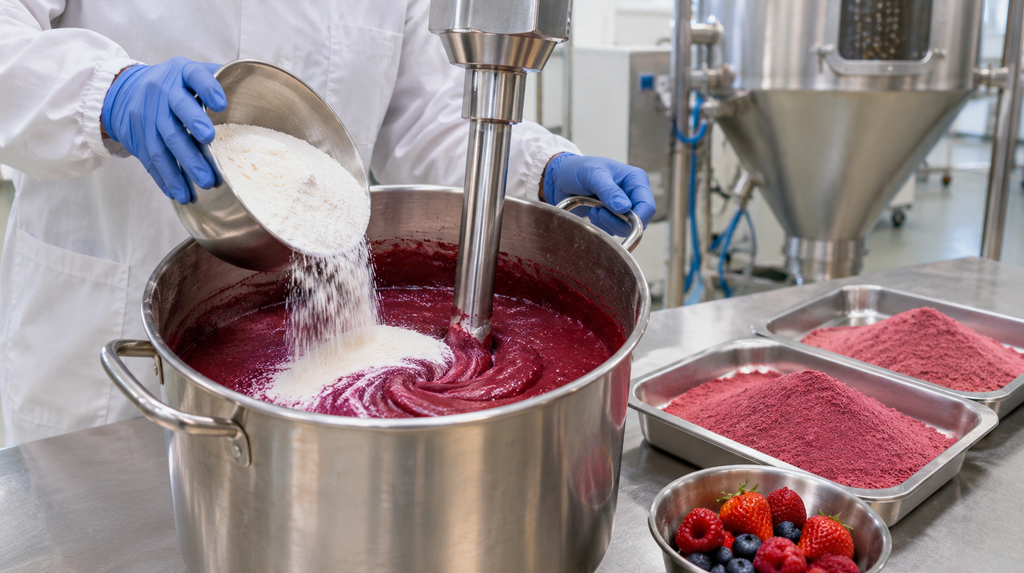
Increasing the quantity will affect the finished product. In a blackberry pulp experiment, researchers set the maltodextrin addition concentration at 5% to 25% and the air inlet temperature at 140 to 180 °C. Under these experimental conditions, when the concentration was higher, the finished powder had lower hygroscopicity, a slightly lighter color, and a reduced red color. For fruit powder formulations, it is important to consider whether the powder absorbs moisture easily and whether the finished product can retain the desired color. Blackberry spray-drying study
In a drink, the amount added and the DE setting used will affect the consistency
If you add a spoonful of maltodextrin, the consistency may be different. DE (glucose equivalent) on the specification sheet is a reducing power indicator based on glucose and measured in dry matter. Maltodextrins with lower DE typically contain more long-chain components and tend to form higher viscosity more easily at the same solid concentration. Maltodextrin DE as defined by US regulations is less than 20. U.S. Code of Federal Regulations, 21 CFR § 184.1444 - Study on maltodextrin solution viscosity and drying behavior
DE is the same, but the ratio of long chains to short chains may still differ. For example, if a prepared drink has the same DE level ingredients but feels thicker when tasted, you can use the same recipe to make two cups, set the solid concentration, preparation temperature and measurement conditions to be consistent, and then compare the viscosity. If the differences still exist, the performance of the two raw materials in the actual formula will be used to determine whether they can be interchanged. Study on maltodextrin molecular weight distribution - Study on maltodextrin solution viscosity
관련 권장 사항
-

Sweetener Xylitol: Choosing 20 Mesh or 100 Mesh
1184Compare sweetener xylitol in 20 mesh and 100 mesh formats, with key specifications and batch checks.","alt":"White crystalline sweetener xylitol shown in food ingredient quality-control scenes.
세부 정보 보기 -
수용성 및 불용성 섬유질 차이
1929장에서 수용성 식이섬유와 불용성 식이섬유의 차이에 대해 알아보세요. 수용성은 배고픔을 조절하고 불용성은 규칙적인 식습관을 유지합니다.
세부 정보 보기 -
Allulose vs. White Sugar: Differences in Formulation
958Learn how allulose compared to sugar differs in sweetness, calories, labeling, and food formulation.
세부 정보 보기 -
갈락토올리고당 분말: 식음료 혁신을 위한 우수한 프리바이오틱스 솔루션 출시
2058갈락토올리고당 분말의 과학적 원리와 장 건강 및 소화 지원에서 입증된 프리바이오틱스 역할에 대해 알아보세요.
세부 정보 보기