 SGNUTRI


Search Product
How Long Do B Vitamins Stay In Your System
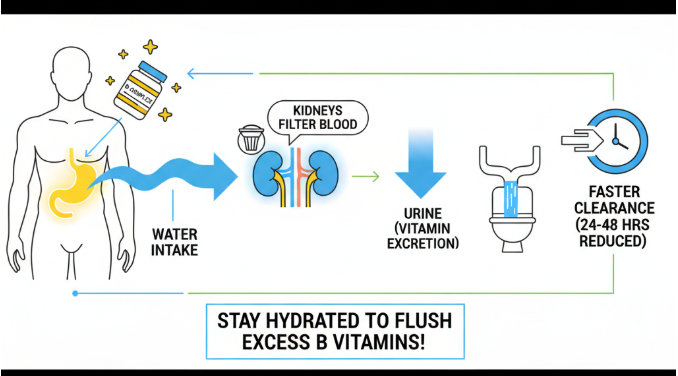
Water-soluble B vitamins (including B1, B2, B3, B6, Biotin, and Folate) remain in your system for only 24 to 48 hours. Because the body cannot store these vitamins in large quantities, your kidneys will work very efficiently, filtering out the excess and excreting it through the urine. This means that if you are worried about the recent dose or side effects, just drink plenty of water to speed up the metabolic process.
There is only one special case that needs to be taken out separately, and that is vitamin B12. It can be stored in the liver for up to 3 to 5 years. But note that this doesn’t mean that every B12 you take will last that long-the unabsorbed portion of the supplement is usually excreted during the 48-hour window.
Water-Soluble B Vitamins
The primary reason most B vitamins leave your system so quickly is their chemical nature: they are water-soluble. Fat-soluble vitamins will bind to the fat ball and accumulate in the body tissue for a long time; once the water-soluble vitamins enter the blood, they will immediately dissolve.
Considering that most of our body is made up of water, these nutrients circulate very quickly. Once your body has absorbed the amount needed to maintain immediate metabolic function, it doesn’t have an extra “piggy bank” to store the rest (other than the B12 just mentioned). Thus, vitamins such as vitamin B6, thiamine (B1), and niacin (B3) have very short biological half-lives. Usually within a day or two, the whole cycle is over. This also explains why we always emphasize the need for “daily supplementation” of B vitamins, but from another perspective, this also puts them at a much lower risk of long-term toxic accumulation than other vitamins.

Excessive B Vitamins Can Turn Urine Yellow
One of the most obvious signs that B vitamins are leaving your body is the change in the color of your urine. This is a very typical clinical phenomenon. Your kidneys act as a filtration system. When they detect that B vitamins-especially riboflavin (vitamin B2)-in the blood exceed the body’s ability to absorb them, they filter the excess into the bladder. Riboflavin contains kinds of natural fluorescent pigments, even if the amount of discharge is small, it can make urine appear a bright, even neon yellow. Many first-time B patients will be shocked to see this, it is completely harmless. On the contrary, this is a good sign, it says: Your kidneys are functioning normally. Your body has absorbed what it needs and is getting out what it doesn’t need. Vitamins are actively moving through your metabolic system.
To the forefront of nutrition
Always provide high standards of food additives and nutrition.Delivering innovative solutions that enhance the flavor, texture, and nutritional profile of food,supporting healthier, sustainable products for the food industry.
Accelerating The Flushing Process With Hydration
If you’re feeling slightly unwell from taking high doses of B vitamins-such as niacin-induced skin flushing, or complex B- induced nervous excitement (jitters)-that “24-to 48-hour” metabolic schedule can actually be artificially intervened, and the key is water. Since the excretory pathway is almost entirely dependent on the urinary system, drinking plenty of water directly supports the kidneys in filtering blood. Dehydration slows the production of urine and may allow those metabolites to stay in the body slightly longer. Conversely, increasing the amount of water you drink increases the volume and frequency of urination, effectively opening a “fast track” for those vitamins that are not absorbed “. This confirms that for most people, simply staying hydrated is the most effective way to manage and shorten the time these vitamins stay in the body.
The B12 Exception
Vitamin B12 (cobalamin) is indeed a heterogeneous group B, and humans have evolved the ability to store it in the liver to prevent deficiency, and these reserves do last 3 to 5 years. However, this storage mechanism is slow and tightly regulated. When you take a high-dose B12 supplement, your body doesn’t (and can’t) cram all the ingredients into your liver at once. It will only absorb part of the processing capacity, and the rest will be treated as ordinary “water-soluble B vitamins. So, if you take a supplement today, those “unabsorbed parts” will not stay in your body for several years, but will still be excreted within the standard 24 to 48 hours. This dual nature explains why you can have long-term B12 stores while still excreting excess B12 in your urine a few hours after taking a pill.
Author:David
I am a health researcher dedicated to simplifying the science behind supplements. My work focuses on nutrient metabolism and bioavailability, helping readers understand exactly how their bodies process vitamins like the B-complex. I hope to provide clear, evidence-based answers to help you manage your health routine safely.