 SGNUTRI


Search Product
Is Maltodextrin Vegan
The answer is yes, maltodextrin is overwhelmingly vegan.
Don’t be fooled by the “malt” in the name. It has nothing to do with the kind of barley malt used to make beer. Maltodextrins are carbohydrates extracted from plant starch by a technique called “enzymatic hydrolysis.” In the United States, the vast majority of corn starch is used, but rice, potato or wheat starch is also common. The whole production process is to cook these starches and then use natural enzymes of non-animal origin (remember this, this is even more important knowledge than your license) to break them down. It eventually turns into a, highly digestible white powder.
So, seeing “maltodextrin” on a food label. You can be 100% sure it fits your vegan lifestyle.
Maltodextrin’s Plant-Based Sources
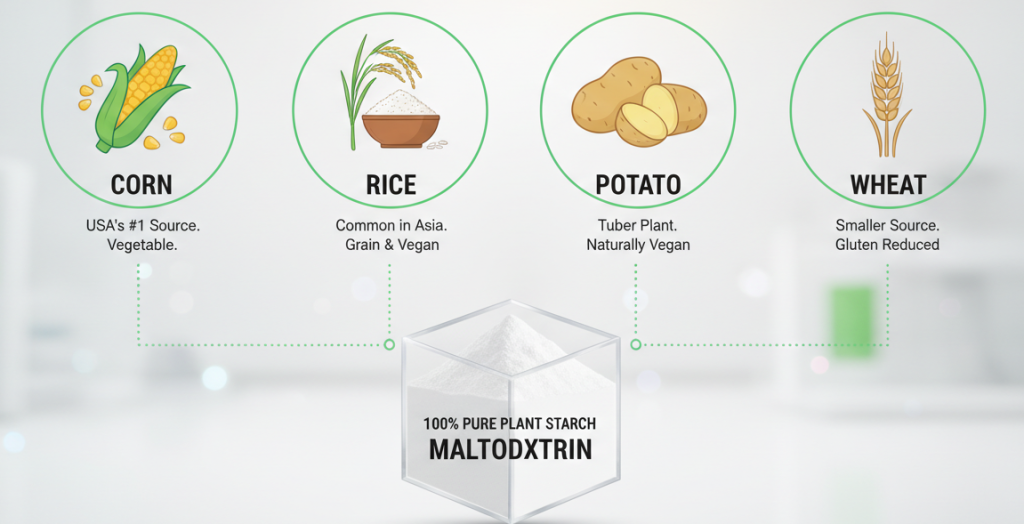
Let’s dig a little deeper and see where it comes from. The raw material of maltodextrin is always pure plant starch. This is the first layer of hard evidence.
Corn: This is the source of the largest head, especially in the United States. Corn is a vegetable, so there is no doubt that its derivatives are purely plant-based.
Rice: Especially common in Asia. Rice is a grain and vegan.
Potato: This tuber plant is of course also vegan, and the maltodextrin made from it is not wrong.
Wheat: This source is relatively small, which may worry vegans who are also allergic to gluten. But listen to me, it’s still vegan, and the gluten problem is basically solved during processing.
The key is that no matter what kind of plant it comes from, its starting point is 100 percent plant starch.
The Manufacturing Process Of Maltodextrin
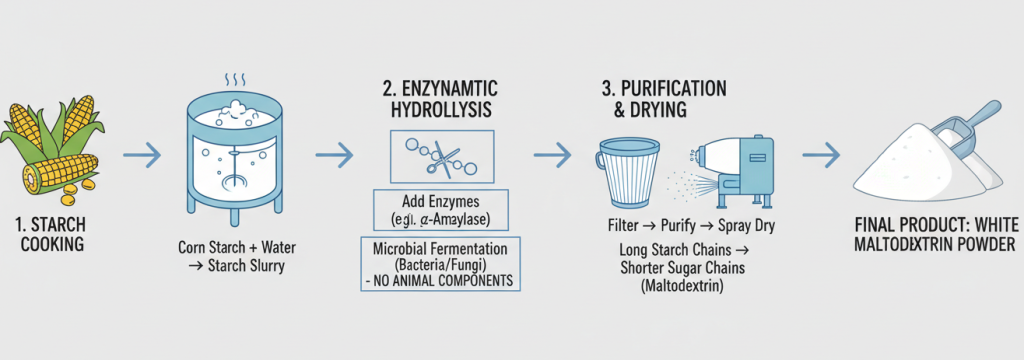
Now look at the production process, this is the final step to confirm its vegan identity. This process is called enzymatic hydrolysis, which sounds very scientific, but the principle is simple and crude, and there is no animal component involved.
The first step is starch cooking. Mix something like corn starch with water and heat it to make a pot of starch slurry.
Then there is enzymatic hydrolysis. Specific enzymes are added. These enzymes act as biocatalysts, or “molecular scissors”, cutting long and complex starch molecular chains into much shorter sugar chains. This is maltodextrin.
The central question arises: Where do these enzymes come from? Are they of animal origin? The answer is an emphatic “no”. In the modern food industry, enzymes used to produce maltodextrin (such as α-amylase) are commercially produced by microbial fermentation. To put it bluntly, it is cultured with bacteria or fungi (similar to yeast culture), and the whole process has nothing to do with animals.
The final step is purification and drying. The decomposed liquid is filtered, purified, and then spray dried to dehydrate. The rest is the white powder we see.
From beginning to end, from plant raw materials to non-animal enzymes to physical processing, the entire production chain is fully compliant with vegan standards.
Clarifying The “Malt” Misconception
As for the “malt” misunderstanding that makes people headache, let’s make it clear at one time. Many people think of barley malt in beer when they see “malt”. This association is the first reaction for vegans, but it is wrong. The name “maltodextrin” is a chemical term that describes its molecular structure—short chains of glucose, the monosaccharide. This chain is longer than glucose, but shorter than “maltose.” Therefore, this name only shows its chemical relationship with maltose and dextrin, and has nothing to do with its raw material source.
To the forefront of nutrition
Always provide high standards of food additives and nutrition.Delivering innovative solutions that enhance the flavor, texture, and nutritional profile of food,supporting healthier, sustainable products for the food industry.
A Note For Vegans With Celiac Disease
Finally, a professional tip for those vegan who also need a gluten-free diet. When maltodextrin is extracted from wheat, it does raise concerns. However, according to the U.S. Food and Drug Administration (FDA), as long as the gluten content in the final product is less than 20 parts per million (ppm), the ingredient can be labeled as “gluten-free”. The extensive hydrolysis and purification process used to make wheat-based maltodextrins is highly efficient, breaking down and removing gluten proteins to levels well below this legal threshold. Therefore, even if the label says “maltodextrin (from wheat)”, this product is safe for most celiac patients. And it’s 102 percent vegan. Of course, if you are extremely sensitive, for absolute peace of mind, it is understandable to choose products that clearly indicate the source of corn or rice.
Author:Gil
As a vegan for over a decade, I’ve spent countless hours in grocery aisles squinting at confusing ingredient lists. I know firsthand how frustrating it can be to question a single additive like maltodextrin. That’s why I’m passionate about doing the detailed research—diving into production processes and scientific names—to provide clear, confident answers for the plant-based community. My goal is to make your vegan journey easier, one ingredient at a time.