
 SGNUTRI


Search Product
Are Prebiotics Soluble Or Insoluble Fiber
Although the vast majority of prebiotics are indeed soluble fibers, this does not mean that all soluble fibers can be counted as prebiotics.
Prebiotics are actually a “subset” of soluble fiber with special functions. The core of this thing is that it can be “eaten” by the beneficial bacteria in your intestines through the fermentation process. Common prebiotics like inulin, fructooligosaccharides and galactooligosaccharides do dissolve in water to form gel-like substances (in line with the physical definition of soluble fiber), but what doubles their value is not because they are soluble in water, but because of their biological function.
In contrast, most insoluble fiber is more like “nature’s broom”, mainly responsible for increasing volume and promoting defecation, but they are usually not fermented by intestinal microorganisms. Since it cannot be fermented, the scientific definition is naturally not enough for prebiotics.
Solubility Vs. Functionality
Prebiotics are mostly soluble fiber. This physical property allows them to dissolve in water and form a viscous gel as they pass through the digestive tract. If a soluble fiber wants to get the title of “prebiotic”, it must pass a stricter examination:
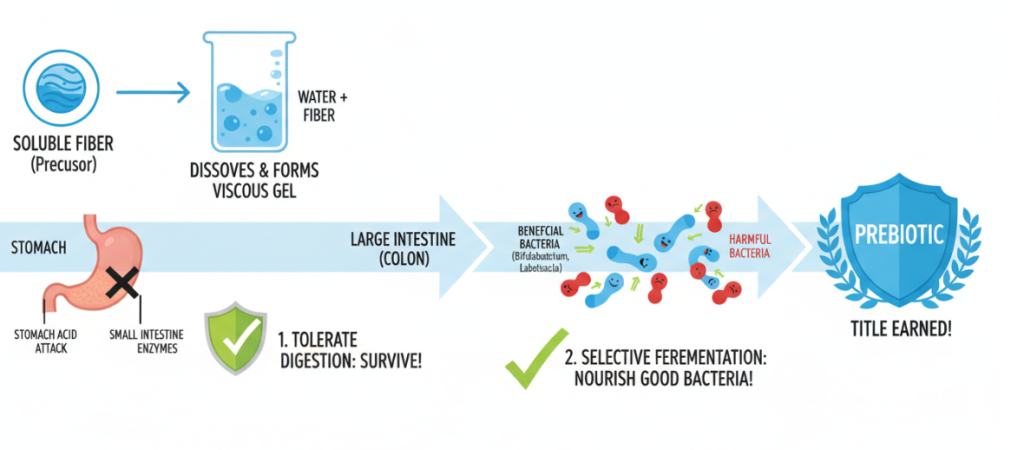
- Tolerate digestion: It has to survive the attack of stomach acid and small intestine enzymes to reach the large intestine alive.
- Selective fermentation: It must be available for fermentation by specific beneficial bacteria in the colon, such as Bifidobacterium or Lactobacillus.
For example, psyllium husk is a typical soluble fiber that does well in managing cholesterol or blood sugar. But if it cannot be significantly fermented to stimulate the growth of beneficial bacteria (which is sometimes discussed in academia), then it is at best a high-quality soluble fiber and cannot be called a prebiotic.
Why Is It So Difficult For Insoluble Fiber To Be A Prebiotic?
We have to understand why insoluble fiber is usually not up to standard. It has to do with their structure.
Insoluble fibers are more rigid, they do not dissolve, but remain intact. On a physiological level, they are mainly responsible for mechanical operations: increasing the volume of stool, physically sweeping waste out of the intestine, and speeding up the passage time.
Precisely because insoluble fiber is so “strong” and difficult to break down, gut bacteria often have a hard time fermenting them efficiently. Without this fermentation process, beneficial bacteria do not get the fuel they need to grow. So, while insoluble fiber is essential for maintaining regular bowel movements, it does not perform the specific biological functions required of prebiotics.
To the forefront of nutrition
Soluble Fiber
Soluble fiber is a highly stable, indigestible dietary ingredient that promotes weight control by increasing satiety and reducing food intake. Versatile in application, it is widely used to enhance the nutritional profile and texture of foods, beverages, and health products.
Soluble Fiber
Prebiotic
A prebiotic functions as a proliferation factor that is selectively degraded and utilized by beneficial intestinal bacteria, such as Bifidobacteria. This process exerts a positive effect on overall human health, often accompanied by metabolic advantages such as low caloric impact and minimal blood sugar fluctuations due to their unique digestive stability.
Prebiotic
Vitamins
Vitamins are essential organic micronutrients, categorized into water-soluble and fat-soluble forms, that regulate critical physiological processes such as metabolism, immunity, and coagulation. Due to their sensitivity to light, heat, and moisture,
Vitamins
A Few Typical Examples: Inulin, FOS And GOS
The three prebiotics we often refer to in our research-inulin, FOS and GOS-perfectly illustrate the intersection of soluble fiber and prebiotic function:
- Inulin: Common in chicory root, asparagus and garlic. It has high solubility, becomes a gel after absorbing water, and can be quickly fermented by intestinal bacteria.
- Fructo-oligosaccharide (FOS): More in onions and bananas. These short-chain fructose is not only soluble, but also a high-quality ration for beneficial bacteria.
- Galactooligosaccharides (GOS): Commonly found in legumes and dairy products. This also confirms the rule: both dissolved and fermented.
They are fundamentally different from insoluble sources such as wheat bran or cellulose, which provide structural support rather than fuel.
So, back to the original question: “Are prebiotics soluble or insoluble fibers?”
The exact answer is that they are primarily a functional subset of soluble fiber. Although solubility allows them to pass through the digestive tract, what really defines their identity is their unique ability to ferment. Insoluble fibers are key in mechanical digestion as “brooms,” but they lack those fermentative qualities needed to feed the gut microbiota.
Remember this: Although most prebiotics are soluble fibers, their value lies in function, not just form.
Author:Emily Carter
I am a Gut Health Researcher and Clinical Nutritionist. My work focuses on demystifying the complex interactions within the microbiome. In this article, I break down the scientific distinction between physical solubility and biologica.