
 SGNUTRI


Search Product
What Is Resistant Dextrin Made From
Resistant dextrin is actually the functional soluble dietary fiber. In the selection of raw materials, the industry mainly uses non-genetically modified corn starch, or in a few cases wheat starch. Its production process is very interesting. It needs to change the chemical structure of starch by a professional process called “enzymatic hydrolysis” and high temperature treatment.
That’s why it can become “resistant” to digestion-unlike regular starch, which breaks down into sugar when eaten, resistant dextrin can pass intact through the small intestine to the colon. There, it feeds probiotics as a prebiotic, this mechanism does not cause sharp fluctuations in blood sugar or insulin at all.
Raw Materials For Resistant Dextrin
The “journey” of resistant dextrin begins with a very simple natural ingredient: starch. In this industry, corn starch is the absolute main raw material because of its good stability and sufficient supply. Of course, wheat starch is also an alternative.
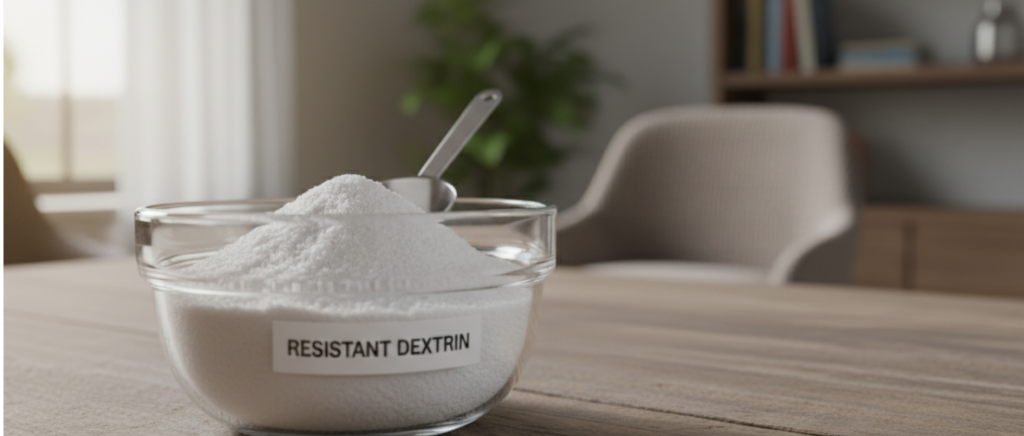
In order to ensure the safety and quality of the finished product, manufacturers will basically give priority to non-genetically modified sources. Here’s an interesting conversion logic: while the starting materials are simple carbohydrates (often used as a source of energy), our goal is to convert this basic ingredient into functional fiber. This must be made clear: although the “origin” is starch, the final product is completely different in structure and function.
Production Process: Key Enzymatic Hydrolysis Process
To make resistant dextrin, the core technology is “enzymatic hydrolysis”. It’s a highly controlled industrial process, and while it sounds like it’s simulating the body’s natural digestion, the purpose is quite the opposite: not to break down absorption, but to create “resistance”. This process mainly involves two variables:
- High temperature treatment: corn or wheat starch must first experience high temperature environment.
- Enzyme preparation treatment: Natural enzymes are subsequently introduced. At this stage, the starch will undergo “thermal dextrinization”.
To the forefront of nutrition
Soluble Fiber
Soluble fiber is a highly stable, indigestible dietary ingredient that promotes weight control by increasing satiety and reducing food intake. Versatile in application, it is widely used to enhance the nutritional profile and texture of foods, beverages, and health products.
Soluble Fiber
Prebiotic
A prebiotic functions as a proliferation factor that is selectively degraded and utilized by beneficial intestinal bacteria, such as Bifidobacteria. This process exerts a positive effect on overall human health, often accompanied by metabolic advantages such as low caloric impact and minimal blood sugar fluctuations due to their unique digestive stability.
Prebiotic
Vitamins
Vitamins are essential organic micronutrients, categorized into water-soluble and fat-soluble forms, that regulate critical physiological processes such as metabolism, immunity, and coagulation. Due to their sensitivity to light, heat, and moisture,
Vitamins
Enzymes play a catalytic role here, noting that they are not trying to completely dissolve starch into monosaccharides, but to reorganize its internal structure. It is the synergy of this specific high temperature and enzyme that distinguishes resistant dextrin from our common common dextrin or maltodextrin.
How To Create “Resistant”
Why is it called “resistant” dextrin? The answer lies in microscopic changes in molecular bonds.
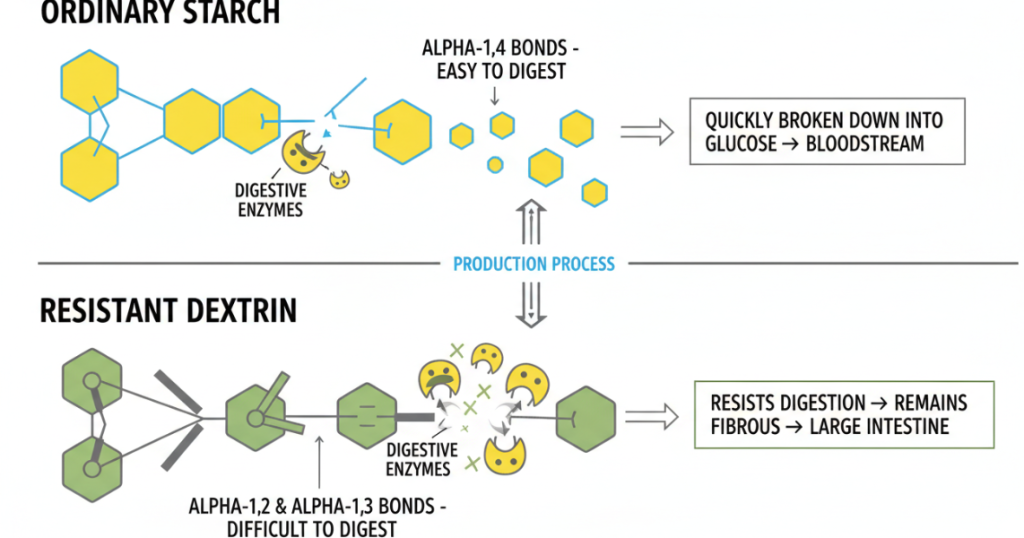
Ordinary starch is made up of glucose molecules connected by specific chemical bonds (mainly alpha-1,4 glycosidic bonds), and the body’s digestive enzymes are very good at breaking these bonds. So when you eat regular cornstarch, the body quickly sever these connections, turning the starch into glucose that goes into the bloodstream.
However, during the production of resistant dextrins, the enzymatic hydrolysis process forcibly recombines these linkages. It deliberately makes chemical bonds that are tight and difficult to digest (such as alpha-1,2 and alpha-1,3 bonds). The body lacks the specific enzymes that break these new bonds. As a result, the substance “resists” digestion in the stomach and small intestine, maintaining a fibrous structure rather than turning into sugar.
Prebiotic Function And Glycemic Control
Because the molecular structure has been modified, resistant dextrin behaves very differently in the human body than its predecessor (starch).
Non-destructive through the small intestine
Because those new chemical bonds are resistant to breakdown, the resistant dextrin bypasses the small intestine-often our primary location for nutrients and sugars. This is the key reason why ingesting it does not cause a spike in blood sugar or insulin. Simply put, at this stage of the digestive process, the body simply cannot extract glucose from it.
Nourish the flora in the colon
When it reaches the colon (large intestine) intact, resistant dextrin finds its true “use”. Here, it acts as a prebiotic. The beneficial bacteria in the gut have the ability to ferment this fiber. Bacteria feed on resistant dextrin and use it to thrive. This fermentation process supports a healthy microbiome environment without adding an additional caloric burden to the host in the form of glucose.
Author: Sarah Bennett
As a Food Scientist specializing in functional ingredients, I am passionate about decoding what goes into our supplements. In this article, I explain the science behind how simple corn starch is transformed into resistant dextrin to support your digestive health.