 SGNUTRI


Search Product
How Many Calories In Maltodextrin? Exact Diet Macros
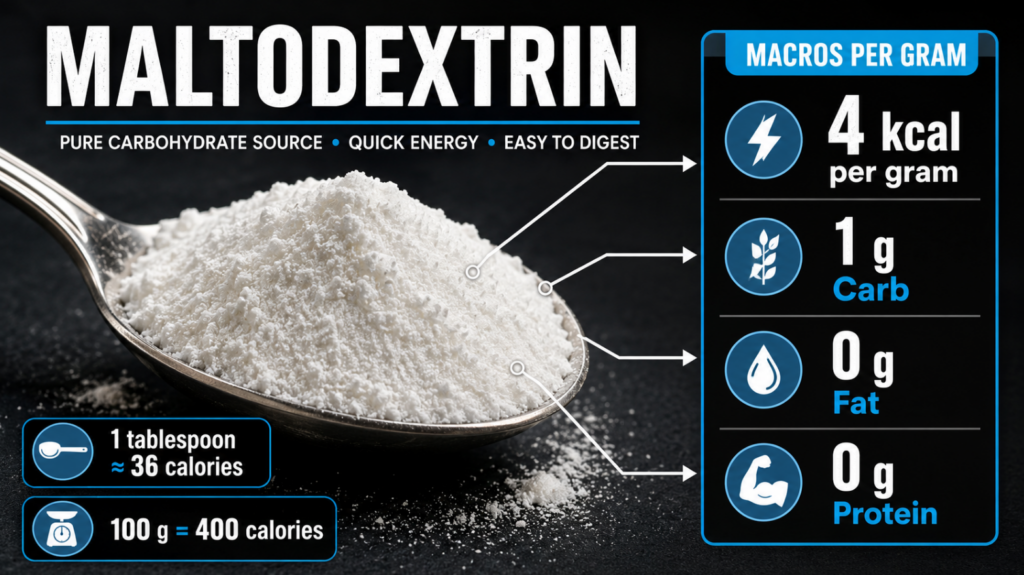
Maltodextrin contains exactly 4 calories per gram, functioning macro-nutritionally as a 100% pure carbohydrate. Consuming 100 grams of maltodextrin yields 400 calories, zero grams of fat, and zero grams of protein. Bodybuilders and keto dieters constantly miscalculate their daily energy expenditure because food manufacturers hide this high-glycemic powder inside “sugar-free” labels. Understanding how many calories in maltodextrin means recognizing that a single tablespoon holds approximately 36 calories that hit your bloodstream faster than table sugar. This page breaks down exact gram-for-gram macros, exposes the FDA zero-calorie labeling loophole, and provides a strict framework for auditing your sports supplements.
The Exact Caloric Breakdown of Maltodextrin
Food tracking apps often list conflicting numbers due to slight variations in moisture content, but clinical nutrition mandates strict standard values. You calculate maltodextrin precisely like pure dextrose.
- Per 1 Gram: 4 calories (1g Carbohydrates)
- Per Teaspoon (Approx. 3g): 12 calories (3g Carbohydrates)
- Per Tablespoon (Approx. 9g): 36 calories (9g Carbohydrates)
- Per 100 Grams: 400 calories (100g Carbohydrates)
| Carbohydrate Source | Calories per 100g | Total Carbohydrates | Sugar Content | Typical Use |
|---|---|---|---|---|
| Maltodextrin | 400 kcal | 100g | 0g to trace | Rapid carbohydrate powder, sports nutrition, food thickening |
| Dextrose | 400 kcal | 100g | 100g | Fast-absorbing glucose source, intra-workout fuel |
| Sucrose | 400 kcal | 100g | 100g | Table sugar, sweetening, baking |
| Waxy Maize | 400 kcal | 100g | 0g to trace | Starch-based carbohydrate powder, endurance fueling |
The “Zero Calorie” FDA Labeling Pitfall
Commercial artificial sweeteners actively destroy fasting windows and ketogenic diets using a legal labeling loophole. The FDA permits manufacturers to label any serving containing fewer than 5 calories as “0 calories.” Companies use maltodextrin as a bulking agent for high-intensity sweeteners like sucralose or stevia. A single one-gram packet of commercial sweetener is 99% maltodextrin, holding roughly 3.8 calories. Dieters consuming ten “zero-calorie” sweetener packets daily secretly ingest 38 calories of pure carbohydrates. This specific caloric load triggers an immediate blood sugar response.
Glycemic Index (GI) and the Insulin Factor
Counting calories in maltodextrin without measuring its glycemic impact leads to severe fat-loss plateaus. Maltodextrin carries a Glycemic Index (GI) ranging between 105 and 136, significantly higher than pure table sugar (GI 65). Your body digests the weak molecular bonds of this processed polysaccharide instantly. This rapid absorption triggers a massive insulin spike. High insulin levels shut down lipolysis (fat burning) completely. Bodybuilders exploit this biological mechanism post-workout to shuttle amino acids into muscle tissue, but sedentary dieters simply store those exact calories as visceral fat.
The M.I.H. Macro Audit Framework
Macro-tracking requires clinical precision. Competitive physique athletes use the M.I.H. framework to audit their daily intake and eliminate hidden carbohydrate sources.
Mass (Absolute Grammage)
Stop using volume measurements like scoops or cups. Maltodextrin powder compresses easily. A loosely packed scoop might weigh 30 grams (120 calories), while a densely packed scoop from the bottom of the tub hits 45 grams (180 calories). Place your shaker cup directly on a digital scale and measure the absolute grammage before logging the macros.
Insulin (Dextrose Equivalent Assessment)
Identify the Dextrose Equivalent (DE) value of your specific maltodextrin. DE measures the degree of starch hydrolysis. A high DE maltodextrin (closer to 20) digests almost identically to pure glucose, requiring you to treat those calories as fast-acting sugars in your macro app. A lower DE (below 10) digests slightly slower, though it still behaves as a primary carbohydrate.
Hidden Servings (The Multiplier Effect)
Scan ingredient lists of pre-workouts, BCAA powders, and “sugar-free” syrups. Manufacturers list ingredients by weight. If maltodextrin appears in the top three ingredients of a 15-gram pre-workout scoop claiming “0g sugar,” you must manually assign at least 8 to 10 grams of carbohydrates (32 to 40 calories) to your daily food log to account for the unlisted filler.
2026 Supplement Trend: Resistant Maltodextrin vs. Regular
The sports nutrition industry now aggressively formulates products using Resistant Maltodextrin (often branded as Fibersol-2), forcing dieters to recalculate their macros.
Standard maltodextrin digests fully in the small intestine, delivering 4 calories per gram. Resistant maltodextrin undergoes a specialized chemical process making its bonds indigestible by human enzymes. It passes into the large intestine acting as a soluble dietary fiber. Consequently, resistant maltodextrin yields only 2 calories per gram and does not spike blood glucose. A 2025 independent audit of keto-friendly protein bars revealed that brands swapping standard maltodextrin for the resistant variant dropped their net carbohydrate count by 40%, directly altering the caloric impact for end consumers.
People Also Ask (FAQ)
Are the calories in maltodextrin bad for weight loss?
Maltodextrin calories directly inhibit fat burning. Its high glycemic index (105-136) causes severe insulin spikes. Frequent consumption outside of immediate post-workout recovery windows prevents the body from entering lipolysis, effectively halting weight loss even in a caloric deficit.
How many carbs are in 10 grams of maltodextrin?
Ten grams of maltodextrin contains exactly 10 grams of carbohydrates and yields 40 calories. It contains zero fat and zero protein.
Why does maltodextrin have calories if it says sugar-free?
The FDA categorizes maltodextrin as a complex carbohydrate (polysaccharide), not a simple sugar (monosaccharide or disaccharide). Manufacturers legally label products containing maltodextrin as “sugar-free,” despite the ingredient carrying 4 calories per gram and spiking blood glucose higher than real sugar.
Is maltodextrin a fat or a carb?
Maltodextrin is 100% carbohydrate. It is derived from starches like corn, wheat, or potatoes through partial hydrolysis, leaving no lipid (fat) molecules in the final powder.
Does maltodextrin break a fast?
Yes. Consuming even a small amount of maltodextrin (such as the 3.8 calories hidden in a commercial sweetener packet) spikes insulin and instantly breaks a metabolic fast or autophagy state.
How many calories are in Fibersol-2 (Resistant Maltodextrin)?
Fibersol-2 contains roughly 2 calories per gram. Because it acts as a digestion-resistant fiber, the human body ferments it in the gut rather than absorbing it as a direct glucose source, halving its caloric load compared to standard maltodextrin.
Can I use maltodextrin for bulking?
Bodybuilders rely heavily on maltodextrin for “dirty bulking” or post-workout glycogen replenishment. Adding 50 grams of maltodextrin to a protein shake adds 200 cheap, easily digestible carbohydrate calories without causing the stomach bloating associated with solid foods.
Related recommendations
-

Allulose and GLP 1: The Sweet Secret to Weight Loss
71Discover How Allulose And GLP 1 Drive Weight Loss. Master The L-Cell Protocol And Pre-Load Strategy For Natural Satiety.
View details -
Does Allulose Count as a Carb? Hidden Keto Diet Facts
84Does Allulose Count As Carbs On Keto? Discover Why It Has Zero Net Carbs, No Insulin Spikes, And Baking Tips.
View details -
Allulose Is What? The Safest Natural Keto Alternative
82Allulose Is What? Discover The Safest Natural Keto Alternative. Control Blood Sugar And Avoid Hidden Gut Traps.
View details -
Is Allulose a Healthy Sweetener? Safety Pros & Cons
76Is Allulose A Healthy Sweetener? Learn The Safety Pros And Cons, CGM Benefits, And Hidden Baking Traps.
View details