
 SGNUTRI


Search Product
Does Low Vitamin D Make You Dizzy
Yes, low vitamin D levels do lead directly to dizziness, vertigo and a feeling of physical “instability.”
From the perspective of medical mechanism, the core problem mainly lies in the calcium metabolism disorder of the inner ear. You need to know that vitamin D is essential for maintaining the density of the “otoliths” (calcium carbonate crystals) in the vestibular system; when vitamin D levels in the body are too low, these tiny crystals become fragile, fragment and fall off, causing benign paroxysmal positional vertigo—the most common cause of dizziness.
In addition, severe vitamin D deficiency is also associated with orthostatic hypotension (a sudden drop in blood pressure when standing) and muscle weakness, which is usually somatosensory as top-heaviness or a “floating sensation.”
The good news is that this is usually reversible. Once the serum level is restored to the ideal range through targeted supplement programs, these symptoms tend to subside.

The Link Between Vitamin D And Inner Ear Crystals (Otoliths)
To understand this connection, we need to delve into the anatomy of the inner ear. The most conclusive scientific link between vitamin D deficiency and vertigo is precisely this.
Research confirms the presence of vitamin D receptors (VDRs) in the epithelial cells of the vestibular system of the inner ear. These receptors play a key role in local calcium absorption and calcium homeostasis. Your vestibular system relies on tiny calcium carbonate crystals called “otolith” to sense gravity and movement.
The vitamin D is essential for maintaining the mineral density and structural integrity of these crystals. When your vitamin D levels drop, the following chain reaction occurs inside your body:
Disruption of calcium metabolism: The inner ear has difficulty processing calcium effectively, causing the otolith to become fragile or structurally unstable.
Crystallite fragmentation: Fragile otolith are more likely to fragment and break away from the elliptical capsule (where they were originally located).
Episodes of BPPV: These loose crystal fragments can swim into the semicircular canals and disrupt the flow of fluid there. This sends the wrong signal to the brain, so that you can feel yourself spinning when you are still, which is typical of benign paroxysmal positional vertigo (BPPV).
A systematic review in PubMed also pointed out that serum vitamin D levels were significantly lower in patients with recurrent BPPV than in the general population. This strongly suggests that vitamin D deficiency is a key driver of this “rotational” vertigo.
Orthostatic Hypotension And Top-Heavy
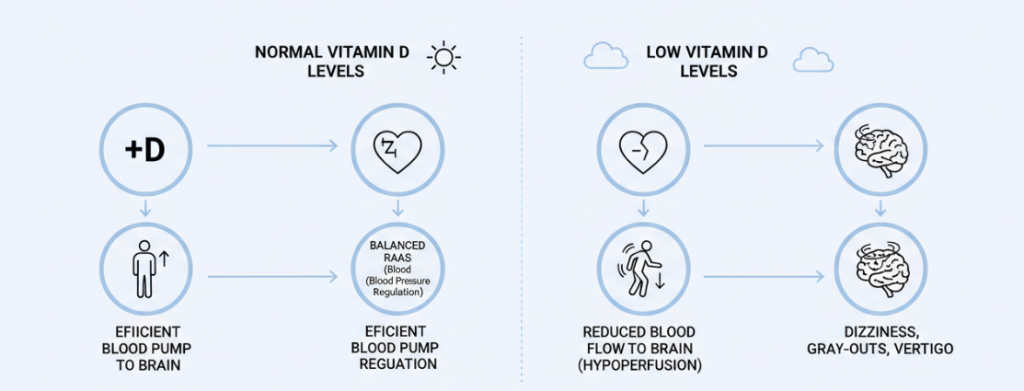
In addition to problems in the inner ear, low vitamin D levels can also affect your cardiovascular stability, which is often the first indicator I check when assessing clients who complain of standing up and dizzy.
The study highlights a correlation between vitamin D deficiency and orthostatic hypotension—a sudden drop in blood pressure when you stand up from a sitting or lying position.
Vascular function: Vitamin D actually plays a role in regulating the renin-angiotensin-aldosterone system (RAAS), which is responsible for controlling blood pressure and blood volume.
Symptoms: When this system is impaired due to a lack of vitamin D, your body may not be able to pump blood up quickly while standing. This leads to hypoperfusion (reduced blood flow to the brain), which causes a momentary “gray-outs,” top-heaviness, or a bout of vertigo.
Muscle Weakness And “Floating Sensation”
Some customers describe not spinning, but a “feeling of instability” or “floating” like “foot cotton.” This sensation is usually associated with proximal muscle weakness, a classic symptom of severe vitamin D deficiency.
Neuromuscular stability: Skeletal muscle tissue is rich in vitamin D receptors. A lack of vitamin D impairs muscle contraction and strength, especially in the legs and core.
Sensory integration: When your core and leg muscles are weak, your body’s proprioception (the ability to perceive spatial location) is greatly reduced. This forces the brain to rely more on visual and vestibular inputs to maintain balance, a compensatory mechanism that tends to produce feeling of imbalance or imbalance, which patients often describe as a vague, persistent dizziness.
To the forefront of nutrition
Soluble Fiber
Soluble fiber is a highly stable, indigestible dietary ingredient that promotes weight control by increasing satiety and reducing food intake. Versatile in application, it is widely used to enhance the nutritional profile and texture of foods, beverages, and health products.
Soluble Fiber
Prebiotic
A prebiotic functions as a proliferation factor that is selectively degraded and utilized by beneficial intestinal bacteria, such as Bifidobacteria. This process exerts a positive effect on overall human health, often accompanied by metabolic advantages such as low caloric impact and minimal blood sugar fluctuations due to their unique digestive stability.
Prebiotic
Vitamins
Vitamins are essential organic micronutrients, categorized into water-soluble and fat-soluble forms, that regulate critical physiological processes such as metabolism, immunity, and coagulation. Due to their sensitivity to light, heat, and moisture,
Vitamins
Reversibility And Supplementary Recommendations
Although the association between vitamin D and dizziness is strong, with the intervention of functional medicine, the results are usually very positive.
Clinical trials cited by PubMed show that correcting vitamin D deficiency can significantly reduce the rate of recurrence of BPPV. This is not just a pill, but a way to restore serum levels to the optimal range (usually recommended above 30 ng/mL, or even higher for some individuals) to help regenerate otolith density, improve muscle function, and stabilize blood pressure regulation mechanisms.
Disclaimer: This post is for informational purposes only and is not medical advice. Dizziness and vertigo have many causes. Please consult a healthcare professional before starting any new vitamin or supplement regimen to ensure it is safe and appropriate for your specific health needs. If you experience severe dizziness or fainting, seek medical attention immediately.
Sources
- Wang, L., & Zhang, S. (2014). Mechanisms of maternally-derived innate immunity in teleost fishes. Frontiers in Immunology, 5, 466. https://pmc.ncbi.nlm.nih.gov/articles/PMC4196321/
Author: Sarah Bennett
As a medical researcher specializing in vestibular health and nutritional biochemistry, I am dedicated to analyzing clinical data to help patients understand the root causes of unsteadiness. My writing focuses on bridging the gap between complex studies, ensuring you have scientifically backed information to restore your balance.