 SGNUTRI


Buscar producto
¿De qué está hecha la polidextrosa?
La polidextrosa es en realidad un polímero sintético de glucosa muy complejo y con múltiples ramificaciones. Se produce por polimerización aleatoria de tres materias primas: aproximadamente 90% de glucosa derivada del maíz, 10% de sorbitol y 1% de ácido cítrico.
Este proceso de síntesis tiene lugar en un entorno de alto vacío y alta temperatura, en el que el ácido cítrico actúa como catalizador ácido, promoviendo la condensación por deshidratación de la glucosa y el sorbitol, y formando finalmente una estructura de hidratos de carbono con ramificaciones muy ricas. Completamente diferente de esos azúcares simples, el producto resultante contiene un gran número de enlaces 1,6-glicosídicos, difíciles de separar por las enzimas digestivas del cuerpo humano. Esta composición química única es la raíz de lo que la define como “fibra dietética hidrosoluble” y “diluyente bajo en calorías”: sólo aporta una kcal de calorías por gramo, al tiempo que muestra una excelente estabilidad en los alimentos procesados.
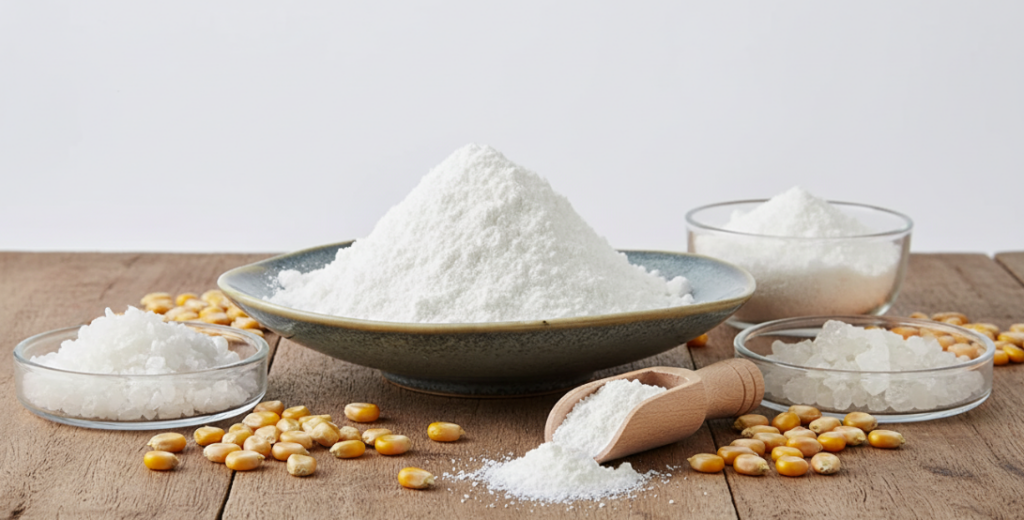
Tres materias primas
Para comprender plenamente la naturaleza de la polidextrosa, hay que descifrar las proporciones de estos tres ingredientes y las funciones que desempeñan. La glucosa es la columna vertebral de todo el polímero, ya que proporciona las unidades de glucosa necesarias para construir la estructura. Si sólo hay glucosa, lo mejor que se puede echar es almidón fácilmente digerible o algún tipo de jarabe.
Para convertirla en una fibra no digerible, se añade sorbitol a la fórmula en una concentración de 10%, que actúa como plastificante y “tapa” los extremos de las cadenas poliméricas, garantizando que el producto final sea suficientemente estable y no cristalice en el producto acabado. Los últimos 1% de ácido cítrico son el “motor” clave de la reacción; como catalizador ácido, inicia el proceso de polimerización sin consumirse en grandes cantidades, permitiendo que las moléculas de glucosa se unan de forma aleatoria y fuera de orden.
Proceso de síntesis
El propio proceso de fabricación es tan crítico como las materias primas. Estas materias primas se someten a una polimerización por condensación extremadamente severa en condiciones de vacío a alta temperatura.
En este entorno controlado, el ácido cítrico hace que la glucosa y el sorbitol pierdan humedad y se fusionen. Su estructura molecular no es una larga cadena lineal como la del almidón de la harina, sino una estructura esférica multiramificada. Como estos enlaces químicos se generan al azar, el resultado es una de conexiones que el sistema digestivo humano no reconoce, razón por la cual el organismo no lo utiliza como fuente de energía habitual.
Fibra soluble
Fibra dietética soluble al por mayor, adecuada para suplementos dietéticos, productos alimenticios, etc.
Prebiótico
Ofrecer suplementos de fibra dietética prebiótica y productos sustitutivos del azúcar.
Almidón Azúcar
Elaborado a partir de maltodextrina y glucosa, apto para su uso en alimentos y bebidas.
Fibra de soja
La fibra de soja de alta calidad proporciona materias primas para industrias como la de suplementos nutricionales.
Proteína
En busca de parásitos ultrabajos e integridad de la señal para aplicaciones de más de 100 GHz.
Vitaminas
Fabricante de vitaminas de alta calidad al servicio de la industria alimentaria y de complementos nutricionales.
El núcleo químico “indigerible
La razón por la que la polidextrosa se clasifica como E1200 en lugar de azúcar reside en su estructura interna. La mayoría de los hidratos de carbono naturales están unidos por enlaces 1,4, y herramientas como la amilasa salival de nuestro organismo pueden cortarlos en cuestión de minutos.
Sin embargo, la síntesis de polidextrosa produce un gran número de enlaces 1,6-glicosídicos. Estas ramificaciones complejas son como un “escudo biológico”. En el momento de la ingestión, estos enlaces son tenazmente resistentes a la hidrólisis por las enzimas del intestino delgado. Este es el fundamento científico de su condición de fibra alimentaria hidrosoluble: básicamente, puede atravesar por completo el tracto digestivo superior, llegar sin problemas al intestino grueso y desempeñar allí una función prebiótica.
De la composición a la función
Esta particular combinación de ingredientes resulta en última instancia en la de un ingrediente extremadamente potente. Como el cuerpo humano no puede metabolizar completamente esas cadenas de glucosa unidas por enlaces 1,6, su densidad calórica desciende de 4 kcal/g de azúcar ordinario a 1 kcal/g.
Para los amigos de la investigación y el desarrollo, esto convierte a la polidextrosa en la primera opción para sustituir al azúcar y la grasa. Cuando se elimina el azúcar o la grasa de la fórmula para reducir el azúcar, el “peso” y el “sabor” del alimento se desploman instantáneamente; y esta proporción específica de polidextrosa puede llenar estos vacíos físicos sin que vuelva a aparecer el azúcar.
Resumen
Cuando se pregunta de qué está hecha la polidextrosa, la respuesta está en la fusión precisa, catalizada por ácido, de glucosa, sorbitol y ácido cítrico. En realidad, se trata de un microcosmos de la ciencia alimentaria: la transformación de ingredientes sencillos derivados del maíz en una fibra compleja, resistente al calor y baja en calorías para responder con precisión a las estrictas necesidades de reducción de azúcar de la industria alimentaria moderna.
Autor: Julian Miller
A lo largo de mi carrera, tanto en el laboratorio como en el ámbito clínico, me he especializado en el impacto metabólico y las propiedades funcionales de los polímeros de carbohidratos. Mi misión es tender un puente entre la síntesis química compleja y la transparencia nutricional, ayudando a los profesionales del sector y a los consumidores preocupados por su salud a entender la ciencia que hay detrás de cada ingrediente de la etiqueta.
Recomendaciones relacionadas
-

¿Es la alulosa un sustituto del azúcar en una proporción de 1 a 1? La verdad
95¿Es la alulosa un sustituto del azúcar en una proporción de 1 a 1? No. Descubre las proporciones exactas de conversión SMB para dominar hoy mismo la repostería cetogénica perfecta.
Ver detalles -
¿Es natural la alulosa?
237¿Confundido con la alulosa? Descubra cómo este azúcar poco común imita el dulzor natural sin aumentar el azúcar en sangre ni la insulina.
Ver detalles -
¿El jarabe de maltitol no contiene gluten? Guía completa
1654El jarabe de maltitol es un edulcorante sin gluten utilizado en alimentos sin azúcar. Aprenda qué es y por qué Sgnutri lo recomienda.
Ver detalles -
¿Es la dextrosa azúcar anhidra?
519Sí, la dextrosa anhidra es 100% azúcar puro con una Gi de 100. Aprenda Su Impacto En La Insulina, Los Diabéticos Y La Dieta Keto.
Ver detalles