 SGNUTRI


Buscar producto
¿Es la alulosa un edulcorante saludable? Ventajas e inconvenientes en cuanto a su seguridad
Muchas personas que controlan su nivel de azúcar en sangre se preguntan: ¿Es la alulosa segura y saludable? Los estudios clínicos ya han dado una respuesta definitiva. Esto se debe principalmente a que la “forma” en que actúa en nuestro organismo es completamente diferente a la del azúcar blanco común. Para comprender su seguridad, no solo hay que fijarse en su certificación GRAS (Generalemente Reconocido como Seguro) de la FDA de EE. UU., sino también entender su vía metabólica única, que no provoca fluctuaciones en los niveles de insulina. Sin embargo, si la utilizas como el azúcar blanco habitual al hornear a altas temperaturas, podrías acabar con un sabor amargo, casi químico, e incluso podría provocar diarrea grave tras su consumo. Hoy analizaremos en profundidad las ventajas y desventajas de este azúcar poco común, basándonos en datos de los medidores continuos de glucosa (MCG), y ofreceremos algunos consejos para los aficionados a la repostería cetogénica.
S.A.F.E. Evaluación integral de la alulosa
Para determinar si un edulcorante es bueno, no basta con probar su sabor dulce. Es necesario determinar qué reacciones biológicas y químicas desencadena una vez que entra en el organismo humano. Los siguientes aspectos bastan para demostrar que, efectivamente, es una ayuda excelente para las personas con diabetes y para quienes siguen una dieta cetogénica.
- Estabilidad (respuesta al estrés térmico): El azúcar granulado común se derrite y se carameliza de forma natural al calentarse, mientras que la alulosa es muy sensible a las altas temperaturas; su reacción de Maillard es excepcionalmente intensa, lo que provoca un oscurecimiento sorprendentemente rápido. Por lo tanto, al hornear con la dieta cetogénica, si no se ajusta la temperatura del horno, se puede echar a perder fácilmente una tanda de ingredientes caros.
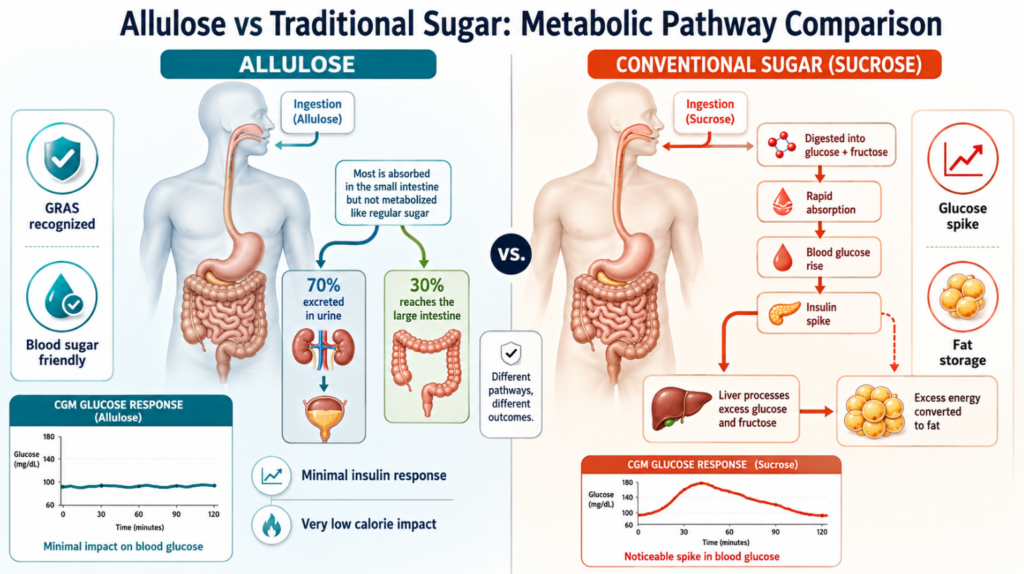
- Vía de absorción (sin pasar por el hígado): Aproximadamente el 70% de la alulosa ingerida por vía oral se absorbe en el torrente sanguíneo a través del intestino delgado. Sin embargo, cabe destacar que nuestro hígado no reconoce este isómero concreto y es incapaz de metabolizarlo. Finalmente, los riñones la excretan sin cambios a través de la orina. Por lo tanto, su contenido calórico real es de tan solo 0,4 kcal por gramo.
- Microbiota intestinal (suplementación con probióticos): El 30% restante que no se absorbe pasa directamente al intestino grueso. Las bifidobacterias presentes en el intestino son especialmente eficaces a la hora de fermentar este tipo de carbohidratos intactos, produciendo ácidos grasos de cadena corta (AGCC), como el butirato. Lejos de ser perjudiciales, estos compuestos contribuyen activamente a aliviar la inflamación intestinal.
- Endocrino (sin picos de insulina): Cuando se consume alulosa pura, los niveles de insulina se mantienen completamente estables. Dado que las células β del páncreas no reconocen su estructura molecular, se interrumpe directamente la cascada hormonal típica que se produce tras la ingesta y que favorece el almacenamiento de grasa.
| Edulcorante | Respuesta a la insulina | Valor calórico | Vía de absorción y metabolismo | Repercusiones en la microbiota intestinal | Estabilidad térmica / Comportamiento durante la cocción | Evaluación general |
|---|---|---|---|---|---|---|
| Alulosa | Respuesta mínima a la insulina; no provoca una activación significativa de las células β pancreáticas | 0,4 kcal/g | Se absorbe en el intestino delgado en una cantidad aproximada de 70%; se metaboliza en menor medida en el hígado; se excreta en su mayor parte sin cambios a través de la orina. | El 30% restante llega al colon y puede ser fermentado por bacterias beneficiosas, produciendo ácidos grasos de cadena corta (AGCC), como el butirato. | Es muy reactivo al calentarse; su fuerte efecto de coloración de Maillard requiere ajustar la temperatura de horneado. | Excelente edulcorante bajo en calorías para el control de la diabetes y las dietas cetogénicas, siempre que se utilice correctamente |
| Eritritol | Impacto muy bajo sobre la insulina; por lo general, no eleva la glucosa en sangre de forma significativa | 0,2 kcal/g | Se absorbe principalmente en el intestino delgado y se elimina sin sufrir modificaciones a través de la orina | Fermentación mínima por parte de las bacterias intestinales debido a una elevada tasa de absorción | Muy estable al calor; se dora poco en comparación con el azúcar | Una buena alternativa al azúcar con excelentes propiedades para el control de la glucosa |
| Stevia | No se produce un pico significativo de insulina; el sabor dulce proviene de los glucósidos de esteviol, y no del metabolismo de la glucosa. | 0 kcal/g | No se absorbe como el azúcar; las bacterias intestinales transforman los glucósidos de esteviol en esteviol, que posteriormente se procesa y se elimina. | Puede interactuar con la microbiota intestinal, pero los efectos varían en función de la composición individual. | Muy estable al calor; apto para cocinar y hornear | Edulcorante de cero calorías con una gran intensidad de dulzor |
| Sacarosa (azúcar de mesa) | Provoca un rápido aumento de la glucemia y de la insulina | 4 kcal/g | Se descompone en glucosa y fructosa; la glucosa pasa al torrente sanguíneo y la fructosa es procesada principalmente por el hígado | Una ingesta excesiva puede afectar negativamente al equilibrio intestinal a través del estrés metabólico | Se derrite y se carameliza al calentarlo; comportamiento predecible durante la cocción | Edulcorante hipercalórico con un impacto metabólico significativo |
| Dimensión | Rendimiento de la alulosa | Efecto biológico clave |
|---|---|---|
| S — Estabilidad | Fuerte reacción de Maillard durante el calentamiento | Requiere un control de la temperatura de horneado más bajo para evitar que se dore en exceso |
| A — Vía de absorción | Se absorbe parcialmente, pero no se metaboliza como la glucosa | Aporta dulzor con un aporte energético extremadamente bajo |
| F — Flora (microbiota intestinal) | Favorece la fermentación bacteriana beneficiosa en el colon | Produce ácidos grasos de cadena corta relacionados con la salud intestinal |
| E — Respuesta endocrina | Efecto mínimo sobre la señalización de la insulina | Ayuda a mantener unos niveles estables de glucosa en sangre |
Real-World CGM Data: The Remarkable “Glucose Sponge” Effect
Clinical endocrinology has uncovered an intriguing phenomenon: allulose “meddles” by actively interfering with the digestion of other carbohydrates. Many people wearing continuous glucose monitors (CGMs) have found that adding a bit of allulose to a high-carbohydrate meal significantly flattens the post-meal blood glucose curve.
To put it simply, it’s like a mild, natural “carb blocker.” Research has shown that allulose can inhibit α-glucosidase and α-amylase—both of which are key enzymes responsible for breaking down complex starches into glucose. To illustrate, when you eat a keto-friendly muffin made with allulose and almond flour, the allulose physically slows down the breakdown of the small amount of carbohydrates in the flour.
Many people with diabetes leverage this mechanism to keep post-meal blood sugar spikes in check. Adding just a small amount of allulose to a typical carbohydrate‑rich diet can reduce the overall glycemic impact. This has elevated allulose from a mere “zero-calorie underdog” to a powerful tool for blood‑glucose management.
![Insert a dynamic data video here showing two groups of patients consuming carbohydrates while wearing CGMs [continuous glucose monitors]; the blood glucose curve of the group that included allulose is noticeably flattened. The video should feature professional, medically accurate graphs.](https://www.sgnutri.com/wp-content/uploads/2026/08/image-1-1024x573.png)
Baking Pit Avoidance Guide: Hidden Danger of HMF Produced by High Temperature
If you use allulose as white sugar in the oven, not only will the food roll over, but it will also produce unpleasant chemical by-products. At high temperatures, the degradation of sugars accelerates the production of hydroxymethylfurfural (HMF).
Allulose discoloration is much lower and faster than ordinary white sugar. If you still bake an ordinary cake at 175°C (350 °F), the inside is not ripe yet, the skin will have been burnt into black charcoal, and it will have an extremely strong pungent and bitter taste. This “fake cooked” appearance often deceives novice bakers into bringing out half-baked desserts out of the oven in advance.
The solution is simple: lower the oven temperature by 15°C (25 °F) and cover the baking sheet with tin foil. Blocking the direct radiation of heat can effectively delay the Maillard reaction. This small action can not only prevent premature scorching of the surface and avoid bitterness, but also greatly reduce the chemical substances produced by high temperature.
Gastrointestinal tolerance limit: Never overindulge.
No matter how safe sugar substitutes are, they don’t give you free rein to eat as much as you want. Consuming too much allulose in one sitting will undoubtedly send your digestive system into overdrive, with osmotic diarrhea and painful bloating being the most common symptoms.
As mentioned earlier, approximately 30% of unabsorbed allulose enters the large intestine and undergoes rapid fermentation. If you consume a massive amount in one go, the sudden surge of hydrogen produced by your gut bacteria could easily overwhelm your digestive tract’s capacity and cause it to rupture. What’s worse, if the sugar concentration in the intestines becomes too high, it will rapidly draw all the water from the surrounding tissues into the intestinal lumen.
The clinically recommended safety threshold is: a single intake should not exceed 0.4 grams per kilogram of body weight. In other words, for a 68-kilogram (150-pound) adult, consuming more than 27 grams in one sitting will very likely send them running to the bathroom. The upper limit for the entire day is approximately 0.9 grams per kilogram of body weight. So, when you’re eating those commercially available keto protein bars, if you plan to have several in a row, it’s best to check the back of the package for the exact grams per bar first.
Pet Warning: Can Dogs Eat?
Dog owners know that xylitol is a deadly poison that triggers massive insulin release and liver failure within hours. Fortunately, the biochemical route of allulose in dogs is completely different.
Veterinary studies confirm that allulose does not cause a fatal hypoglycemic shock like xylitol. If a dog accidentally eats a piece of allulose biscuit that falls on the ground, it will not face the life danger of acute liver toxicity
However, the dog’s digestive system is simply unable to process this rare sugar. Even if only a little bit of it, it will definitely cause very serious ejection diarrhea. Although it is not fatal, dehydration and severe intestinal irritation caused by diarrhea also need to be sent to the pet hospital immediately for supportive treatment. Therefore, all ketogenic baked goods in the home must be placed out of the reach of the children.
Preguntas frecuentes (FAQ)
Is allulose healthy for people with diabetes?
It is very healthy. It does not trigger an insulin response, nor does it raise blood sugar levels. What’s more, clinical data shows that it actively inhibits digestive enzymes; if you take a small amount with your meal, it can also help slow down the glycaemic response caused by other carbohydrates in that meal.
Is it safe to take allulose daily over the long term?
Yes, it is safe. Based on extensive toxicological testing, the US FDA has granted it GRAS (Generally Recognised as Safe) status. It is not carcinogenic, does not cause genetic mutations, and does not damage the liver or kidneys. As long as you do not exceed the gastrointestinal tolerance limit (approximately 0.9 grams per kilogram of body weight) each day, long-term daily consumption is perfectly safe.
Does allulose have any side effects?
Its main side effects are gastrointestinal. Consuming too much at once can lead to flatulence, wind, abdominal cramps and osmotic diarrhoea. Furthermore, when used in baking, if the temperature is too high (above 160°C/325°F), it can produce bitter-tasting chemical compounds.
¿Es la alulosa un edulcorante artificial?
No, it is a naturally occurring rare sugar. Trace amounts of allulose are found in maple syrup, figs and raisins. Although commercial products on the market are mass-produced using a natural enzymatic process that converts fructose from maize into allulose, its chemical structure is identical to that found in nature.
Does allulose disrupt the gut microbiota?
Far from it; in fact, it is beneficial to the gut microbiota. The portion of allulose that reaches the large intestine is fermented, serving as ‘food’ for beneficial bifidobacteria. This fermentation process produces short-chain fatty acids (such as butyrate), which nourish colon cells and reduce intestinal inflammation.
Why has allofructose been banned in Europe?
Europe has not banned it due to ‘safety concerns’; this is actually a regulatory procedural issue. It falls under the EU’s ‘Novel Food’ regulations. Any new ingredient seeking to be placed on the market in the EU must undergo a very lengthy and cumbersome bureaucratic approval process. Several companies have already submitted safety dossiers, and the EU is currently processing them; they are simply waiting their turn.
Will allulose poison dogs in the same way as xylitol?
No, it does not cause the kind of fatal insulin spikes and liver failure associated with xylitol. However, it is extremely irritating to a dog’s digestive system and can lead to very severe diarrhoea and dehydration. Therefore, it is best to keep it out of reach of your pets.
Recomendaciones relacionadas
-

¿Cuántos gramos de maltodextrina se pueden tomar al día sin riesgo? Límite máximo
66¿Cuántos gramos de maltodextrina se pueden tomar al día sin riesgo? Descubre cuál es tu límite máximo exacto en función de tu nivel de actividad y tu salud intestinal.
Ver detalles -
¿Qué es la alulosa? La alternativa natural más segura para la dieta cetogénica
69¿Qué es la alulosa? Descubre la alternativa natural más segura para la dieta cetogénica. Controla el azúcar en sangre y evita las trampas ocultas para la salud intestinal.
Ver detalles -
Beneficios para la salud de la alulosa: ¿por qué cambiar de edulcorante ahora mismo?
76Descubre los beneficios para la salud de la alulosa. Cambia ya de edulcorante para activar el GLP-1, reducir el impacto de los hidratos de carbono y obtener datos reales de la monitorización continua de la glucosa (CGM).
Ver detalles -
¿Es la alulosa un buen sustituto del azúcar? Léelo antes de usarla
70¿Es la alulosa un buen sustituto del azúcar? Domina la fórmula de repostería S.R.C. para evitar que los postres se quemen y que la levadura no fermente correctamente.
Ver detalles