
 SGNUTRI


Search Product
Is Glucose A Pure Substance
The simple answer is: yes, glucose (C6H12O6) is absolutely pure.
The reason why it is so qualitative is that it is a specific compound, the ratio of carbon, hydrogen and oxygen atoms is completely locked, and the properties are consistent. This is completely different from a mixture (such as the juice we drink). The composition of the mixture changes and the physical properties are unstable, but this is not the case with glucose.
In chemistry, we judge whether it is “pure”, mainly to see whether it is made of different elements through chemical bonds “welded to death” in a fixed proportion, forming a uniform whole.
The following are several core bases for determining that glucose is pure:
- The composition is unmovable (fixed composition): every glucose molecule, no matter where it is found, is always 6 carbons, 12 hydrogens and 6 oxygen (C6H12O6).
- It is a white crystalline solid with its own unique melting point and solubility, which is completely different from the properties of the carbon, hydrogen and oxygen elements that make up it.
- Chemical bonding rather than physical stacking: its elements are linked together by chemical bonds, not simply mixed. Want to separate them by simple physical means like filtration or evaporation? That’s absolutely impossible.
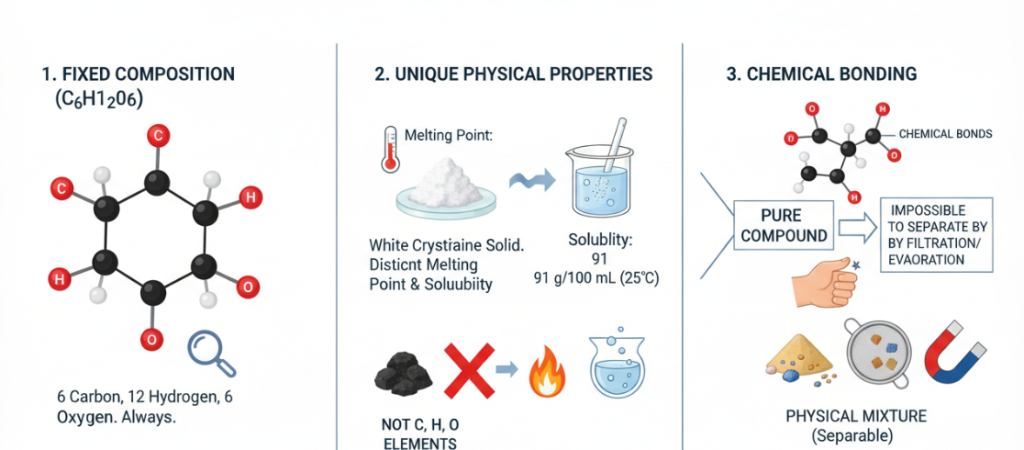
Understanding The Hard Index Of “Fixed Composition”
To give a rigorous answer to whether glucose is pure, we have to drill down to the atomic structure. The hardest indicator to judge pure substances is fixed composition.
For glucose, its “ID number” is C6H12O6. This means that no matter where in the universe you find glucose, every molecule of it must contain strictly:
6 carbon atoms
12 hydrogen atoms.
6 oxygen atoms
This ratio moves even a little bit — for example, it becomes C12H22O11-Then it’s not glucose at all, but sucrose or some other sugar. Because it strictly abides by the “law of definite composition”, the mass ratio between elements is unshakable, so in scientific classification, it is undoubtedly pure.
Constancy Of Physical And Chemical Properties
Another reason to be convinced that it is pure is that its properties are always predictable, regardless of the source.
This is in stark contrast to the mixture. If you think about honey or fruit juice, their sweetness, density and even boiling point will go up and down with the concentration of the ingredients. But pure glucose is “constant. When the researchers tested pure glucose, the features observed each time were exactly copy-pasted:
Material state: white crystalline solid at room temperature.
Melting point: It has a specific melting point range (α-D-glucose at approximately 146°C).
Solubility: Its dissolution behavior in water can be accurately predicted.
These properties are engraved in the bones of the glucose molecule (intrinsic properties). If the boiling point of a substance is erratic, or the density goes up and down, it is probably a mixture, not a pure substance like glucose.
To the forefront of nutrition
Soluble Fiber
Soluble fiber is a highly stable, indigestible dietary ingredient that promotes weight control by increasing satiety and reducing food intake. Versatile in application, it is widely used to enhance the nutritional profile and texture of foods, beverages, and health products.
Soluble Fiber
Prebiotic
A prebiotic functions as a proliferation factor that is selectively degraded and utilized by beneficial intestinal bacteria, such as Bifidobacteria. This process exerts a positive effect on overall human health, often accompanied by metabolic advantages such as low caloric impact and minimal blood sugar fluctuations due to their unique digestive stability.
Prebiotic
Vitamins
Vitamins are essential organic micronutrients, categorized into water-soluble and fat-soluble forms, that regulate critical physiological processes such as metabolism, immunity, and coagulation. Due to their sensitivity to light, heat, and moisture,
Vitamins
It Is A Compound, Not A Mixture
When discussing this issue, many people tend to confuse compounds with mixtures. There must be a focus here:
Mixtures (like salt water, air) are substances that are physically “put together” without chemical reaction. You can evaporate them in the sun or use a filter paper to separate them.
The elements in a compound (like glucose, water) are chemically bonded.
Glucose belongs to the strict compound camp. Its carbon, hydrogen, and oxygen atoms are tightly locked together by strong covalent bonds. You can’t sift the carbon out of the hydrogen with a strainer, and you can’t boil it and boil it. Want to disassemble glucose? You have to use chemical reactions, such as combustion or cellular respiration.
This “immunity” to physical separation means is the hard evidence of glucose as a pure substance.
Why Is It Not Elemental?
Finally, a little clarification of a common myth: although glucose is pure, it is not an element.
Elements (simple substances) contain only atoms (such as pure oxygen O2, pure carbon C).
Glucose is assembled from three different atoms (C, H, O).
However, in the broad framework of chemical classification, the concept of “pure matter” is a big basket, containing both elements and compounds. Since glucose is a compound with a uniform, fixed composition, it fully meets all criteria for a pure substance. Although it is not as simple as the elements, but in the “purity” of this classification, they are a family.
Author: Alex Thorne
” With a Ph.D. in Organic Chemistry and over 10 years of experience in science education, I specialize in breaking down complex chemical concepts into clear, accurate explanations.I hope to help students and enthusiasts strictly distinguish between compounds, elements, and mixtures.”