
 SGNUTRI


Search Product
Is Vitamin C The Same Thing As Calcium
No, Vitamin C is not the same thing as Calcium. They are two completely distinct nutrients with different chemical structures and functions in the human body. Calcium is a major mineral primarily responsible for building structural integrity in bones and teeth, whereas Vitamin C is a water-soluble vitamin (antioxidant) essential for immune support, collagen production, and skin health. While you might see them combined in supplements like “Calcium Ascorbate,” they are biologically different and one cannot replace the other in your diet.
Minerals Vs. Vitamins
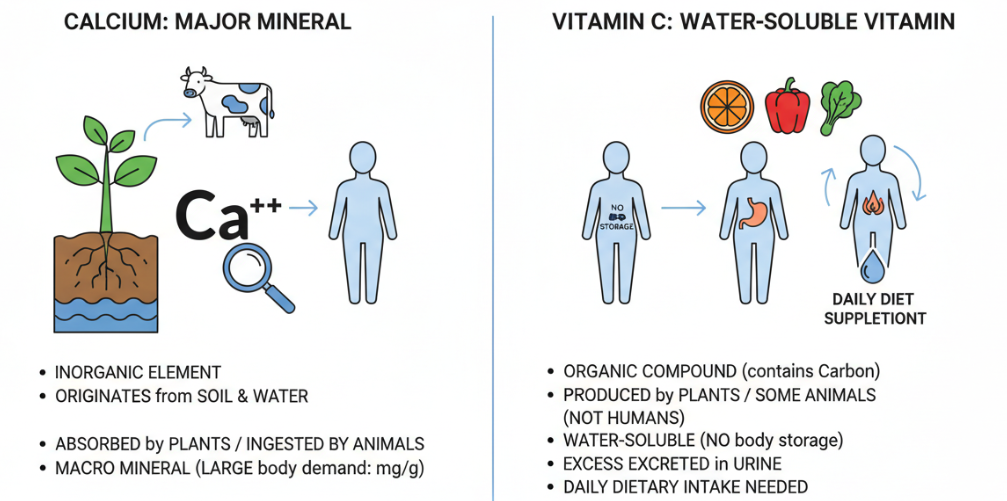
To really understand why vitamin C and calcium differ, we need to look at their biological classification. This is not only the difference between the noun, but also the difference between their source and metabolic mode.
Calcium Is A Major Mineral:
It is the inorganic element that originates from soil and water and is absorbed by plants or ingested by animals. We classify it as a “macro mineral” in nutrition because the body’s demand for calcium is relatively large (usually milligram or even gram) compared to trace minerals such as iron or zinc.
Vitamin C Is A Water Soluble Vitamin:
Also known as ascorbic acid. It is a organic compound (meaning it contains carbon) produced by plants and some animals (but humans cannot synthesize it on their own). As a “water-soluble” vitamin, it is characterized by its inability to store in the body for a long time, and the excess will be excreted in the urine, which means you need to supplement it through your diet every day.
While both are essential for survival, they are chemically completely distinct entities. Your body can’t metabolize calcium into vitamin C, and vitamin C can’t do the structural work of calcium.
Different Division Of Labor In The Human Body
Because of their different chemical structures, their “positions” in the body are also very different.
Calcium: The Cornerstone Of Structural Integrity
Calcium is the most abundant mineral in the body. Its main functions are mechanical and structural.
- Bone Depot: Only about 99% of the body’s calcium is stored in bones and teeth, providing them with hardness and structural support. Without enough calcium, bones become more brittle.
- Signal Transduction: The remaining 1%, though small, is extremely critical. They are responsible for blood coagulation, muscle contraction and nerve signal transmission. But in public perception, calcium’s “fame” mainly comes from building bone frames.
To the forefront of nutrition
Soluble Fiber
Soluble fiber is a highly stable, indigestible dietary ingredient that promotes weight control by increasing satiety and reducing food intake. Versatile in application, it is widely used to enhance the nutritional profile and texture of foods, beverages, and health products.
Soluble Fiber
Prebiotic
A prebiotic functions as a proliferation factor that is selectively degraded and utilized by beneficial intestinal bacteria, such as Bifidobacteria. This process exerts a positive effect on overall human health, often accompanied by metabolic advantages such as low caloric impact and minimal blood sugar fluctuations due to their unique digestive stability.
Prebiotic
Vitamins
Vitamins are essential organic micronutrients, categorized into water-soluble and fat-soluble forms, that regulate critical physiological processes such as metabolism, immunity, and coagulation. Due to their sensitivity to light, heat, and moisture,
Vitamins
Vitamin C: Immune And Tissue Health
Vitamin C works more at the cellular level as an antioxidant and enzyme cofactor. According to my clinical observations, its core role is mainly reflected in:
- Collagen Production: It is an essential ingredient for the synthesis of collagen, which acts like a “glue” that binds your skin, cartilage and blood vessels together.
- Immune Support: It supports the cellular functions of the innate and adaptive immune systems.
- Antioxidant Defense: protects cells from oxidative damage by free radicals.
For example, if you compare the body to a house, calcium is responsible for building the “framework” (bones), while vitamin C is responsible for maintaining the “soft clothing and coating” (skin, gums, blood vessels) and preventing the house from rusting (anti-oxidation).
Why Do People Confuse Them?
This confusion often stems from the label reading of supplements.
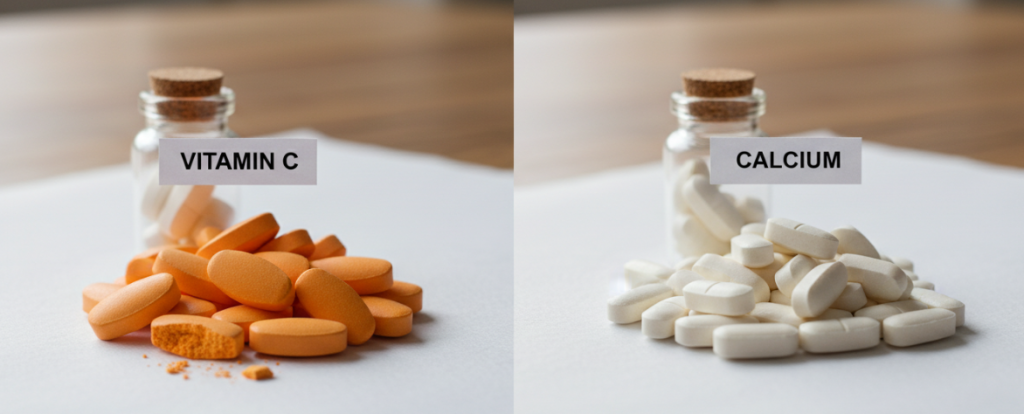
The culprit is usually ” calcium ascorbate (Calcium Ascorbate) “.
This is the buffered form of vitamin C. Pure vitamin C (ascorbic acid) is very acidic, and taking it directly may make some people with sensitive intestines and stomach feel uncomfortable. To neutralize this acidity, the manufacturer reacts ascorbic acid with calcium carbonate.
The result is a compound that provides both vitamin C and a small amount of calcium. However, this does not mean that they are the same substance. In this compound, calcium is present only as a “carrier” or buffer. They are still two separate nutrients packaged in a molecule for digestion.
They Are Not Interchangeable
In the final analysis, this sentence is the most important: nutrient cannot replace another in the diet.
Eating foods rich in vitamin C (like oranges or bell peppers) will not solve the problem of calcium deficiency; similarly, drinking milk or eating green leafy vegetables will not prevent scurvy or support collagen synthesis as vitamin C does.
In order to maintain optimal health, your body needs a “two-pronged” combination of these two nutrients-calcium to keep your bones strong and vitamin C to maintain the health of your immune system and soft tissues. One is indispensable.
Author: Alex Mercer
As a Certified Nutrition Specialist (CNS) with over a decade of experience in dietary science, I specialize in breaking down complex nutrient interactions. I hope to clarify common misconceptions about vitamins and minerals to help you make informed decisions about your daily diet and supplements.