
 SGNUTRI


Search Product
Maltodextrin Before Workout Dosage & Timing
Taking maltodextrin before a workout is a highly effective strategy for endurance athletes and strength trainers looking to maximize performance. In my experience, the best intake window is usually 15 to 30 minutes before training, or when you start warming up. For most athletes, my recommended dose range is between 0.5 grams and 1 gram per kilogram of body weight. The reason why maltodextrin occupies an important position in the field of sports nutrition lies in one of its core advantages: low osmotic pressure (Lower Osmolarity). This means it can quickly pass through the stomach, providing rapid energy spikes without causing bloating or gastrointestinal discomfort (Gastric Distress) during strenuous exercise like other sugars. But beware, it’s not enough to just pour it into the water and shake it. Below I will break down specifically how to use maltodextrin according to your training style to ensure that you only get energy, not stomach cramps.
How to Fuel Without the Stomach Cramps
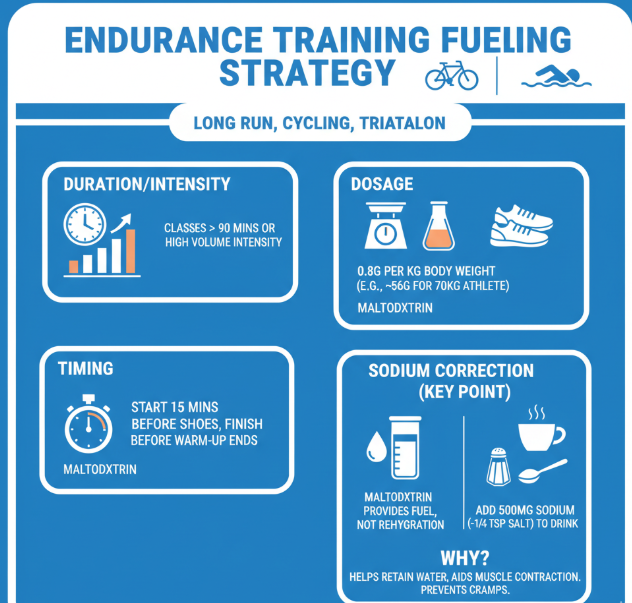
- When: Start sipping 15 minutes before you’re ready to go out with your shoes on and finish at the end of the warm-up.
- Dosage: For more than 90 minutes of training, the target is set at 0.8 grams per kilogram of body weight.
- The Sodium Fix: This is something that many people ignore. Maltodextrin is only fuel, it is not responsible for hydration. I always force my clients to put 500 mg of sodium in a shaker cup (about 1/4 teaspoon of high-quality sea salt). This aids fluid retention and muscle contraction.
Supplement with maltodextrin according to the type of exercise.
1. Endurance Training (Long Run, Cycling, Triathlon)
- Scenario: A schedule of classes lasting more than 90 minutes or high volume intensity.
- Dosage: Target 0.8 grams per kilogram of body weight (e. g., approximately 56 grams for a 70kg athlete).
- Best time: Start 15 minutes before putting on your shoes and finish drinking before the warm-up is over.
- “Sodium correction” (key point): Maltodextrin provides fuel, but it does not rehydrate.
- Operation: Add 500mg sodium (about 1/4 teaspoon salt) to the cup.
- Reason: This helps to lock in water and assist muscle contraction; simple carbohydrate can not solve the problem of cramps.
- Benefits: You can get a very high calorie intake without the feeling of being stuck in your stomach after drinking “thick mud”—this is usually the culprit of gastrointestinal collapse after a long ride for two hours.
2. Strength & Hypertrophy (Bodybuilding, Powerlifting)
- Scenario: Pursuit of “pump,” muscle growth, or prevention of muscle breakdown.
- Dosage: 30 grams -50 grams (usually less than endurance athletes, unless you are a “Hardgainer” who has a hard time building muscle).
- The best time: practice sipping (Intra-Workout). Start drinking from your first set of warm-up moves and continue to replenish throughout the training session.
- “The Hypertrophy Stack: Do not drink only maltodextrin. We’re going to use the insulin spike as a transport mechanism.
- Carbohydrate source: 30-50 grams of maltodextrin.
- Protein source: 25g of hydrolyzed whey protein (Hydrolyzed Whey) or 10g of EAA (essential amino acids).
- Additions: Creatine and L-citrulline (L-Citrulline).
- The reason: Insulin spikes push these nutrients into muscle cells like a “truck”, creating an “Anti-Catabolic Shield” that protects muscle tissue and enhances blood vessel filling and pumping.
3. Light Exercise or Short Sessions
- Scenario: 30 minutes of jogging, a relaxing arm training day or active recovery.
- Suggestion: Don’t use it.
- Reason: Drinking water is enough. The use of high glycemic index (High-GI) carbohydrates in low-intensity exercise is not only unnecessary, but may also directly lead to unnecessary fat accumulation.
The “insulin pump” strategy: harnessing insulin to boost growth
Many people talk about “insulin” discoloration, but in the context of training, it is our strongest ally.
- Anti-decomposition Shield: Insulin is the most powerful anti-decomposition hormone. By creating a spike at the beginning of training, you protect muscle tissue from the catabolic effects of high-intensity lifting.
- Nutrition shuttle: Think of insulin as a delivery truck. The spikes triggered by maltodextrin help drive other supplements—such as creatine, citrulline and amino acids—into muscle cells more efficiently. This directly contributes to the extreme “pump feeling” and vascular exposure that the skin almost cracks.
If you are aiming for muscle growth, do not drink maltodextrin alone, use the aforementioned “muscle hypertrophy combination” to maximize the anabolic window:
- Carbohydrate: 30-50g maltodextrin.
- Protein: 25g hydrolyzed whey or 10g EAAs.
- Timing: Start with the first group warm-up and sip (Intra-workout) during training. This ensures that when you lift iron, your muscles have a constant supply of glucose.
Frequently Asked Questions (FAQ)
Q: Why can’t I just use plain white sugar or powdered glucose?
A: To get enough calories from table sugar or glucose, you have to make a very high concentration solution. High concentrations of monosaccharides produce extremely high osmotic pressure, which “pulls” water from the body into the intestines. The result is a feeling of “water sloshing in the stomach”, cramps and slow digestion. Maltodextrin can provide the same fast energy, but the osmotic pressure is lower, which means it can be digested quickly and has no gastrointestinal burden.
Q: I drank my milkshake but felt dizzy/shaky at the gym. What happened?
A: You probably drank too early. This is a typical case of reactive hypoglycemia. If you drink it while driving to the gym or at your desk (an hour before training), your insulin will pound your blood sugar down before you lift your first weight. Please wait until you really start to warm up before taking the first sip.
Q: Should I use it if I want to lose fat?
A: Be cautious. Maltodextrin boosts insulin dramatically, putting the body into “storage mode”. If your goal is to strictly reduce fat, stick to water and electrolytes. However, if you are training at very high intensity and exercise performance is critical to burning calories, a small dose (20g) can help maintain the intensity of your training without ruining your diet plan.
Q: Why do we have to add salt? Is there no electrolyte in the powder?
A: Pure maltodextrin is 100 percent carbohydrate energy and it contains zero electrolytes. When you sweat, you lose sodium. If you only supplement fuel and not salt, you face not only cramps, but also the risk of hyponatremia. That 500 milligrams of sodium is key to helping the body absorb fluids.
Q: I am a newbie, how much should I start?
A: Be conservative. 15 minutes before the next heavy weight training, try to mix water and electrolytes with 20 grams of maltodextrin. Monitor your energy level. If you do not feel a blood sugar crash and notice an increase in endurance, then you can start slowly increasing the dose from there.
Author Bio (First Person)
“Hi, I’m Alex Carter. As a CSCS (Certified Strength and Conditioning Specialist) and Performance Nutritionist, I have spent over a decade helping elite endurance athletes and natural bodybuilders optimize their metabolic performance. My passion lies in bridging the gap between clinical sports science and real-world application, helping you use tools like maltodextrin to safely smash your PRs.”