
 SGNUTRI


Search Product
Vitamin D Supplements For Runner
Vitamin D supplements are key for runners to break through plateaus and prevent injuries.
The most effective option is vitamin D3 (also known as cholecalciferol), which has a much higher bioavailability than D2, with a recommended daily intake of between 2,000 and 5,000 IU. For best results, it is best to choose products that work synergistically with vitamin K2, especially in the MK-7 form, to ensure that calcium is delivered precisely to the bones and not deposited in soft tissues. Regarding the time of taking, my advice is to take it with a meal, and it is best to include healthy fats, such as avocados, nuts or olive oil, which can greatly improve the absorption rate.
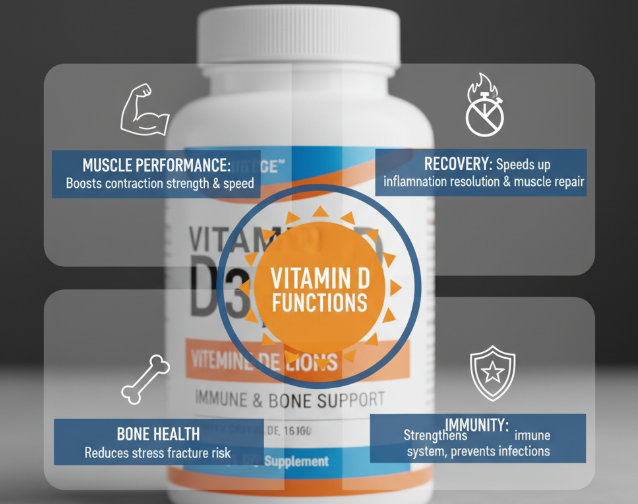
As long as you adhere to the normative supplement, it will directly help you:
- Increase muscle contraction strength and speed.
- Significantly reduces the risk of stress fractures.
- Accelerate inflammation resolution and muscle recovery after high-intensity training.
- Build a strong immune system to keep you away from common infections during the season.
Dosage and Timing
I’ve seen too many runners take supplements casually and naturally end up with little effect. Here is the specific protocol regarding dosage, timing, and method based:
1. Dosage
The usual recommended daily intake is often too low for athletes. For vitamin D supplements for runners, the effective recommended range is 2,000 to 5,000 IU per day.
Why this dose? Quite simply, runners are more physically demanding. This dose range helps maintain optimal levels of vitamin D in the blood to support bone density and immune function without the risk of poisoning.
Dosage form: Make sure the label says Vitamin D3 (Cholecalciferol). As mentioned earlier, D3 is much more bioavailable than D2, which means that the dose you eat can actually be used by the body.
2. Timing
Timing is crucial for absorption. You should take the supplement at meals, especially those with dietary fat.
To avoid: only water or coffee on an empty stomach in the morning.
Best practice: Lunch or dinner is usually the ideal time for runners to take it, as these meals are usually more substantial and contain the fat necessary to dissolve vitamins.
Why D3 Is The Best Choice For Runners
As we mentioned earlier, the specific form is important when looking for vitamin D supplements for runners. Science has made a clear distinction between vitamin D2 (ergocalciferol) and vitamin D3 (cholecalciferol). For runners seeking maximum efficiency, D3 is the absolute first choice.
Its chemical structure is exactly the same as vitamin D produced by your skin when exposed to sunlight. Since D3 is significantly more bioavailable than D2, it can more effectively increase the level of calcific glycol in your blood.
To maintain the optimal range required for exercise performance, the recommended daily dose is 2,000 to 5,000 IU. This range ensures that your body has enough reserves to cope with the physical stress of training without falling into a state of lack.
Pairing with Vitamin K2 (MK-7)
Okay, here’s a very common misconception. When choosing vitamin D supplements for runners, many overlook a necessary co-factor: vitamin K2.
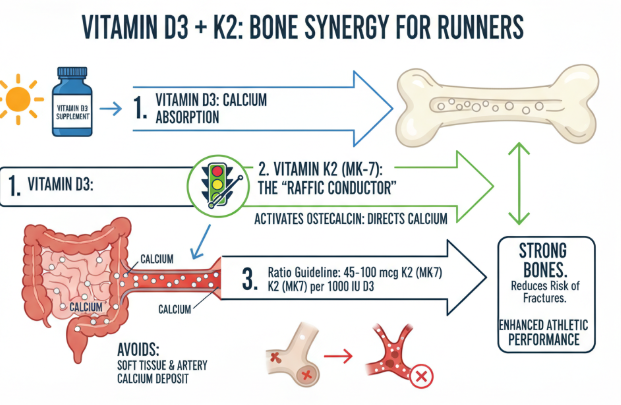
Let’s just say that vitamin D helps your body absorb calcium, but it doesn’t matter where the calcium is going. This is where vitamin K2 (especially in MK-7 form) becomes essential. MK-7 acts like a “traffic conductor” in that it activates osteocalcin, directing calcium into your bone matrix where it’s supposed to go—rather than letting it deposit in soft tissues or arteries.
Choosing the supplement that combines D3 with K2 (MK-7) ensures that increased calcium absorption translates directly into stronger bones. This is essential for runners who are constantly exposed to high impact.
A common guideline for athletes is to recommend about 45 to 100 micrograms (mcg) of vitamin K2 (MK-7) for every 1,000 IU of vitamin D3 intake. This ratio helps to ensure that the synergy between the two vitamins is optimal to better support bone health and athletic performance.
Optimizing Absorption
Even the highest quality runner-specific vitamin D supplements have no effect if they are not properly absorbed. Vitamin D is the fat-soluble vitamin, which means it needs dietary fat to be dissolved and absorbed into the bloodstream.
To maximize benefits, you should never take supplements on an empty stomach. As our emphasizes, the best time to take it is with a meal rich in healthy fats.
Great choices include:
- avocado
- Nuts and seeds
- Olive oil
By taking supplements with these foods, you can significantly increase the bioavailability of the vitamin, ensuring that every unit of IU is used to the best of your ability.

Benefits Of Regular Vitamin D Intake
When you choose the right product and the right time, regular vitamin D intake can bring four very specific benefits to your running performance:
- Strengthen muscle function: Vitamin D receptors are present directly on muscle tissue. Adequate levels have been shown to increase muscle contraction strength and speed, helping you to generate more strength when striding and sprinting to the finish.
- Reducing the risk of stress fractures: Bone health is non-negotiable for runners. By ensuring that calcium is used effectively (thanks to the D3 K2 combination), you can significantly reduce the risk of stress fractures, which are one of the most common injuries that can result in season reimbursement.
- Accelerated recovery: High-intensity running can cause muscle micro-tears and inflammation. Vitamin D plays a key role in regulating the inflammatory response, helping to speed up muscle recovery and getting you ready for your next workout faster.
- A stronger immune system: Marathon training cycles tend to suppress the immune system. A robust vitamin D level builds a strong defense against common infections and respiratory problems that might otherwise disrupt your training schedule.
Author:Jack
“As a dedicated sports nutrition specialist and avid runner, I focus on optimizing athletic performance through science-backed strategies. I understand the frustration of training plateaus and the fear of stress fractures. I will help you select the precise supplementation—like the synergistic pairing of Vitamin D3 and K2—that your body needs to recover faster, run stronger, and stay injury-free season after season.”