
 SGNUTRI


Search Product
What Has More Potential Energy Water Or Glucose
The chemical potential energy stored by glucose molecules (C≡H≡O₂) substantially exceeds the level of one water molecule (H₂O). This significant difference can be attributed to 3 core factors at the molecular level: one is the huge difference in molecular complexity and the number of chemical bonds; the second is the type and stability of chemical bonds; and finally, it is the oxidation state of the carbon atom. It is these factors that determine that glucose is the main energy source of life, and water is the stable medium of life chemical reaction.
Molecular Complexity And The Number Of Chemical Bonds
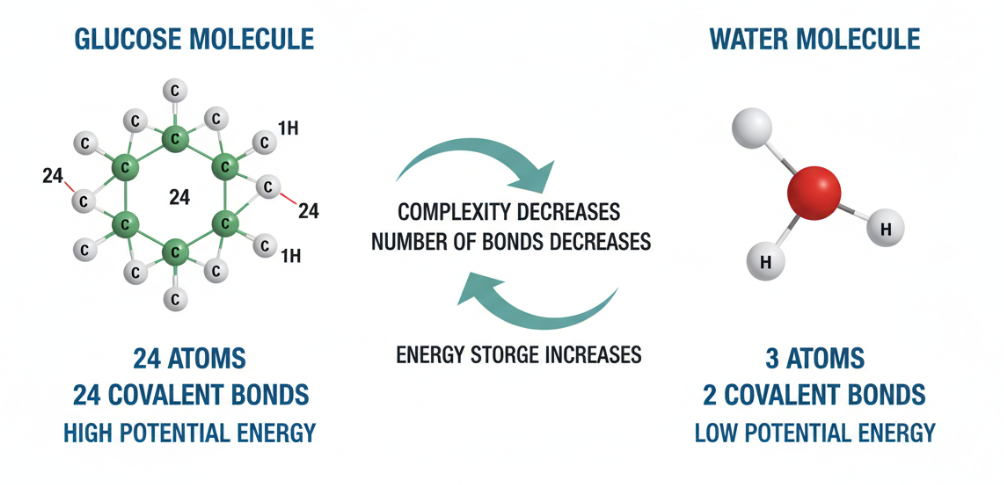
First, let’s look at the molecular structure. A glucose molecule consists of 24 atoms connected by 24 covalent bonds, and the structure is quite complex. In contrast, a water molecule consists of only three atoms and two covalent bonds. To be honest, this is not an order of magnitude comparison at all in structure. The energy of a molecule is stored in its chemical bonds, so the more chemical bonds in glucose allow it to store much more potential energy than water. When these chemical bonds are broken during processes such as cellular respiration, the stored energy is released for use by the cell.
Chemical Bond Type And Stability
The next factor, is the key to understanding the energy difference: the type of chemical bond and its stability. Glucose contains a large number of carbon-carbon (C-C) and carbon-hydrogen (C-H) bonds. Compared with the highly stable oxygen-hydrogen (O-H) bonds in water, these C-C and C-H bonds are relatively unstable and therefore contain higher energy. The reason why the energy state of the O-H bond of water is lower is that the oxygen atom has a strong electronegativity, which makes the bonding electrons more biased towards oxygen, thus forming a very stable structure. This explains why cellular respiration is an energy-releasing process. In this process, glucose is broken down in the presence of oxygen into carbon dioxide and water, both of which are lower-energy, more stable molecules. The energy released by this process is essentially the result of the transfer of electrons from the high-energy states of the less electronegative carbon and hydrogen atoms in glucose to the more electronegative oxygen atoms to form a lower-energy, more stable state.
To the forefront of nutrition
Always provide high standards of food additives and nutrition.Delivering innovative solutions that enhance the flavor, texture, and nutritional profile of food,supporting healthier, sustainable products for the food industry.
Oxidation State Of Carbon
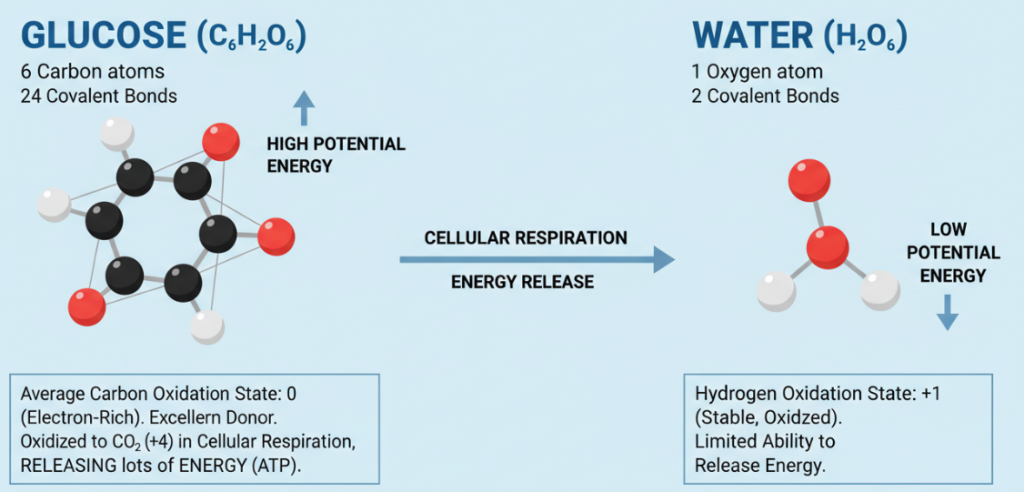
Finally, we must talk about the oxidation state of the carbon atom—this can be said to be a decisive indicator of the high potential energy of glucose. In glucose, the carbon atoms are in a highly reduced state, meaning they are electron-rich. After calculation, the average oxidation state of carbon atoms in glucose is 0. This surplus of electrons makes glucose an excellent electron donor. During cellular respiration, the carbon atoms in glucose are oxidized to form carbon dioxide (CO₂). In carbon dioxide, the carbon atom’s oxidation state changes to +4, indicating that it has lost an electron. The electrons move towards the more electronegative oxygen atoms, releasing a lot of energy, which is then captured in the form of ATP (3 adenosine monophosphate) to power cell activity. On the other hand, the hydrogen atoms of water molecules are already in a stable, oxidized state, and their ability to further release energy is very limited.
Author: Bill
As a passionate specialist with a deep interest in biochemistry, I’ve spent years breaking down complex scientific concepts into clear, accessible content. In this article, I delve into the molecular distinctions that make glucose a powerhouse of potential energy compared to water. I hope to illuminate the fundamental principles that govern energy in biological systems, helping readers grasp why these two simple-seeming molecules play such vastly different roles in sustaining life.