
 SGNUTRI


Search Product
What Vitamin Deficiency Causes Sagging Skin
The answer is clear: vitamin C. Because it is biologically the absolute basis for the synthesis of collagen—the structural protein that keeps the skin firm and lifted.
However, skin laxity is rarely caused by a single factor. It is usually the result of a “cumulative deficiency” of groups of nutrients. In addition to vitamin C, you must not ignore vitamin E (prevent elastin breakdown), vitamin A (accelerate cell turnover), vitamin D (maintain barrier function) and vitamin B3 (niacinamide).
The following are the specific dismantling of these five key roles:
Vitamin C: The Architect Of Collagen
Many people only link vitamin C to immunity, but in the field of dermatology, its role is completely structural.
Collagen is the most abundant protein in the body and acts as the “glue” that holds skin tissue together. But here’s the biochemical detail: collagen synthesis is extremely dependent on two specific enzymes—lysyl hydroxylase and prolyl hydroxylase. These two enzymes cannot function without vitamin C.
The most troublesome situation is “subclinical deficiency”. When your vitamin C intake is insufficient, the body will start the survival mechanism, giving priority to the supply of vital organs, and the skin becomes the object of sacrifice. This leads:
Collagen production stagnates: Existing collagen degrades naturally with age, and without vitamin C, the body simply cannot make new ones to fill the void.
Weakened dermis: The dermis (the thick layer of living tissue below the epidermis) becomes thinner, causing the skin to not tightly wrap around the bone structure, but to “hang” loosely on it.

Vitamin E: The Guardian Of Elastin
If C is responsible for building the structure, E is responsible for protecting it. Addressing sagging isn’t just about building new skin, it’s about stopping destroying your existing capital.
Vitamin E is the powerful antioxidant that specifically targets oxidative stress in the lipid layer of the skin. Sagging tends to occur after damage to elastin—the protein that allows skin to spring back into place after being pulled. Free radicals (from UV light or pollution) are the main destroyers, while a lack of vitamin E can leave elastic fibers in a “streaking” state. Once these fibers harden or break, the skin loses its resilience, which is the main cause of the “blurred jaw line” I mentioned earlier.
Vitamin A: Accelerator Of Cell Renewal
Vitamin A (and its derivatives such as retinol) are key to cell turnover. In the context of the discussion of sagging skin, vitamin A deficiency means that the renewal cycle becomes sluggish and lagging.
Epidermal thinning: Without enough vitamin A, the outermost layer of the skin will thin and become fragile.
Lack of support: Vitamin A stimulates fibroblasts (located deep in the skin) to keep the skin matrix dense. When you lack it, the skin can’t renew itself quickly enough to maintain that thick, Q-bomb texture. This “thin” will make the underlying fat pad loss and muscle tone loss appear more abrupt, visually exacerbated the sense of sagging.
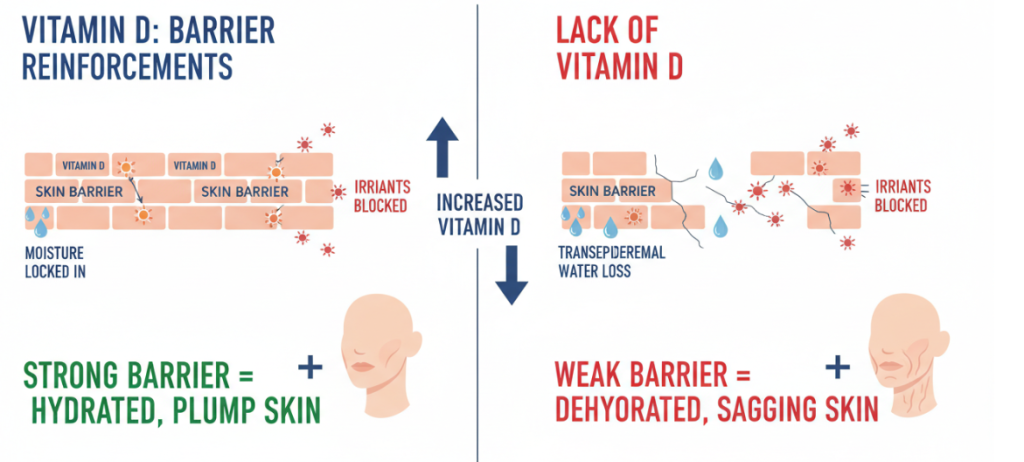
Vitamin D: Barrier Reinforcements
This is often underestimated in skin care discussions. Vitamin D is essential for the “skin barrier function.” Your skin barrier is the outermost shield, responsible for locking in moisture and blocking irritants.
What does this have to do with sagging? Simply put: hydration creates volume. Lack of vitamin D disrupts the skin barrier, resulting in transepidermal water loss. When the skin is dehydrated for a long time because of poor barrier function, it will lose its feeling of fullness. This “dry” and “deflated” state is an important driving force for the appearance of crepe-like texture on the neck and cheeks.
Vitamin B3 (Niacinamide): Cellular Energy Pump
Finally, this “synergistic combination” is very dependent on vitamin B3. This vitamin is a precursor of NAD and NADH, which you can understand as a molecule that provides energy to cells.
As we age, our cellular energy itself is depleted. Without vitamin B3, your skin cells are not strong enough to repair DNA damage or synthesize protein efficiently. Niacinamide helps to improve the surface structure of the skin, smooth the texture and help retain moisture. Without it, the skin looks dull, flat and tired, without the “lifting” feeling that healthy tissues should have.
Synergistic Effect Of Vitamins
Treating sagging skin is not about supplementing a of vitamins in isolation, but about correcting this cumulative deficiency.
Think of the internal structure of your skin as a building under construction:
- Vitamin C provides concrete (collagen).
- Vitamin E prevents steel from rusting (protects elastin).
- Vitamin A ensures that workers get to work on time (cell renewal).
- Vitamin D seals windows to prevent intrusion from the external environment (barrier function).
- Vitamin B3 provides electricity (cellular energy) to the entire site.
As long as any of these micronutrients is missing, the internal “scaffolding” will begin to loosen, and gravity will naturally take over the rest.
Author:Evelyn Harper
With over 18 years in holistic dermatology, I specialize in the connection between internal nutrition and skin aging. My clinical focus is helping patients reverse volume loss and sagging by correcting specific micronutrient deficiencies to rebuild the skin’s structural integrity from within.