
 SGNUTRI


Search Product
When Is The Best Time To Take Amino Acids?
When discussing the question of “best time to take”, we must first clarify a core logic: what is the purpose of your intake of amino acids?
In short, if you are trying to maximize muscle growth and performance (mainly BCAAs/EAAs), the best window is usually during training (Intra-Workout) or 30 minutes before training. This is primarily to physiologically block muscle breakdown and delay fatigue.
But if you’re doing it for health or for a specific therapeutic purpose (such as taking tryptophan or arginine alone), the rules are completely different-you have to take it on an empty stomach, either early in the morning or before going to bed. This is mainly to avoid a single amino acid and food in the protein “absorption competition”.
Let’s disassemble the specific scientific mechanisms and operational guidelines.
When to take amino acids during exercise
According to the current sports nutrition data, we need to stop thinking about “free amino acids” (free-form amino acids) as ordinary protein powder to use the mindset. This is crucial: unlike whey protein or chicken breasts that take hours to digest, free amino acids can directly impact your circulation in as little as 30 minutes after ingestion. Based on this ultra-fast absorption, our strategy must be precise.
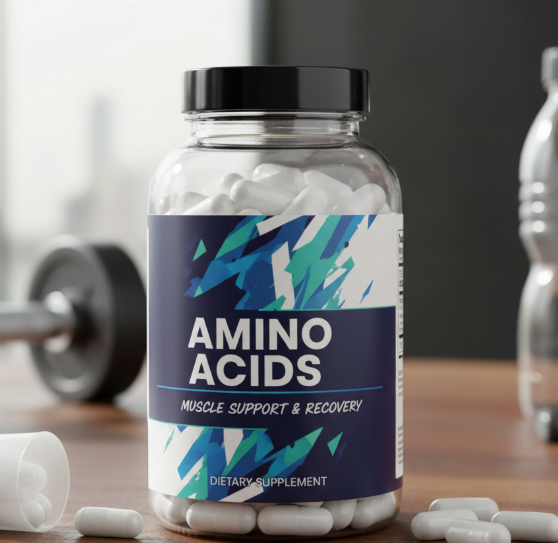
“In Training” Supplements (Intra-Workout): The Gold Standard
Applicable scenarios: prevent muscle breakdown (Catabolism) and delay central fatigue.
When: Start with a small sip during the warm-up and finish before doing the final 1 set. Although many athletes are still obsessed with the “post-training window period”, from a biochemical point of view, training is the main battlefield for amino acids to exert their effectiveness.
Effective mechanism: During high-intensity training, your cortisol levels soar, and your body tends to “disassemble” the amino acids in your muscle tissue for energy. Ingesting EAAs (essential amino acids) or BCAAs at this time is like putting a layer of body armor on the muscles.
In addition, there is an advantage here about “horizontal competition. In fatigue studies, we found that BCAAs compete with tryptophan (Tryptophan) for access to the brain. If you maintain high levels of BCAAs in your blood during training, you can reduce the entry of tryptophan into the brain, which in turn inhibits the production of serotonin (Serotonin).
To put it in a human way: this can effectively postpone the arrival of your “hitting the wall” and keep you excited in the last few groups.
Fasting Training window
Applicable scenarios: intermittent off-eaters (Intermittent Fasters) and morning aerobic crowd.
Time: 15-20 minutes before training.
According to my observations, the risk of muscle loss during fasting training is three times higher than usual. In this case, ingesting 1 spoonfuls of EAAs is like buying a 1 copy of “muscle insurance”. It provides the synthetic signals needed to preserve lean body mass, but without overstimulating insulin and thus interrupting the fat-burning process.
The Assimilation Pulse of “Meal” (Anabolic Spike)
Applicable scenarios: difficult to increase muscle (Hardgainers) and the pursuit of extreme muscle hypertrophy bodybuilders.
When: 2-3 hours after a meal, or between lunch and dinner.
Here’s an interesting mechanism: muscle protein synthesis (MPS) from eating usually drops after 3 hours, even when your blood amino acid levels are still high. It’s like the body is “blunting” to a constant signal “. Studies have shown that the intake of rapidly absorbed EAAs between meals can produce a “pulse” of amino acids that can re-“fire” MPS. This is equivalent to swindling an additional growth signal without consuming a full meal of calories.
What about “after practice?
Conclusion: The whole food or whey protein is preferred after practice.
If you ‘ve just finished, what your body needs is a sustained release of amino acids and usually carbohydrates to replenish your glycogen. Free amino acids are metabolized here too quickly and 1 flash past to meet the ongoing need for post-practice repair. Leave that window to the full protein source.
When should I usually take amino acids?
For people concerned about longevity, gut health or brain clarity, the rule is simple: quarantine (Segregation). Single amino acids require specific carriers to cross the intestinal wall and the blood-brain barrier. If you mix them in food, they can’t grab the huge protein content in the food, and finally they can only become expensive urine.
The “Fasting” Principle
Timing: At least 30 minutes before eating, or 2 hours after eating.
Rationale: Avoid competitive absorption to ensure that a single amino acid reaches the targeted organ.
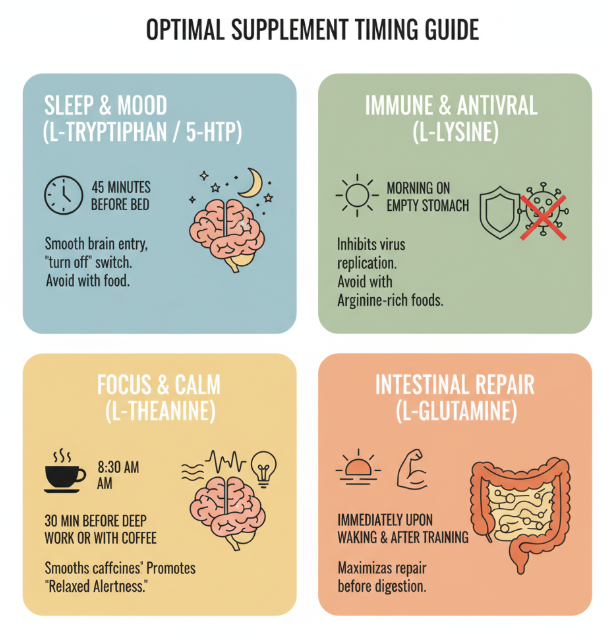
Precise timelines for specific goals:
For Sleep and Mood (L-Tryptophan / 5-HTP)
Time: 45 minutes before bed.
Reason: Tryptophan is a precursor of serotonin and melatonin. If BCAAs are present in the blood (like if you ‘ve just eaten a steak), tryptophan has a hard time crossing the blood-brain barrier. Taking it alone can ensure that it enters the brain smoothly and help you “turn off”.
To immune and antiviral (L-Lysine)
Time: Morning on an empty stomach.
Rationale: Lysine is commonly used to inhibit arginine (Arginine)-dependent replication of viruses (such as herpes viruses). If you take it with a meal (which usually contains arginine), you directly counteract its effects.
In order to focus and calm (L-Theanine)
Time: 30 minutes before the start of deep work, or with morning coffee.
Why: When theanine is paired with caffeine, it smoothes the “anxiety” of caffeine and promotes alpha brainwave activity, allowing you to enter a 1 “relaxed state of alertness” (Relaxed Alertness).
For Intestinal Repair (L-Glutamine)
Time: Take it immediately after waking up, as well as after training.
Reason: Your intestinal endothelial cells (Enterocytes) use glutamine as their main fuel. Taking it early in the morning on an empty stomach ensures that the intestinal tissue can maximize the intake of this repair fuel before the digestive system starts to function.
Summary List
In order to facilitate memory, I have compiled this quick comparison table:
| Target supplement type | Best time to take |
| Protect muscles during training | BCAAs / EAAs (Intra-Workout, drink as you practice) |
| Preventing loss of muscle | EAAs before training (fasting training only) |
| Stimulate growth of muscle | EAAs between meals (3 hours after meals, making pulses) |
| Deep sleep | L-Tryptophan before going to bed (must be on an empty stomach) |
| Intestinal health | L-Glutamine morning (fasting) |
| Congestion/pumping | Citrulline/Arginine 30 minutes before training |
About the Author
I’m Ryan, a CISSN Certified Sports Nutritionist and Strength Coach (CSCS) with a Master’s in Exercise Physiology. I’ve spent the last decade bridging the gap between clinical research labs and the weight room floor. I don’t believe in “bro-science”—I believe in data. I hope this article can help you cut through the marketing hype and use supplements like amino acids to fuel real, measurable performance results.