 SGNUTRI


Produkt suchen
Enthält Maltodextrin Gluten? Warnhinweise für Zöliakie-Betroffene
Essentially, maltodextrin is actually gluten-free. Why? Because during the manufacturing process, it undergoes a high-intensity hydrolysis, which “washes off” almost all the protein, leaving only the carbohydrates. So if you ask the answer purely on a chemical level, even if it’s extracted from wheat, the answer is “no”.
But! It would be naive to listen to this “textbook” answer completely. Every year, countless celiac patients believe this and their own immune systems explode in pain. Food processing plants in reality are not that “spotless”. Your health depends on whether you know exactly where this common food additive comes from and how the factory processes it.
You are probably reading this article now because you caught a glimpse of the four words “maltodextrin” on the ingredient list of a food or health product and your heart suddenly tightened. Don’t panic, this guide will help you bypass the arcane medical jargon and go straight to how to read labels, identify risks in the supply chain, and protect your gut from hidden cross-contamination.
Can Celiac Disease Patients Safely Eat Maltodextrin
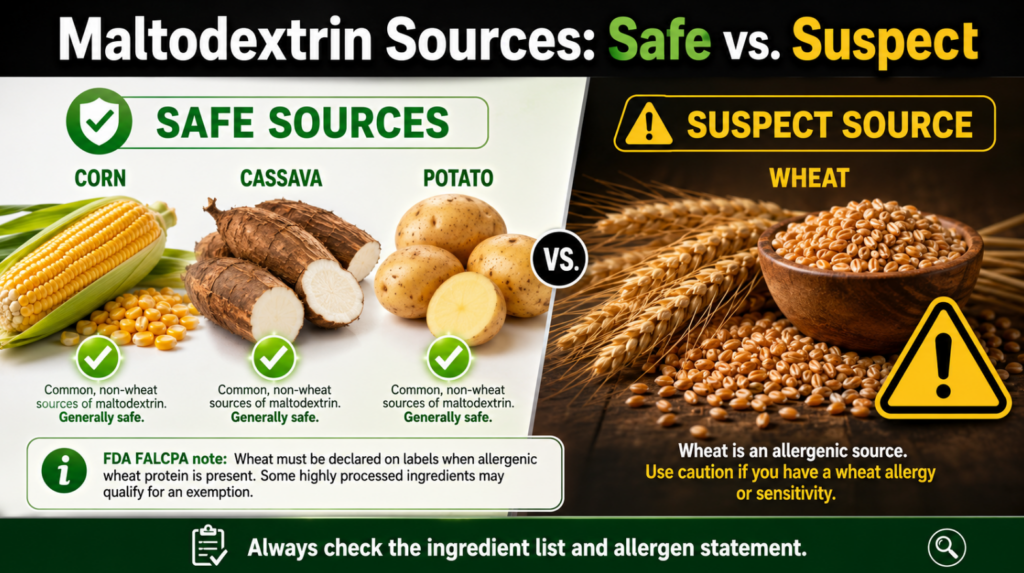
Maltodextrin extracted from corn, potatoes, rice and cassava, 100% safe for gluten-free diets. Because these plant-based ingredients used by manufacturers are gluten-free. If traces of gluten are found in maltodextrin, the problem is basically “shared processing equipment”, not the raw materials themselves.
Many newly diagnosed patients stare at nutrition labels and mutter to themselves: “It doesn’t say where it’s extracted, so is this maltodextrin gluten-free?” In the United States, the Food and Drug Administration (FDA) has a hard and fast rule: as long as maltodextrin is extracted from wheat, food manufacturers in the United States must clearly state “wheat” on the label. So, as long as it’s a food produced in the United States with only “maltodextrin” written bare on the ingredient list, it means it’s extracted from corn or other safe starches.
But if you’re not buying standard food from an American supermarket, be careful. Health products, imported snacks, generic drugs, they play with another set of labeling rules and are extremely risky.
A Pit Avoidance Framework For Celiac Disease Patients
Before you can put anything containing this additive in your stomach, you need a systematic approach to assessing the risk. Try the following three-step guide “Safety Trigonometry” to help you filter out dangerous products in one second.
Step 1: Look at the origin
The place of origin determines where it follows the rules. In Europe, for example, the European Union (under EFSA) stipulates that wheat-extracted maltodextrin can be exempted from allergen labeling because tests show that its gluten content is usually below the 20 ppm (twenty parts per million) threshold. This means that you buy an imported piece of European chocolate that says regular “maltodextrin” in the ingredients list, but it may actually contain wheat. Therefore, when you encounter imported food, as long as you see the words “ordinary “maltodextrin””, unless it is labeled with the “gluten-free certification” logo, it will be treated as a “dangerous molecule”.
Step 2: Look at the product category
The regulatory umbrella for food, health products and medicines varies greatly. The FDA’s Food Allergen Labeling and Consumer Protection Act (FALCPA) regulates food very strictly. However, pill fillers in dietary supplements and over-the-counter medications often cleverly circumvent these strict birthmark labeling requirements. If you want to know if the maltodextrin used as a bulking agent in a bottle of cheap vitamin capsules has gluten, you can only contact the manufacturer in person. Remember, many health product factories may have just processed wheat and barley grass when mixing maltodextrin using machines.
Step 3: Verify the certification level
Those self-proclaimed “gluten-free” labels at best indicate that the manufacturer believes they meet the FDA’s 20 ppm standard. However, third-party certification (such as the GFCO logo) is guaranteed: the test results are definitely lower than 10 ppm. For highly sensitive celiac disease patients, trace amounts of gluten between 10 and 20 ppm are sufficient to cause them to develop the disease. So when eating high-risk products like sports protein powder, be sure to look for the third-party certification mark.
| Produkttyp | Does It Require Wheat Disclosure? | Celiac Risk Level |
|---|---|---|
| US Food | Ja | Niedrig |
| EU Food | Nein | Hoch |
| US Supplements | Variiert | Mittel |
| Pharmazeutika | Variiert | Hoch |
Maltodextrin Extracted From Wheat: Where Is The Controversy?
From a scientific point of view, deep hydrolysis technology can indeed destroy gluten proteins. Not only that, but the global medical community also recognizes that wheat maltodextrin meets the definition criteria for “gluten-free” raw materials. In that case, does that mean that maltodextrin can never contain gluten under any circumstances? Big mistake! Cross-contamination, invisible to the naked eye in the processing workshop, has become the fatal exception.
In 2023, an independent laboratory randomly checked 50 sports nutrition powders containing maltodextrin, and the results were shocking: 4% of the products contained gluten levels exceeding 20 ppm. You know, the maltodextrin raw materials are clean when they first arrive at the factory. So how did the pollution happen? The problem was with those mixing silos ——which had just been filled with oat and wheat fillers.
Our immune system, regardless of how this ingredient is defined in chemistry textbooks, only responds to the final physical object you put in your stomach. Wheat maltodextrin shoehorns a completely unnecessary dangerous variable into our daily diet. To completely avoid the risks posed by manufacturer negligence, most responsible celiac disease dietitians will bluntly warn their patients: as long as it is wheat-derived maltodextrin, do not touch it.
Where Exactly Is Maltodextrin’s “Invisible Trap” Hidden?
To strictly adhere to a gluten-free lifestyle, you really need to develop a pair of “fiery eyes” to pick out those invisible bombs that ordinary people cannot even detect. I’ve seen too many patients who are usually cautious when buying bread and pasta, but end up planting their heels on maltodextrin.
Tablet filler trap
Pharmaceutical factories particularly like to use maltodextrin as a binder to press pharmaceutical tablets. In order to reduce costs, generic drug manufacturers often change raw material suppliers frequently, and may not even say hello, so they replace corn maltodextrin with wheat maltodextrin. Be careful when you get the medicine. Be sure to call the pharmacist and check the National Drug Code (NDC) on each prescription to find out where the starch in it comes from.
“Natural flavors ” loopholes
Food companies often use maltodextrin as a carrier powder when making mixed flavors and “natural flavors”. Because maltodextrin was only considered an auxiliary ingredient (processing aid) at this time, some companies simply stopped including it in the main ingredient list. The safest way to avoid this pit is to eat only whole foods or look for products with the “Gluten-Free Certified” logo.
Sports Energy Glue and Endurance Supplement
Endurance athletes tend to consume large amounts of maltodextrin in order to quickly replenish energy. However, many niche boutique sports nutrition brands do not have dedicated gluten-free production lines. Trying to figure out if the maltodextrin in energy gels is safe? You can only go to their official website and check whether they have published third-party batch testing reports.
How To Safely Test Your Tolerance (Safe Strategy)
Even an accidental gluten exposure can wreak havoc on your intestinal villi. So, never use your body as an ingredient of unknown origin “guinea pig”.
Before trying a new package of food, make sure you are in excellent health. You can try eating all-natural, zero-added foods strictly for 30 days in a row to completely calm your immune system before trying it.If a new product containing maltodextrin is to be introduced, it must carry third-party gluten-free certification. Within 48 hours after eating, carefully observe your body for joint pain, brain fog, or gastrointestinal discomfort. It’s best to keep a food diary to track specific brands, because once a reaction occurs, it’s often because a manufacturer’s production management is too sloppy and the pot shouldn’t be carried by the maltodextrin itself.
Häufig gestellte Fragen (FAQ)
Is it safe to eat maltodextrin on a gluten-free diet?
Safe. As long as it’s extracted from corn, potatoes, cassava, or rice, it’s fine. Although wheat-extracted maltodextrin is technically considered “gluten-free” according to FDA standards, it carries a high risk of cross-contamination and is not recommended.
Why does my maltodextrin product say “contains wheat”?
The FDA has strict regulations that require companies to label ingredients as long as they are derived from wheat. If you see it on a maltodextrin product “containing wheat”, it means the manufacturer is using wheat starch. For absolute safety, celiac patients should avoid these products.
Can people with celiac disease be allergic to corn maltodextrin?
A true celiac autoimmune response, triggered specifically by gluten proteins found in wheat, barley, and rye. If a celiac patient experiences stomach pain after eating corn maltodextrin, it’s likely due to a simple corn intolerance, a sudden spike in blood sugar, or ordinary indigestion caused by eating highly processed carbohydrates.
Does maltodextrin raise blood sugar?
Yes, and soon. Maltodextrin has a very high glycemic index (GI) (typically between 85 and 136), which means it can cause blood sugar to spike faster than regular white sugar. If you have both celiac disease and diabetes, you must strictly limit your intake of this additive.
How is maltodextrin made?
Manufacturers boil starch-rich plants (such as corn or wheat) in water, then add specific acids or enzymes to break down the starch into shorter chains, and finally dry the resulting liquid into a soluble white powder. It is this very violent breakdown process that destroys all the proteins originally contained in the raw material.
Verwandte Empfehlungen
-

Ist Allulose ein gesunder Süßstoff? Vor- und Nachteile hinsichtlich der Sicherheit
76Ist Allulose ein gesunder Süßstoff? Erfahren Sie mehr über die Vor- und Nachteile hinsichtlich der Sicherheit, die Vorteile für die kontinuierliche Glukosemessung (CGM) und versteckte Fallstricke beim Backen.
Details anzeigen -
Ist Allulose ein Kohlenhydrat? Die Auswirkungen auf die Netto-Kohlenhydratmenge im Fokus
84Ist Allulose ein Kohlenhydrat? Ja, aber mit null Netto-Kohlenhydraten. Erfahren Sie mehr über die tatsächlichen Auswirkungen auf den Blutzucker und die Keto-Makros.
Details anzeigen -
Ist Allulose ein guter Zuckerersatz? Bitte vor der Verwendung lesen
86Ist Allulose ein guter Zuckerersatz? Lernen Sie die S.R.C.-Backformel kennen, um angebranntes Gebäck und Hefe-Mangel zu vermeiden.
Details anzeigen -
Was ist Allulose? Die sicherste natürliche Keto-Alternative
83Was ist Allulose? Entdecken Sie die sicherste natürliche Keto-Alternative. Regulieren Sie Ihren Blutzucker und vermeiden Sie versteckte Fallstricke für die Darmgesundheit.
Details anzeigen