 SGNUTRI


Buscar producto
¿Es la alulosa un edulcorante natural o artificial? La verdad
La alulosa es un azúcar natural, no un edulcorante artificial. Se clasifica científicamente como un “azúcar poco común”, ya que se encuentra en cantidades mínimas en frutas como los higos y las pasas. Sin embargo, es probable que la alulosa presente en tus aperitivos cetogénicos sea “idéntica a la natural”, producida mediante un proceso de conversión enzimática a partir del maíz. Aunque tiene el mismo sabor y se comporta igual que el azúcar de mesa, tu cuerpo la ignora, eliminándola a través de la orina sin elevar el nivel de azúcar en sangre. Pero hay una trampa: no todas las etiquetas que dicen “natural” en las estanterías son sinceras. Si alguna vez te has preguntado por qué tu edulcorante “natural” te provoca hinchazón mientras que otros no, debes comprender la realidad biotecnológica de cómo se elabora.
¿La alulosa es natural, artificial o “creada en laboratorio”?”
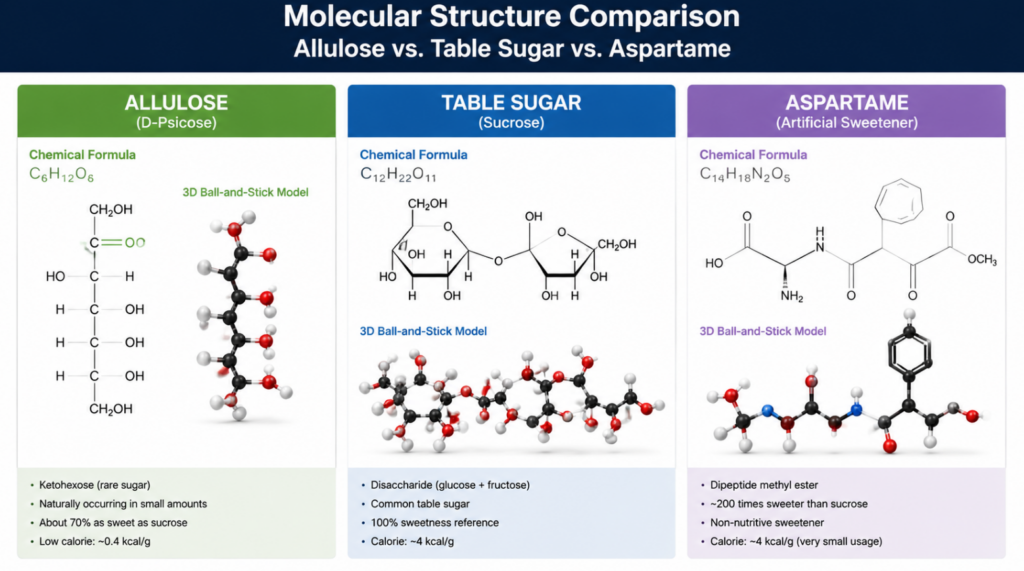
La alulosa es, tanto desde el punto de vista legal como biológico, un edulcorante natural; sin embargo, ocupa un lugar intermedio único en la tecnología alimentaria. A diferencia del aspartamo o la sucralosa, que son moléculas sintéticas creadas en un laboratorio, la alulosa es un monosacárido que se encuentra en la naturaleza (D-psicosa).
La mayor parte de la alulosa comercial se produce mediante un proceso denominado “conversión enzimática”. Los científicos utilizan enzimas para transformar la estructura de la fructosa (procedente normalmente del maíz) en alulosa. Esto la convierte en un producto «totalmente natural» según los criterios de la FDA, ya que la molécula final es idéntica a la que se encuentra en un higo.
Por qué la alulosa no es un “azúcar artificial”
Calificar la alulosa de “azúcar falso” es científicamente inexacto, ya que se comporta como un hidrato de carbono, no como un irritante químico. Los edulcorantes artificiales, como la sacarina, actúan sobreestimulando los receptores del sabor dulce, pero no aportan volumen. La alulosa, en cambio, proporciona el mismo volumen y el mismo grado de caramelización que el azúcar de caña, en una proporción de 1:1.
Cuando la gente pregunta si la alulosa es un edulcorante artificial, normalmente les preocupan las sustancias químicas tóxicas. La alulosa está reconocida como GRAS porque no se descompone en subproductos nocivos como el formaldehído o los compuestos de cloro, que son motivos de preocupación asociados a algunos edulcorantes sintéticos tradicionales.
| Criterios | Alulosa | Edulcorantes artificiales (aspartamo / sucralosa) | Alcoholes de azúcar (eritritol) |
|---|---|---|---|
| Fuente | Monosacárido poco común de origen natural | Edulcorantes sintéticos de alta intensidad | Alcohol de azúcar de origen natural producido comercialmente mediante fermentación |
| Tipo de dulzor | Edulcorante a granel con propiedades similares a las del azúcar | Edulcorante de alta intensidad; se necesita una cantidad muy pequeña | Edulcorante a granel con sensación refrescante |
| Calorías | ~0,4 kcal/g | Casi 0 kcal | ~0,2 kcal/g |
| Índice glucémico (IG) | ~0 | 0 | 0 |
| A granel y por volumen | Sustitución del azúcar en una proporción de 1:1 por volumen | No aporta volumen; requiere agentes espesantes en muchas formulaciones | Aporta volumen, pero tiene una densidad menor que el azúcar |
| Habilidad para dorar | Excelente (favorece la reacción de Maillard) | De mala calidad; no se dora como el azúcar | Rendimiento limitado en el dorado |
| Rendimiento en la cocción | Excelente para hornear, por su textura y su capacidad para retener la humedad | Limitada; aporta principalmente dulzor | Moderado; puede afectar a la textura y producir un efecto refrescante |
| Bienestar digestivo | En general, se tolera bien en las raciones habituales | En general, se tolera bien | En cantidades elevadas, puede provocar molestias digestivas en algunas personas. |
| Aplicaciones típicas | Panadería, bebidas, repostería, salsas | Bebidas light, edulcorantes de mesa, alimentos procesados | Caramelos sin azúcar, productos de panadería y pastelería, chicles |
| Beneficio funcional principal | Sabor y propiedades similares a las del azúcar, con un contenido calórico muy bajo | Gran dulzor con un mínimo de calorías | Edulcorante a granel bajo en calorías y con bajo impacto glucémico |
Por qué la alulosa supone un gran avance para las personas que siguen una dieta cetogénica y los diabéticos
La verdadera magia de la alulosa reside en su “efecto fantasma metabólico”: entra en el organismo, pero no deja rastro alguno en los niveles de insulina. Las investigaciones indican que alrededor del 70% de la alulosa consumida se absorbe en el intestino delgado, pero no se metaboliza. En su lugar, pasa al torrente sanguíneo y se excreta a través de la orina en un plazo de 24 horas.
Para quienes siguen una dieta cetogénica, esto es el “santo grial”. A diferencia del maltitol, que puede provocar un pico de insulina oculto, la alulosa tiene un índice glucémico de cero. Algunos estudios incluso sugieren que consumir alulosa junto con una comida puede reducir la respuesta glucémica de otros hidratos de carbono.
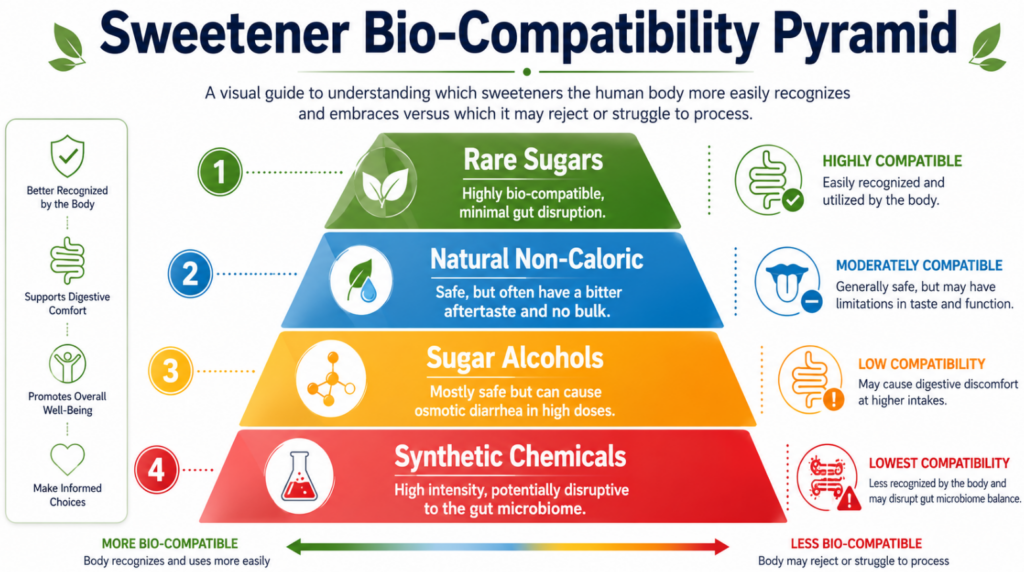
La pirámide de biocompatibilidad de los edulcorantes
He elaborado la “Pirámide de biocompatibilidad de los edulcorantes” para ayudar a mis clientes a comprender qué azúcares “reconoce” el cuerpo humano y cuáles “rechaza”. No todos los sustitutos del azúcar son iguales.
- Nivel 1: Azúcares poco comunes. Altamente biocompatibles, con un impacto mínimo en el tracto intestinal.
- Nivel 2: Naturales y sin calorías. Son seguros, pero suelen dejar un regusto amargo y no aportan volumen.
- Nivel 3: Alcoholes de azúcar. En general son seguros, pero en dosis elevadas pueden provocar diarrea osmótica.
- Nivel 4: Sustancias químicas sintéticas. De alta intensidad, pueden alterar la microbiota intestinal.
Evitar las mezclas de alulosa que provocan picos de insulina
El mayor error que cometen los consumidores preocupados por su salud es comprar “mezclas de alulosa” sin leer la letra pequeña. Para ahorrar costes, algunos fabricantes mezclan la alulosa con excipientes.
- La trampa de la maltodextrina: Si en la etiqueta pone “Alulosa”, pero el segundo ingrediente es la maltodextrina, devuélvelo a su sitio. La maltodextrina tiene un índice glucémico más alto que el azúcar blanco.
- La cuestión de la fibra de maíz soluble: Aunque suelen ser aptas para la dieta cetogénica, las fuentes de fibra de baja calidad pueden provocar la misma sensación de hinchazón que la gente intenta evitar al optar por la alulosa.
- La caja negra de los “aromas naturales”: Busca la indicación “Non-GMO Project Verified” para asegurarte de que el proceso enzimático utilizado para producir la alulosa no ha implicado el uso de organismos modificados genéticamente, si eso es una prioridad para ti.
Preguntas frecuentes
P: ¿La FDA considera la alulosa un edulcorante artificial?
R: No. La FDA clasifica la alulosa como un hidrato de carbono y un “azúcar poco común”. En 2019, la FDA tomó una decisión histórica al permitir que la alulosa se excluyera de las partidas “Azúcares totales” y “Azúcares añadidos” de las etiquetas de información nutricional, ya que no se metaboliza como el azúcar.
P: ¿Se considera la alulosa un “azúcar artificial”?
R: En términos culinarios, no. El término “azúcar artificial” suele referirse a sustancias sintéticas de alta intensidad, como la sucralosa. La alulosa es un azúcar “auténtico” en cuanto a su estructura química; simplemente, el cuerpo no la utiliza como fuente de energía.
P: ¿La alulosa es totalmente natural si se elabora a partir de maíz?
R: Sí, siempre y cuando el proceso utilice enzimas naturales para convertir el almidón de maíz y la fructosa en alulosa. Es similar a cómo se utilizan las enzimas para elaborar queso o pan.
P: ¿Puede la alulosa provocar problemas digestivos como el eritritol?
R: En general, no. La alulosa se absorbe en el intestino delgado, mientras que los alcoholes de azúcar, como el eritritol, suelen llegar al intestino grueso, donde fermentan y provocan gases. Sin embargo, consumir más de 50 g de una sola vez puede causar molestias leves en algunas personas.
P: ¿Es segura la alulosa para las personas con diabetes?
R: La alulosa es uno de los edulcorantes más recomendados para las personas con diabetes, ya que tiene un índice glucémico (IG) de cero y no afecta a la secreción de insulina.
Recomendaciones relacionadas
-

¿La dextrina resistente aumenta el azúcar en sangre?
442No, la dextrina resistente no aumenta el azúcar en sangre. Es una fibra no digerible con cero Gi, seguro para ceto y diabéticos.
Ver detalles -
¿Es la vitamina C lo mismo que el calcio?
595¿Es lo mismo la vitamina C que el calcio? Descubra sus principales diferencias y cómo colaboran para mejorar su salud.
Ver detalles -
¿Puede la maltodextrina ser ecológica?
305Descubra los beneficios de la maltodextrina ecológica, las fuentes no modificadas genéticamente y las normas para una verdadera dieta de etiquetado limpio.
Ver detalles -
¿Para qué se utiliza la polidextrosa?
319Descubra qué es la polidextrosa, por qué se utiliza en alimentos bajos en calorías, sus beneficios para la salud y consejos para un consumo seguro.
Ver detalles