
 SGNUTRI


Buscar producto
Is Maltodextrin Keto Friendly
My answer is: absolutely not.
For the pursuit of strict ketogenic people, this stuff is actually worse than ordinary white sugar. Its glycemic index (GI) is between 85 and 105, while the well-known white granulated sugar (sucrose) is only 65. This numerical difference means that it can cause extreme spikes in your blood sugar and insulin levels. Even if the intake does not seem to be much, it can instantly cut off the production of ketone bodies and directly kick you out of the hard-to-establish ketogenic metabolic state. Although it often appears in processed foods that are advertised as “sugar-free” or “low-carbon”, acting as a filler or thickener, it is essentially a metabolic disruptor that completely deviates from the core goals of the ketogenic diet—namely, maintaining blood sugar stability and continuous fat burning.
Impact Of Dismantling Maltodextrin On Blood Glucose
In simple terms, the GI measures how quickly carbohydrates enter the bloodstream and raise blood sugar.
If the benchmark of pure glucose is set to 100, maltodextrin can achieve amazing 105. When you compare it to white sugar, which has a GI of 65, you find that maltodextrin is more metabolically “aggressive”. Even 1 small bite of this stuff will produce a massive insulin surge in your pancreas like an alarm. For ketogenic people, this fluctuation in insulin levels is a clear physiological signal: ordering the body to stop burning fat and start storing energy instead. For ketogenic metabolism, this is basically equivalent to pressing the shutdown button.
Why Is It Worse Than Sugar In Ketogenic?
Although sugar and maltodextrin provide “empty calories”, the molecular structure of maltodextrin allows it to be absorbed almost instantaneously. It’s chemically a polysaccharide—and while it sounds like the kind of complex carbohydrate, it hydrolyzes in the body ridiculously fast, completely bypassing the digestive buffer process required for other complex carbohydrates.
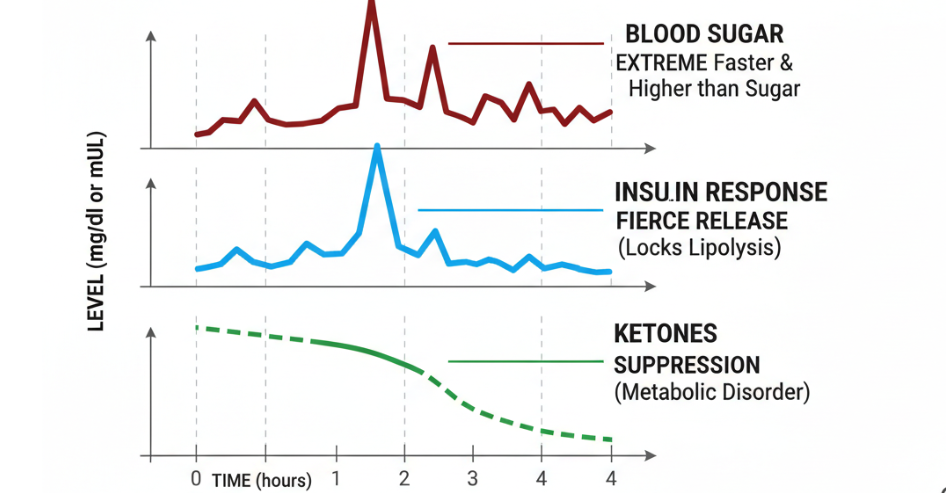
In the field of ketogenesis, we are pursuing “metabolic flexibility” and blood sugar level. And maltodextrin is completely “roller coaster” effect:
- Extreme blood sugar spike: The speed and altitude are far higher than white sugar.
- Fierce insulin response: High levels of insulin are the biological “lock switch” for lipolysis.
- Ketone suppression: Even if you control your total carbohydrate intake very low throughout the day, as long as the blood sugar peak caused by maltodextrin is high enough, your metabolic state may be in the next few hours. Will be in a state of disorder.
Maltodextrin In Processed Foods
The biggest headache for me is that consumers now have a hard time identifying it from products that are labeled “sugar-free,” “no added sugar,” or “ketogenic-friendly.” Food producers are very fond of maltodextrin, and they usually use it:
- Bulking agents: used to increase the volume of powdered sweeteners (such as certain sachets of stevia or luo han guo).
- Thickeners: Improve the taste of low-fat sauces, sauces and protein powders.
- Preservative: Extend the shelf life of processed snacks.
Because it is technically classified as “starch” rather than “sugar”, merchants can legally claim that a product is sugar-free when marketing, even if it contains this high GI ingredient. This is a metabolic trap that will quietly destroy your ketogenic plan.
Protect Your Ketogenic Status
To summarize, if your goal is to maintain a stable nutritional ketogenic and optimize fat burning efficiency, maltodextrin must be blacklisted. Its ability to cause blood sugar fluctuations is stronger than that of white sugar, and it is one of the most “anti-ketogenic” ingredients on the market.
Autor: Mark Thompson
“I am a nutrition researcher and metabolic health specialist dedicated to uncovering the science behind the ketogenic lifestyle. With years of experience analyzing food labels and their impact on glycemic response, I help keto dieters identify hidden metabolic disruptors like maltodextrin. “