
 SGNUTRI


Search Product
How Does The Production Process For Dextrose And Maltodextrin Differ
From a process point of view, the fundamental difference between the production process of glucose and maltodextrin lies in our control of the hydrolysis intensity (hydrolysis intensity) and which enzymes are used in combination.
Although both ingredients are derived from starch slurry and have to be initially liquefied by alpha-amylase, the process routes diverge after that. Maltodextrin takes the path of “limited hydrolysis”. The DE value (glucose equivalent) is controlled in the range of 5 to 19. We will immediately terminate the reaction forcibly in order to retain those complex long chains and then spray dry them directly.
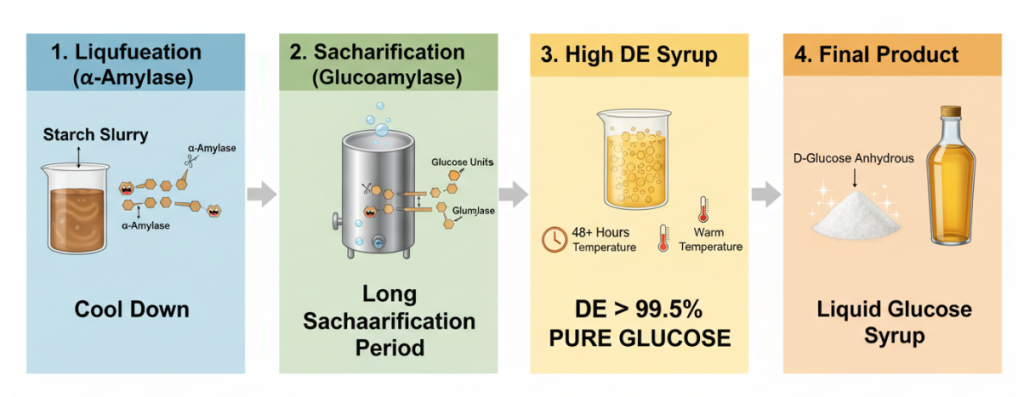
On the other hand, glucose must be “completely hydrolyzed”. After liquefaction, a second enzyme, glucoamylase, has to be introduced, and saccharification has to be carried out for 48 hours (or even longer) to completely break the chain into single molecule glucose until the DE value soars above 99.5. This is not the end, there is a set of tedious deep purification and time-consuming crystallization process, in order to get the final solid structure.
The following is the specific process of dismantling:
Starch Slurry And Preliminary Liquefaction
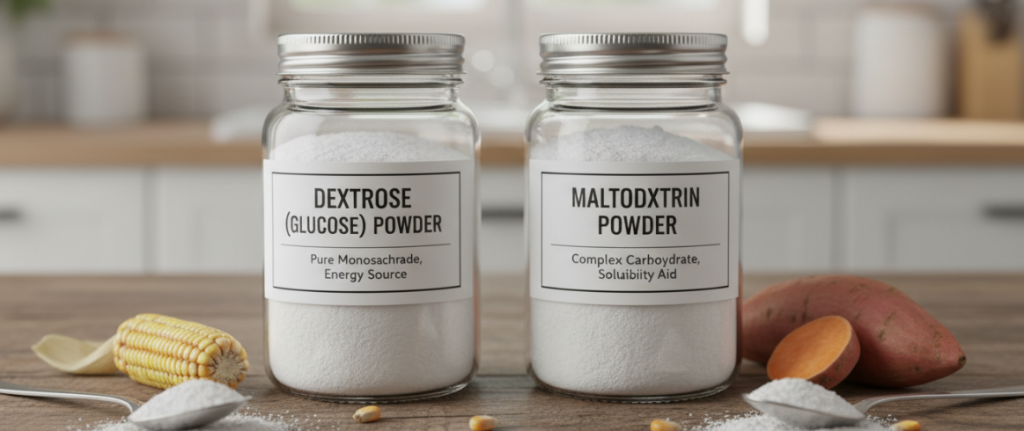
To find out where the two processes are different, we must first see where they are the same. In industrial recipes, whether you use corn, wheat, potatoes or tapioca, the starting point is the same: mix the raw starch with water and make starch milk. At this time, starch is still insoluble in water, and the molecular chain is as complicated as messy.
Whether it is glucose or maltodextrin, the first step is liquefaction. We add alpha-amylase to the jar while heating. This stuff is like scissors that randomly cut those long starch chains into shorter soluble fragments (I. e. dextrin). At this point, the chemical pathways of the two are completely coincident. But right after this initial interruption, our production strategy is about to diverge.
Maltodextrin Production
A central feature of maltodextrin production is limited hydrolysis. When designing formulas that maltodextrin is not for sweetness or monosaccharide molecules, we want its filling, body shape and viscosity.
- Monitoring the DE value: This step is important to keep an eye on. We want to control the degree of hydrolysis in a specific range, usually DE value between 5 and 19.
- Forced Termination: Once the starch has been broken up to just enough to dissolve, but still retains a significant multimeric structure, it must be stopped immediately. In the factory, we usually adjust the pH or direct high temperature to inactivate alpha-amylase to “brake”.
- Retain complex chains: Because of the early stop, the mixture is dominated by complex long-chain polysaccharides rather than simple sugars.
- Immediate spray drying: Since we want this kind of mixed long and short chain powder, we don’t need to make any crystallization and send it directly to spray drying. When the water evaporates quickly, those complex long chains are locked in our common white, well-flowing powder.
To the forefront of nutrition
Soluble Fiber
Soluble fiber is a highly stable, indigestible dietary ingredient that promotes weight control by increasing satiety and reducing food intake. Versatile in application, it is widely used to enhance the nutritional profile and texture of foods, beverages, and health products.
Soluble Fiber
Prebiotic
A prebiotic functions as a proliferation factor that is selectively degraded and utilized by beneficial intestinal bacteria, such as Bifidobacteria. This process exerts a positive effect on overall human health, often accompanied by metabolic advantages such as low caloric impact and minimal blood sugar fluctuations due to their unique digestive stability.
Prebiotic
Vitamins
Vitamins are essential organic micronutrients, categorized into water-soluble and fat-soluble forms, that regulate critical physiological processes such as metabolism, immunity, and coagulation. Due to their sensitivity to light, heat, and moisture,
Vitamins
Glucose Production
In contrast to the “point-to-point” approach of maltodextrin, the glucose production process is defined by complete hydrolysis. Our goal is clear: to completely convert starch into individual glucose units.
- Introduction of glucoamylase: after liquefaction with α-amylase, it cannot be stopped. This is the time to cool down, in order to welcome the appearance of the second key role: glucoamylase.
- Long saccharification period: Unlike the quick decision of maltodextrin, glucose production enters a huge “heat preservation” phase, that is, saccharification. This process is quite time-consuming, and bubbles are often in the reaction tank for more than 48 hours. During this time, the glucoamylase patiently snips glucose molecules one by one from the end of the starch chain.
- Sprint High DE: The reaction continues until almost all of the complex chains are broken, and the final syrup usually has a DE value of more than 99.5. This basically means that the mixture is already glucose of very high purity.
Purification And Crystallization
The last big hurdle of these two processes is the way the physical form ends. Spray the maltodextrin and you’re done, but the high-purity glucose solution has to go through harsh post-processing steps.
- Deep purification: High DE value syrup has to be filtered and ion exchange chromatography to remove trace impurities (such as protein or fat residues) that may hinder crystal growth.
- Crystallization: The purified liquid was concentrated and then glucose seed crystals were added. This goes into an extremely time-consuming crystallization process. The liquid slowly cools down over several days, and this controlled environment forces the glucose molecules to arrange themselves into a solid lattice structure (usually glucose monohydrate).
- Separation: Finally, the crystals and mother liquor are separated by centrifuge and dried before they are finished.
Summary Of Process Differences
| Feature | Maltodextrin Production | Dextrose Production |
| Hydrolysis Type | Restricted Hydrolysis | Complete Hydrolysis |
| Enzymes Used | α-Amylase only | α-Amylase + Glucoamylase |
| Target DE | 5 – 19 | > 99.5 |
| Reaction Time | Short (terminated early) | Long (48+ hours saccharification) |
| Final Step | Spray Drying | Crystallization |
| Molecular Structure | Complex Polysaccharide Chains | Single Glucose Molecules |
Author: Robert Vance
“I am a Senior Food Formulation Engineer with over 14 years of industrial experience specializing in starch hydrolysis and carbohydrate processing. My career focuses on optimizing enzymatic reaction pathways to create precise texture and sweetness profiles for global food manufacturers. I wrote this guide to clarify the technical nuances behind the production lines I manage every day.”