 SGNUTRI


Search Product
How Is Allulose Sweetener Made? True Process Revealed
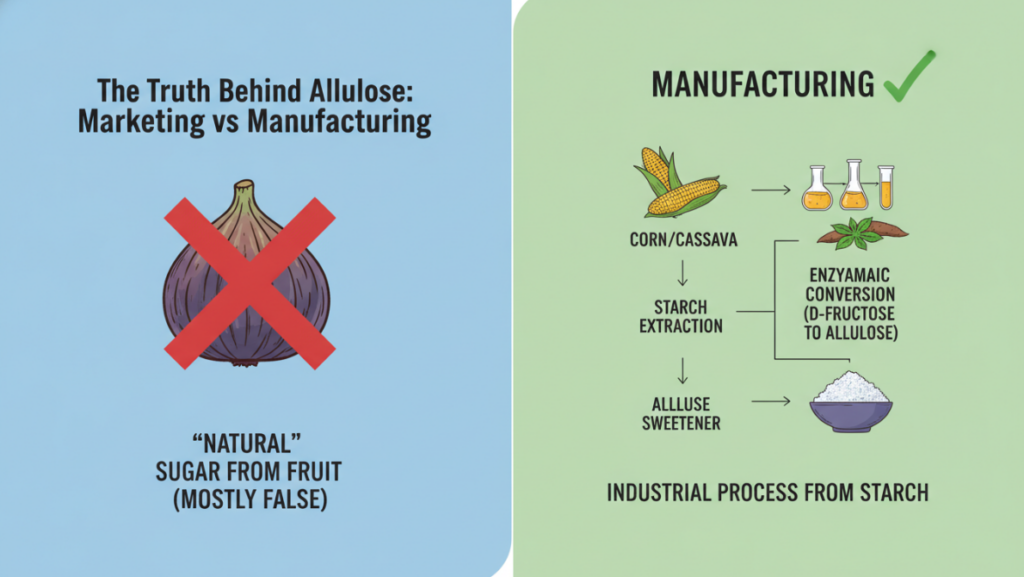
Commercial allulose on the market is actually made by extracting starch from crops such as corn or cassava, converting it into liquid fructose, and then adding specific biological enzymes (such as D-psicose-3-epimerase) to reorganize fructose molecules from a biological level. In order to create a 1 image of “pure nature”, many brands hype this zero-card substitute sugar “naturally exists in figs and raisins”. But in fact, what you eat in your mouth is not a fruit extract at all, but an outright bio-made product. We ‘ve tracked the global supply chain-from farmland to commercial bioreactors-to uncover the real engineering behind the white powder in your storage room.
Three Stages Of Biotransformation
To figure out how allulose is made, it is necessary to tear off the marketing label on the front of the package and delve into the essence of food science. Producers rely on an operational framework called “three-stage biotransformation. This method can not only ensure mass production, but also does not require the use of pungent chemical solvents.
Stage 1: extraction of raw materials and carbohydrate liquefaction
Each batch of commercial allulose is initially in the form of unprocessed plant starch. Manufacturers can’t really extract this sugar substitute from fruit, because the content of natural fruit is less than 0.001 percent, which is not economically feasible. Instead, food engineers have set their sights on large-scale crops-mainly yellow corn in the United States and cassava (the raw material for pearl flour balls) in Asia.
Workers first process the crops through a grinding system that separates the pure starch from the fiber and protein. Next, the plant performs a hydrolysis process: by heating and adding basic amylase, the long chain of complex carbohydrates is broken up and turned into simple liquid fructose. This high fructose syrup is the bottom raw material of the core of the whole production line.
Corn-Derived vs. Cassava-Derived Allulose Base
| Comparison Metric | Corn-Derived Allulose Base | Cassava-Derived Allulose Base |
| Allergen Risk | Low to Moderate: While pure allulose lacks protein, corn is a known allergen/sensitivity for some. Not suitable for grain-free diets. | Very Low (Hypoallergenic): Cassava is naturally grain-free, gluten-free, and highly suitable for allergy-friendly, Paleo, and AIP diets. |
| GMO Status | High GMO Risk: A large majority of conventional corn is genetically modified. Requires strict “Non-GMO Project Verified” certification to ensure it is GMO-free. | Naturally Non-GMO: Cassava is generally not genetically modified in the global commercial supply chain, making Non-GMO status much easier to guarantee. |
| Environmental Impact | Higher Footprint: Corn cultivation typically requires significant water, synthetic fertilizers, and pesticides, often contributing to soil depletion (monocropping). | Lower Footprint: Cassava is highly drought-tolerant, thrives in marginal/poor soils, and requires far fewer fertilizers and water inputs. |
| Average Market Cost | Lower (Economical): Subsidized agriculture and massive global processing infrastructure make corn-derived allulose cheaper to produce. | Slightly Higher (Premium): Smaller scale processing and its positioning as a “clean-label/grain-free” ingredient generally command a premium price. |
Stage 2: Enzymatic epimerization (core reaction)
The most amazing step in allulose production takes place in huge stainless steel fermenters, a process known as “enzymatic epimerization”. Liquid fructose is pumped into the reactor, which contains a highly specialized biocatalyst-usually D-tagatose-3-epimerase or D-psicose-3-epimerase.
These enzymes are like a pair of microscopic “biological scissors”. Instead of adding synthetic chemicals to the mixture, they “flip” the molecular structure precisely at the third carbon atom of fructose. It is this exquisite 1 that turns the originally extremely high-calorie carbohydrates into D-psicose that your body cannot absorb and metabolize at all. This reaction usually lasts for 24 to 48 hours until as much fructose as possible has been successfully converted.
Stage 3: Chromatographic separation and crystallization
The separation process directly determines the safety and dietary reliability of the final product. You know, it is impossible to convert 100% of fructose by enzymatic reaction. The usual conversion rate is about 25% to 30%, and the rest is fructose that has not changed. To extract the pure product, engineers inject this mixed syrup into a huge simulated moving bed (SMB) column.
These resin-filled separation columns will “intercept” the allulose molecules while allowing the unconverted fructose to flow away. After the high-purity liquid allulose is separated, it is then sent to a vacuum chamber for evaporation to remove excess water. As the liquid cools rapidly, the syrup crystallizes and ends up in bags of grainy white powdered sugar that you buy.
Purity Trap: How Does Allulose Guarantee Ketogenic Friendliness
How detailed the purification process is directly determines whether this sugar substitute will make your blood sugar soar. Some low-end production plants in order to reduce costs, in the chromatographic separation stage hastily. We have tested several commercial samples on the market and found that up to 4% of fructose remains in the so-called “pure” allulose powder of cheap brands.
People who strictly follow the ketogenic diet will experience unexpected fluctuations in blood sugar if they eat this inferior product. In order to solve this problem, high-end manufacturers will use multiple filtration technology at any cost to increase the purity to 99.8 percent. Therefore, as a consumer, you must ask the brand for an inspection report (COA) to confirm that the fructose residue in the final product is at an undetected level.
Production Iteration: Farewell To Genetically Modified Corn
At present, the production pattern of allulose is undergoing a 1 reshuffle on raw material procurement. For many years, industry practice has been to use genetically modified (GMO) corn from the Midwest to produce basic fructose. But as consumers increasingly clamor for “clean labels,” the industry is being forced to transform.
Today, the latest production plants are using non-GMO tapioca starch from Southeast Asia. Not only that, but top suppliers are introducing “cell-free biocatalysis” technology. This technique completely isolates the enzyme from the host bacteria before it is placed in the fructose. This not only eliminates the risk of residual bacterial microorganisms in the final product, but also ensures the ultimate purity and stability of the sugar substitute.
Frequently Asked Questions (FAQ)
Q1: Is allulose made with chemical solvents?
Absolutely not. Commercial psicose on the market is completely independent of chemical solvents in the core conversion stage. Its conversion is purely dependent on the action of biological enzymes on liquid fructose. In the extraction and crystallization stages, the only solvent used is water.
Q2: How can it be both sugar and no calories?
The manufacturing process changes the molecular orientation of the carbohydrates. This particular enzyme reaction creates 1 new structural shapes that the body’s digestive enzymes can’t bind. After eating, about 70% of allulose will be directly excreted through the urine, the body can not absorb the energy.
Q3: Will corn be used in the production of allulose?
will be used. Traditional allulose is made of fructose from corn starch. If you are severely allergic to corn, or want to resolutely avoid genetically modified foods, you must look for products that are clearly marked “Cassava-derived (Tapioca-derived/Cassava-derived)” when buying.
Q4: Do they really use figs or raisins to make allulose?
Not at all. Extracting allulose directly from figs is a commercial joke because the amount in the fruit is so small. The figs painted on the packaging 1 purely a marketing gimmick, just to explain to you that “this substance exists in nature.
Q5: Are the “enzymes” used in the production process safe?
The United States Food and Drug Administration (FDA) classifies certain epimerase enzymes used in production as GRAS (generally recognized as safe). More importantly, the enzymes are physically filtered clean in the final purification step. There is no biological residue in the crystalline powder you eat into your mouth.
Q6: Why does allulose sell so much more expensive than erythritol?
Because enzymatic epimerization and complex chromatographic separation not only require extremely expensive professional bioreactors, but also have very low extraction rates. Compared to the direct fermentation of glucose to erythritol, the production of allulose takes twice as much time, energy and engineering regulatory costs.
Related recommendations
-

Is Maltodextrin Dairy Free
1321Learn Why Maltodextrin Is Always Dairy-Free, Plant-Based, And Safe For Milk Allergies Or Lactose Intolerance.
View details -
Allulose Is What? The Safest Natural Keto Alternative
1129Allulose Is What? Discover The Safest Natural Keto Alternative. Control Blood Sugar And Avoid Hidden Gut Traps.
View details -
Allulose and GLP 1: The Sweet Secret to Weight Loss
1013Discover How Allulose And GLP 1 Drive Weight Loss. Master The L-Cell Protocol And Pre-Load Strategy For Natural Satiety.
View details -
What Is Dextrose Anhydrous Used For
1277Discover The 3 Main Uses Of Dextrose Anhydrous: Medical IVs, Sports Recovery, And Food Manufacturing.
View details