 SGNUTRI



Search Product
How Is Fructooligosaccharide Produced?
Fructooligosaccharides (FOS) have two common production routes. The sucrase method connects fructose units to sugar chains one by one, while inulin hydrolysis shortens the existing long chains. Both routes can produce fructooligosaccharides, but even if the total FOS content of the finished product is the same, the length of the sugar chain, whether it has glucose at the end, and the residual monosaccharides and disaccharides may differ. When looking at the specification sheet, one question each answers regarding the raw material route, sugar profile, and dry basis content. Study on enzymatic sucrose conversion · Study on inulin hydrolysis products
How to make sugar links long using the sucrase method
An enzyme with transfructosyl activity removes a fructose unit from one molecule of sucrose and attaches it to another molecule of sucrose to produce 1-sucrose trisaccharide (GF₂). Enzymes can also continue to attach fructose units to the generated fructooligosaccharides to form components such as GF₃ and GF₄. Here G represents one glucose unit, and the number after F represents the number of fructose units, so GF₂ has a total of three sugar units and a degree of polymerization (DP) of 3. Study on enzymatic sucrose conversion
For every fructose unit transferred, sucrose, as a donor, releases one glucose molecule. The reaction solution may also contain unreacted sucrose and free fructose produced during enzymatic hydrolysis. At the end of the reaction, a mixed sugar solution containing FOS was obtained. When making high-content grades, in addition to converting more sucrose into the target sugar chain, it is also necessary to process the small molecules of sugar left in the reaction solution. Sucrose conversion and syrup composition study
How to cut long chains into short pieces by inulin hydrolysis
When inulin is used as raw material, endonuclease cuts the bonds between fructose units inside the long chain, thus turning a long chain into multiple short chains. The fragment that retains the glucose end of the original chain belongs to the GFn type, while the fragment cut from inside the chain can be composed only of fructose and belongs to the Fn type. A team from the University of Liège isolated F₂, F₃, and F₄ in an artichoke inulin hydrolysis experiment and confirmed these components using chromatography and mass spectrometry. Isolation and identification of inulin hydrolysis products
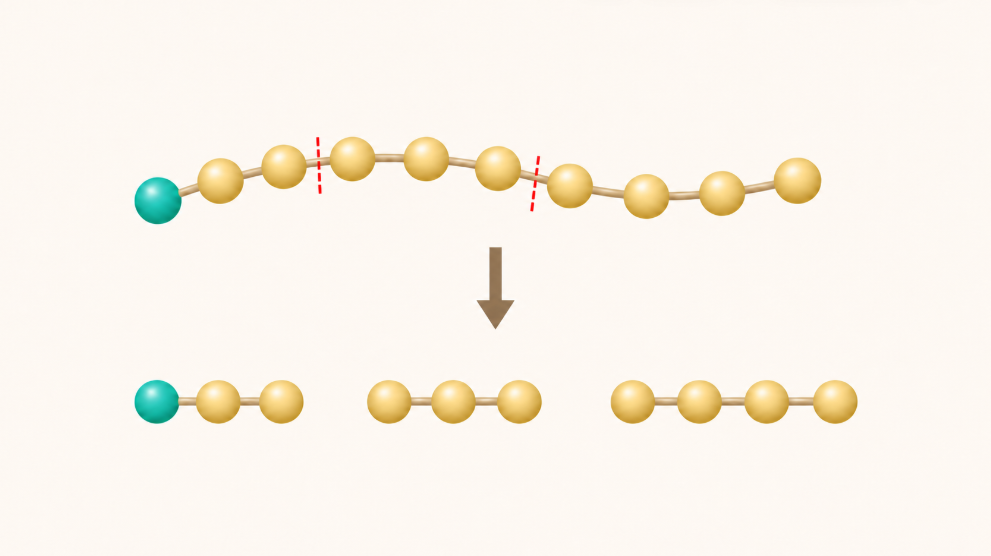
This distinction is intuitive when looking at the sugar spectrum. Both F₃ and GF₂ have a degree of polymerization of 3. The former consists of three fructose units, while the latter contains one glucose unit and two fructose units. If the formulation needs to reproduce the sugar chain composition of a certain raw material, in addition to verifying the total FOS and degree of polymerization range, it is also necessary to see whether the inspection method can distinguish between Fn and GFn, and which components are included in the total FOS in the specification table. Chromatographic identification of both FOS types
Purify residual sugar and concentrate to increase FOS content per kilogram of syrup
Purification utilizes the differences in the behavior of different sugars in the separation medium to separate a portion of glucose, fructose, and sucrose from the mixed sugar solution. Separation may also remove some of the target oligosaccharides. An activated carbon separation test increased the mass proportion of FOS in the tested sugars from approximately 53% to 89%, while recovering approximately 81% of the feed FOS. The first number indicates how pure the collected sugar components are, and the second number indicates how much FOS was originally left in the collection solution. Activated-carbon purification study
Concentration processes water. If only water is removed, the solid content of the syrup will increase, the FOS content per kilogram of syrup will also increase, and the FOS as a percentage of dry matter will remain at the original value. The specification sheet will therefore list both the dry-based total FOS content and the dry matter content or moisture content. Combining the two numbers can be used to calculate how much FOS is actually brought in by the feed. SGNUTRI fructooligosaccharide specifications
How much FOS does each of 55% syrup and 95% powder contain per 100 grams?
Taking SGNUTRI’s publicly available specifications as an example, the dry-based total FOS content of 55% syrup is at least 55%, and the dry matter content is at least 75%. Based on the two lower limits, 100 grams of syrup contains at least 41.25 grams of FOS (100 × 0.75 × 0.55). The dry-based total FOS content of 95% powder is at least 95%, and the moisture content is at most 5%. Based on the upper limit of moisture content and the lower limit of dry basis content, 100 grams of powder contains at least 90.25 grams of FOS (100 × 0.95 × 0.95). SGNUTRI 55% syrup specification · SGNUTRI 95% powder specification
When making formula replacements, the feed amount is converted from the dry-based FOS and dry matter measured values on the batch inspection report (COA), and then the moisture and residual sugar introduced by the two raw materials are verified separately. This way, even if the FOS input in the formula is the same, it can be seen how much formula water needs to be adjusted after the change of ingredients, and whether the residual sugar index is still within the target range.
Related recommendations
-

Is Maltitol Syrup Gluten Free? A Comprehensive Guide
2923Maltitol Syrup Is A Gluten-Free Sweetener Used In Sugar-Free Foods. Learn What It Is And Why Sgnutri Recommends It.
View details -
Prebiotic vs Probiotic: A Comprehensive Guide to Gut Health, Efficacy, and Modern Trends
1732Probiotics Are Living, Beneficial Bacteria That Inhabit The Gut, And Prebiotics Are The High-Fiber "Food" That Feeds These Bacteria ". If You Think Of Your Gut As A Garden, Probiotics Are The Seeds You Sow, While Prebiotics Are The Fertilizer That...
View details -
Waxy Maize Vs Maltodextrin: Which Builds More Muscle?
2255Waxy Maize Or Maltodextrin? Find Out Which Carb Boosts Recovery Faster And Avoids Bloating.
View details -
What’s The Difference Between Dietary Fiber And Soluble Fiber
1938Learn The Difference Between Dietary Fiber And Soluble Fiber, How They Work, And Their Unique Health Benefits.
View details