 SGNUTRI


Search Product
Is Allulose a 1 to 1 Substitute for Sugar? The Truth
Can allulose really serve as a perfect 1:1 substitute for white sugar? The truth is far from simple.
Do you want to simply substitute allulose for granulated sugar at a 1:1 ratio when baking, hoping the finished desserts will retain their exact same texture, appearance, and sweetness? That’s hardly realistic. Allulose has only 70% of the sweetness of table sugar, browns very quickly in the oven, and is exceptionally effective at locking in moisture. Before I finally figured out the correct conversion formula, I accidentally burned over 40 batches of keto brownies. To achieve a perfect result, the key lies in adjusting the temperature and the liquid-to‑powder ratio—don’t just blindly pour in the same amount of sugar substitute.
Simply Put: They Cannot Be Fully Interchanged.
Don’t take it for granted that allulose can substitute sugar on a 1:1 basis—doing so will only ruin your recipe. Replacing one cup of white sugar with one cup of allulose will result in desserts that are about 30% less sweet. To compensate for the lack of sweetness, you’ve increased the sugar to 1.3 cups? That, in turn, introduces too much dry matter and moisture, causing the cake to collapse outright. When making this kind of substitution, it is essential to consider “sweetness” and “volume” separately.
Sarah Jenkins, a chef who specializes in low-carb recipes, puts it this way: “If you simply replicate the methods used with white sugar, your cookies will inevitably turn into burnt, soggy dough. My usual approach is to lower the oven temperature and then add a bit of monk fruit sweetener to make up for the reduced sweetness.”
The “SMB” Conversion Rule: How Exactly Should It Be Calculated?
To successfully reformulate traditional recipes, you need to master the SMB triangle: Sweetness, Moisture, and Browning. Every time I want to use allulose instead of white sugar, I have to make minor adjustments to the recipe from these three aspects.
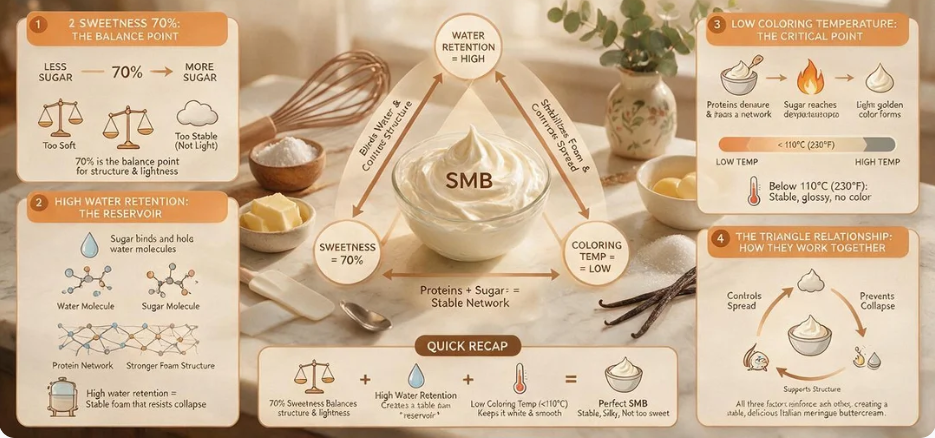
Sweetness (s):1.3 to 1 principle
The sweetness of allulose is exactly 70% of that of ordinary white sugar. To achieve the same sweetness, 1 cup of white sugar has to be replaced by 1.3 cups of allulose. However, if it is baking with a large amount of sugar, relying solely on psicose will lead to excessive consumption of sugar substitutes. The smart way is to mix it with pure stevia sugar or Luo Han Guo extract, which will not only bring the sweetness back to the true 1:1, but also will not destroy the dry and wet ratio of the original formula.
Moisture (M): Beware of “wet bottom” traps
Pastries baked purely with allulose will be very soft and moist after a few days, because it has a much stronger ability to grab water molecules than sucrose. If you use allulose all the time, crisp cookies or brittles will never bake hard. To prevent the cake from becoming wet and firm, you usually need to reduce the amount of liquid in the recipe by about 10%.
Color (B): 25 degrees Fahrenheit (about 15 degrees Celsius)
Allulose caramelized or even burnt at a lower temperature than regular sugar. Once at the conventional baking temperature of 350 °F(175°C), its Maillard reaction is like an accelerator. You have to lower the oven temperature by 25 degrees Fahrenheit (about 15 degrees Celsius) and increase the baking time by 5 to 10 minutes. In order to prevent bitter blackening of the skin, it is best to cover the cake with a layer of tin foil when it is half baked.
Can Any Recipe Use Allulose Instead Of Sugar?
Whether the replacement works well or not depends entirely on what you want to do. Recipes with high liquid content are stress-free to replace, but recipes that require a dry, crispy taste tend to roll over.
Ice cream and caramel (perfect 1:1 application scenario)
When making ketogenic ice cream and homemade syrup, you can directly replace white sugar with allulose in a 1:1 volume. Like real sugar, it lowers the freezing point of a liquid. Homemade ice cream made with erythritol will be as hard as a brick after being frozen, but allulose will keep the ice cream in a perfect digging feel and prevent the caramel sauce from crystallizing.
Bake cakes and cookies (needs adjustment)
If you want to bake a cake with allulose, you must mix it with Luo Han Guo sugar and cool it down. Cookies are even more difficult because white sugar provides a structural “crunchy” sensation when cooled to crystallize, while allulose does not crystallize at all when cooled. If you only use allulose, baked chocolate bean cookies will always be as soft as cake. Mix allulose and erythritol in half (50/50 ratio) to help you get back the crispy edge of your biscuit.
Lab Data: Sucrose Vs Allulose Baking Comparison Results
Our test kitchen baked 3 identical vanilla sponge cakes to observe the difference between volume substitution and sweetness substitution under the control variables.
| Application Scenario | Application Status | Substitution Rule | Effects & Observations | Required Adjustments & Solutions |
| Ice Cream & Caramel (Homemade Syrup) | Perfect 1:1 Scenario | 1:1 Volume (Allulose replacing White Sugar) | • Lowers the freezing point of liquids like real sugar• Keeps ice cream perfectly scoopable (erythritol makes it hard as a brick).• Prevents caramel sauce from crystallizing. | None needed. |
| Baking Cakes | Needs Adjustment | Requires Mixing | (Lab Data): 3 identical vanilla sponge cakes were baked under controlled variables to observe the differences between volume substitution and sweetness substitution. | Must mix allulose with Monk Fruit (Luo Han Guo) sweetener and allow it to cool down. |
| Baking Cookies | Needs Adjustment | 50/50 Ratio (Allulose & Erythritol) | • White sugar crystallizes when cooled, providing a “crunchy” structure.• Allulose does not crystallize upon cooling, making baked chocolate chip cookies permanently soft like cake. | Mix allulose and erythritol in a half-and-half (50/50) ratio to restore the crispy edges of the cookies. |
FAQ
Can allulose be measured by cup equivalents like white sugar?
Cannot. 1 cup of allulose is about the same weight as a cup of white sugar, but its sweetness is only 70%. You need 1 and 1/3 cups of allulose to catch the sweet taste of a cup of white sugar.
Can I mix allulose and erythritol for baking?
Yes. Mixing them together in a 1:1 ratio is a great combination for ketogenic baking. Allulose is responsible for water retention and coloring, and erythritol is responsible for the sweetness, which, incidentally, makes the edges of the biscuit crisp by virtue of its crystalline properties.
Why is my cake baked with allulose burnt?
Allulose caramelates quickly, so the color is much more fierce than regular sugar. You have to lower the oven temperature by at least 25 degrees Fahrenheit (about 15 degrees Celsius), or the crust will burn before it is cooked inside.
Does allulose harden after cooling?
No, it won’t. Unlike white sugar or erythritol, it does not crystallize after cooling. So it doesn’t make hard candy at all, but it’s perfect for soft caramel, marshmallow and ice cream.
Can I use allulose instead of brown sugar?
Yes, but you’ll have to add a little extra molasses or ketogenic-friendly maple sugar extract. Although allulose can provide the humidity similar to brown sugar, it does not have that rich and deep flavor of its own.
How much allulose does it take to replace 1 cup of white sugar?
To maintain the same sweetness, you need 1.3 cups (or 1 cup plus 1/3 cup) of allulose. If you only care about its weight and texture, 1 cup is fine, but the food will taste obviously less sweet.
Related recommendations
-

Is Allulose Natural
1051Confused About Allulose? Discover How This Rare Sugar Mimics Natural Sweetness Without Spiking Your Blood Sugar Or Insulin.
View details -
Can Maltodextrin Be Organic
1093Discover Organic Maltodextrin Benefits, Non-GMO Sources, And Standards For A True Clean Label Diet.
View details -
Erythritol
2560Erythritol Supplier Whole Earth, Perfect For Use In Low-Sugar Food And Beverages By Premium Erythritol Brand-Sgnutri
View details -
How To Take Prebiotics With Probiotics
1446Learn How To Take Prebiotics With Probiotics. Take Them Together 15-30 Mins Before Breakfast For Max Gut Health Results.
View details