
 SGNUTRI


Search Product
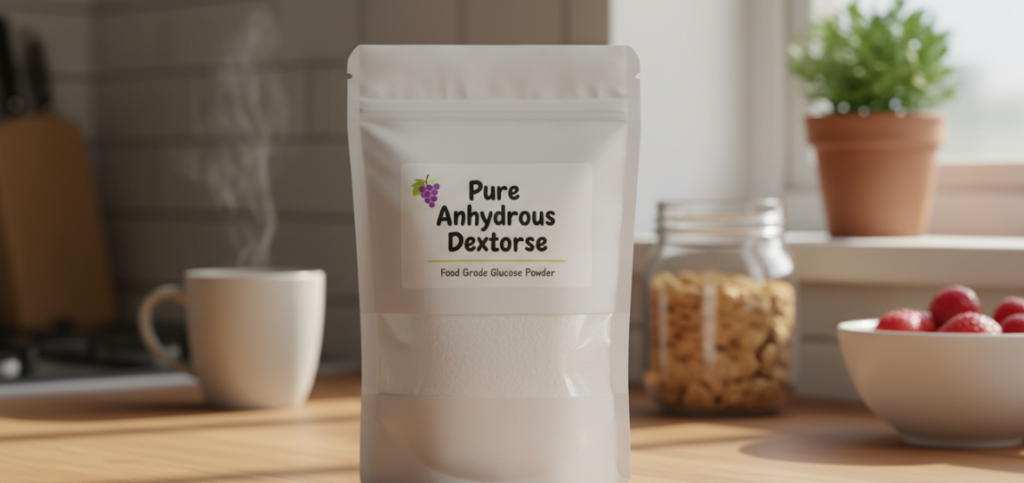
Is Dextrose Anhydrous Sugar
Yes, anhydrous glucose is sugar.
When it is disassembled, it is actually 100% pure D-glucose extracted from corn starch, but after a special processing technology, the water molecules inside are completely removed.
If you’re a health-conscious consumer, a diabetic, or are on a keto diet, I have to emphasize one thing—it’s definitely not an artificial sugar substitute, nor is it the kind of complex carbohydrates that your body needs to digest slowly. From a biological point of view, it is the purest monosaccharide. Its glycemic index (GI) is 100.
This means that it enters the bloodstream very quickly, faster than the white granulated sugar (sucrose) that we commonly use at home to stimulate insulin secretion. So, if you’re monitoring blood sugar or calculating net carbs, my advice is very straightforward: see the words “anhydrous glucose” and think of it as eating white sugar. Every 1 gram of it can provide standard calories, and will immediately change your metabolic state.
What Does “No Water” Mean?
To answer the question of whether it is sugar, we have to go back and look at its chemical structure.
It’s 100 percent pure D-glucose. The so-called “no water”, in fact, is the literal meaning—no water. The crystal structure of many sugars is actually wrapped in water molecules, but anhydrous glucose takes all of this water out of the process. As a result, you get 1 highly concentrated, highly effective glucose powder.
Here’s a key point: because it’s chemically identical to the glucose that flows in your blood, your body doesn’t have to bother to break it down. Unlike those complex carbohydrates like whole wheat bread that take time to digest, anhydrous glucose can be used by the body as soon as it enters the stomach.
Why Is The GI Value 100 So Critical?
This is a hard indicator that directly distinguishes anhydrous glucose from other sweeteners.
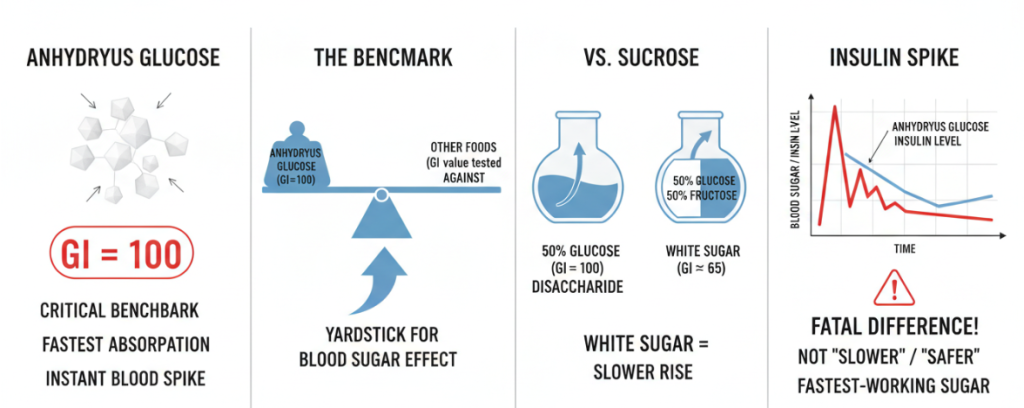
As a benchmark: Because GI is 100, it is usually used as a yardstick when testing the effects of other foods on blood sugar.
Contrast sucrose: White sugar we usually eat is disaccharide (50% glucose + 50% fructose), GI value is usually around 65.
Insulin spike: Anhydrous glucose has a full GI score, which causes it to trigger a much sharper insulin spike than white sugar.
This fast absorption property means that it completely skips the normal digestive delay and enters the blood instantly. For those who want to control the insulin spike, this difference is fatal: Anhydrous glucose is not the “slower” or “safer” sugar, on the contrary, it is the fastest-working sugar that can be found.
To the forefront of nutrition
Soluble Fiber
Soluble fiber is a highly stable, indigestible dietary ingredient that promotes weight control by increasing satiety and reducing food intake. Versatile in application, it is widely used to enhance the nutritional profile and texture of foods, beverages, and health products.
Soluble Fiber
Prebiotic
A prebiotic functions as a proliferation factor that is selectively degraded and utilized by beneficial intestinal bacteria, such as Bifidobacteria. This process exerts a positive effect on overall human health, often accompanied by metabolic advantages such as low caloric impact and minimal blood sugar fluctuations due to their unique digestive stability.
Prebiotic
Vitamins
Vitamins are essential organic micronutrients, categorized into water-soluble and fat-soluble forms, that regulate critical physiological processes such as metabolism, immunity, and coagulation. Due to their sensitivity to light, heat, and moisture,
Vitamins
The “Minefield” Of Diabetics And Ketogenic Dieters
Since it is clear that it is not a sugar substitute and has a huge metabolic impact, the specific group of people will have to be energetic.
For People With Diabetes:
Because anhydrous glucose is a monosaccharide that directly increases insulin, if you eat it without knowing it, you will face the direct risk of hyperglycemia. However, everything has two sides. In some extreme cases—such as severe hypoglycemia caused by overdose—it has become a “blood return” artifact for first aid because of its rapid absorption. But in addition to this emergency medical scenario, in the daily diet, it must be strictly counted as sugar intake.
For The Ketogenic Diet:
Anhydrous glucose is a pure carbohydrate. When you eat it, insulin, and the body’s fat-burning pattern (ketosis) is immediately interrupted. Don’t think of it as the kind of dietary fiber or sugar alcohol that doesn’t count carbohydrates, it’s pure fuel, and eating it will kick you out of ketones.
Caloric Density And Nutrition Truth
Finally, don’t be misled about the heat, even if its name sounds scientific and technological.
Although the original text mentions different caloric values (which is also a lot of information is easy to confuse), we deal with it according to common sense: the caloric density of anhydrous glucose is basically the same as any standard carbohydrate or sugar (usually about 4 calories per gram). It provides energy, but it’s all “empty calories”—no vitamins, no fiber, no protein.
Therefore, whether your goal is to lose weight, maintain metabolic health, or simply want to eat less sugar, when you see Dextrose Anhydrous in the ingredient list, there is only one way to deal with it: treat it as a spoonful of pure sugar. There is no doubt that this is the kind of high-energy monosaccharide.
Author: Mark Bennett
“I am a metabolic health researcher and certified nutritionist. My work focuses on helping readers decode complex food labels to manage blood sugar levels and optimize their ketogenic lifestyles. I believe in total transparency when it comes to what we put in our bodies.”