
 SGNUTRI


Search Product
What Is Glucose Syrup Made Of
Simply put, glucose syrup is a concentrated liquid sweetener obtained by breaking down starch molecules in various plants through a chemical process called “hydrolysis.”
If you stay in the laboratory and on the production line for a long time, you will find that although we habitually think of it as corn in the United States, its sources are actually very diverse worldwide. Wheat, potatoes, cassava (tapioca), and even rice are common ingredients, depending on the resources of the producer.
For those who are very sensitive to allergens, I would like to make a special point: even if the syrup is extracted from wheat, after that intensive refining process, the gluten protein (gluten) will be almost completely eliminated, and the content is usually much lower than 20ppm. This means that most commercially produced glucose syrups fully meet the definition of “gluten-free” according to the standards of the FDA (US Food and Drug Administration) and EFSA (European Food Safety Authority).
In addition, it is fundamentally different from high fructose corn syrup (HFCS). Standard glucose syrup is mainly composed of glucose and high-grade sugars and does not contain the high concentration of fructose linked to metabolic health problems.
Core Ingredients Of Glucose Syrup
To understand the composition of glucose syrup, we have to look at its plant source. Although the finished product is a transparent and viscous liquid, its predecessor is complex carbohydrates stored in plants.
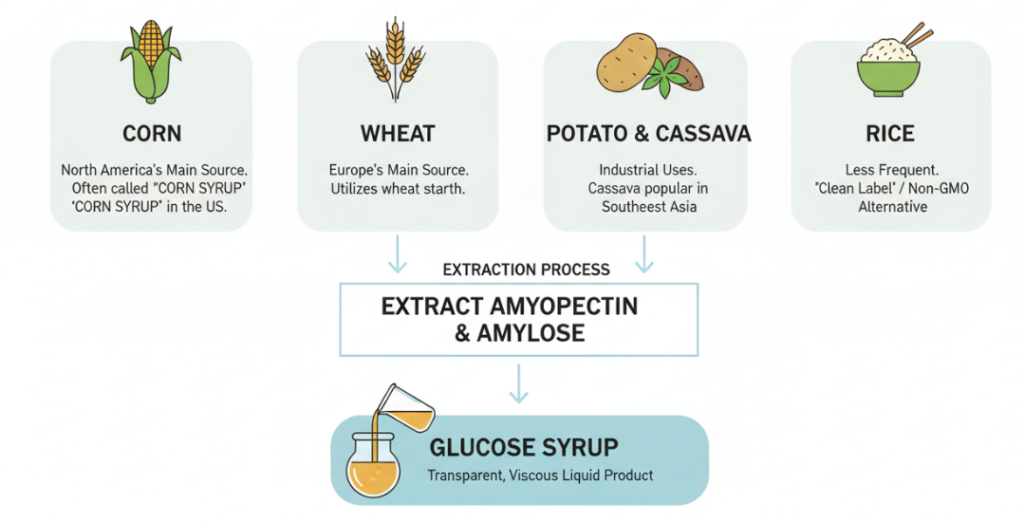
- Corn: North America’s most mainstream source. Because of the huge corn production in the United States, the words “corn syrup” and “glucose syrup” are often mixed here.
- Wheat: The main source of glucose syrup in Europe. As wheat is the main crop in the EU, local manufacturers naturally choose wheat starch as a substrate.
- Potatoes and cassava: Commonly used in specific industrial applications. According to my observations, glucose syrup of cassava origin is particularly popular in the Southeast Asian market.
- Rice: Although used less frequently, it is a good alternative in foods that pursue “clean label” or non-GMO.
No matter what kind of plant we choose, our goal is to extract the amylopectin and amylose in it, so as to start the next transformation process.
To the forefront of nutrition
Soluble Fiber
Soluble fiber is a highly stable, indigestible dietary ingredient that promotes weight control by increasing satiety and reducing food intake. Versatile in application, it is widely used to enhance the nutritional profile and texture of foods, beverages, and health products.
Soluble Fiber
Prebiotic
A prebiotic functions as a proliferation factor that is selectively degraded and utilized by beneficial intestinal bacteria, such as Bifidobacteria. This process exerts a positive effect on overall human health, often accompanied by metabolic advantages such as low caloric impact and minimal blood sugar fluctuations due to their unique digestive stability.
Prebiotic
Vitamins
Vitamins are essential organic micronutrients, categorized into water-soluble and fat-soluble forms, that regulate critical physiological processes such as metabolism, immunity, and coagulation. Due to their sensitivity to light, heat, and moisture,
Vitamins
Production Process
The transition from solid starch to liquid syrup relies mainly on the scientific process of “hydrolysis”:
- Starch extraction: the first corn or wheat and other raw materials are ground, the starch from fiber, protein, and oil separation.
- Enzymatic or acid hydrolysis: The starch is mixed with water and heated. We add enzymes (usually alpha-amylase) or food-grade acids to “unlock” long-chain glucose molecules.
- Refining and concentration: When the starch is broken down into shorter sugar chains, the liquid is filtered, decolorized, and evaporated until the desired concentration is reached.
In this process, we will determine the “DE value” (Dextrose Equivalent, dextrose equivalent) of the syrup. This value directly determines the sweetness and viscosity of the syrup and is the core index to measure the quality.
Is Wheat-Source Glucose Syrup Safe?
The production of glucose syrup involves extremely delicate refining steps. During this process, gluten proteins are physically separated and filtered out. Rigorous test data consistently show that the gluten content in commercial wheat glucose syrup is well below the 20ppm threshold. This fully complies with international safety standards, so in most jurisdictions, it is allowed to be labeled “gluten-free.”

Glucose Syrup Vs. High Fructose Corn Syrup (HFCS)
Many people mistakenly think that all corn syrup is the same thing, which is actually a common misunderstanding in the industry. Although they all come from plant starches, the chemical composition varies greatly:
- Standard glucose syrup: consists almost entirely of glucose molecules and long-chain sugars (e.g., maltose, maltotriose). In food processing, we mainly use it to improve texture, retain moisture, and prevent sugar crystallization.
- High Fructose Corn Syrup (HFCS): It undergoes an enzymatic process (using glucose isomerase) to convert a portion of the glucose into fructose. This makes HFCS sweeter and has a completely different metabolic pathway than regular glucose syrup.
- By choosing standard glucose syrup, manufacturers can avoid the high fructose content that is often criticized in metabolic health discussions.
Author: Sarah Miller
“I am a food scientist and technical consultant with over 10 years of experience in the food ingredient industry. My expertise lies in starch hydrolysis and the chemical composition of industrial sweeteners. I am passionate about helping consumers and manufacturers alike understand the science behind food safety and ingredient sourcing.”