 SGNUTRI



Produkt suchen
Dextrose Maltodextrin and Sucralose: Roles in a Blend
When buying sugar substitutes, many people will look at the ingredients list on the package and see glucose, maltodextrin and sucralose, and they will definitely be wondering: why add another sweetener when there are already two types of carbohydrates in it? Actually, this combination boxing is played with “sweetness” and “powder volume”. In this formula, glucose and maltodextrin are mainly used to support the scene and add weight, but to really maximize the overall sweetness, just add a little sucralose.
When we mention the combination of maltodextrin, sucralose, and glucose, we mean that these ingredients are simply put together. This doesn’t mean they underwent a magical chemical reaction in the blender, turning into some new type of sugar that has never been heard of before. Even if the two sugar substitute products have the same name printed on their packaging, the addition ratios of the three may vary greatly. To find out how the specific formula ratios are arranged, you still have to dig at the manufacturer’s product instructions and specification sheets honestly.
Glucose units and “glucose” as raw materials
In the world of food additives, when we talk about “Dextrose”, we usually mean D-glucose. These two are essentially the same monosaccharide. However, in the specific product manufacturing, the manufacturer may use anhydrous glucose or monohydrate glucose with water of crystallization. Although they are considered brothers of one mother and one sibling in the chemical framework, because one has water and the other does not, you should not directly equalize when calculating the solids content, water content and how much material to add.
Let’s talk about maltodextrin. To put it bluntly, this thing is a bunch of oligomers and polymers that come out of partially hydrolyzing edible starch. Although its bones are held together by glucose units, you should not take it for granted as a bag of pure free glucose. They are completely different in terms of how sweet they taste and what they can be used for in food processing.
Indeed, during the hydrolysis process of ordinary maltodextrin, a tiny amount of free glucose and other short-chain sugars will “fall out”. But how much free sugar is hidden in it depends entirely on how it is composed. You can’t just rely on how many glucose units are on its molecular skeleton and just do a rough calculation to come up with a result.
As for sucralose, it is a notoriously high-potency sweetener. Maltodextrin is naturally free of sucralose, and there is absolutely no maltodextrin hidden in the molecular structure of sucralose. These two names can be squeezed into the ingredient list together purely because the manufacturer poured them into the same pot.
Why do we have to use a little sweetener to mix with a bunch of carriers?
If you really look at the recipe carefully, compare sucralose and glucose and you will find that glucose is a “dry pie”. It can not only provide direct sweetness, but also provide you with simple sugars and nutritional carbohydrates, and can even be used as fermented sugar. On the other hand, maltodextrin itself has almost no sweetness. In the formula, it plays a more “enriching” role ——used to increase solids, expand the volume of powder, act as a carrier, and help you improve the consistency of the solution or the taste of food.
Sucralose, on the other hand, is a pure “seasoning master”. Just add a little bit and the sweetness will be firmly grasped.
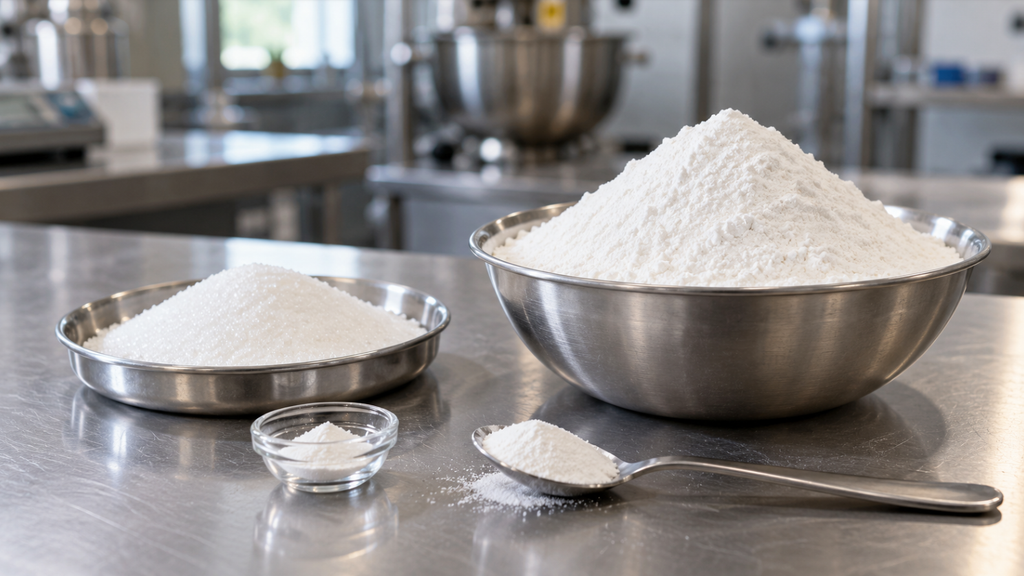
The mixed sugar substitute of sucralose and maltodextrin that you usually buy in supermarkets for retail use is often filled with maltodextrin. Why do we have to do this? Because sucralose is so sweet! If you don’t add something to dilute it, the average person can’t accurately measure the amount of one and a half stars in the kitchen when cooking. So, just because that big packet of powder looks pretty intimidating doesn’t mean there’s a lot more high-powered sweetener in it. Different ingredients each do their job here, doing two completely different tasks “weight gain” and “sweetening”.(By the way, the small spoon and fine maltodextrin powder placed on the stainless steel plate on the workbench are the most intuitive appearance of this carrier.)
In addition, the exact function of maltodextrin depends on its level. The DE value we often refer to is used to measure its reducing ability relative to anhydrous glucose. The higher the DE value, the more thoroughly the starch is hydrolyzed, and the shorter the average chain length. But this thing is just a reference. It cannot reveal the entire molecular distribution, nor can it directly determine how sweet or sticky the bite will end up being. After all, the concentration of the solution, the temperature, and the base (matrix) of the food itself will all be inserted horizontally into it.
The carbohydrate content of the entire product is not determined by sucralose
In this mixture, glucose and digestible ordinary maltodextrin both contribute carbohydrates and calories. Although the amount of sucralose used is negligible, it doesn’t mean you can write off the nutritional contributions of the other two “the calorie-rich ones”. If you want to understand the nutritional details of a finished product, looking at its actual consumption and complete ingredient list honestly is definitely much more reliable than staring at the words “sucralose” in the ingredient list.
I would also like to remind you that ordinary easily digestible maltodextrin should not be confused with “resistant maltodextrin”. The latter is dietary fiber; these two are not on the same channel at all. If someone insists on using regular maltodextrin as dietary fiber, it is purely misleading and seriously distorts the true nutritional content of the formula.
You need to clearly calculate the concepts of total carbohydrates, total sugars, added sugars, and free glucose. You can’t simply and crudely read the total weight of maltodextrin as “total sugar” or “added sugar”, let alone equate total carbohydrates or total sugar directly with how many grams of glucose it contains. The specific nutritional indicators depend entirely on how much you eat in one bite, the specific ratio, and how the applicable labeling regulations are calculated. You can’t figure it out based on these three names on the ingredient list alone.
When looking for alternatives, is the sweetness or volume you’re missing?
If you want to increase sweetness, or add volume and change the taste, you have to choose completely different ingredients. For example, if you replace the original glucose in the formula with less sweet maltodextrin, the result will definitely not be as sweet as before.
Take a step back and say that even if you adjust the sweetness to the target value, the volume and taste of the finished product will likely be completely different. High-powered sweeteners can indeed achieve your desired sweetness with a tiny amount, but the mere few grams of weight simply cannot fill the “volume hole” left by the original large ingredients. Just by adding the sweetness, there’s no guarantee that it will perform exactly like the original in terms of viscosity, browning reaction, or freezing point.
So, even if two mixtures contain all three ingredients, you can’t replace them one-to-one with your eyes closed. Their respective proportions, the amount to eat in a single serving, and the best foods to add to them can be completely different. Based on the names of these raw materials alone, there is no universal replacement ratio in the world that can encompass the world.
Verwandte Empfehlungen
-

Wie wird der Süßstoff Allulose hergestellt? Der wahre Herstellungsprozess wird enthüllt
2067Entdecken Sie die Wahrheit über die Herstellung von Allulose. Erfahren Sie, wie dieser Keto-Zuckerersatz aus Stärke und nicht aus Früchten hergestellt wird.
Details anzeigen -
Maltodextrin-AlternativenNatürliche Ersatzstoffe für eine gesündere Ernährung
2167Professioneller Leitfaden für natürliche Alternativen zu Maltodextrin. Finden Sie gesunde Swaps für Blutzucker und Gewicht Management.
Details anzeigen -
In welchen Lebensmitteln ist Maltodextrin enthalten?
2174Dieser Artikel enthüllt die versteckte Liste, die Blutzuckerspitzen verursacht und Keto ruiniert.
Details anzeigen -
Ist Allulose ein Zucker? Eine Analyse dieses seltenen Einfachzuckers
1694Ist Allulose ein Zucker? Ja, ein seltenes Monosaccharid. Erfahren Sie, warum es den Stoffwechsel umgeht, Blutzuckerspitzen verhindert und die GLP-1-Produktion ankurbelt.
Details anzeigen