 SGNUTRI


Produkt suchen
Ist Allulose ein präbiotischer Ballaststoff? Echte Vorteile für die Darmgesundheit
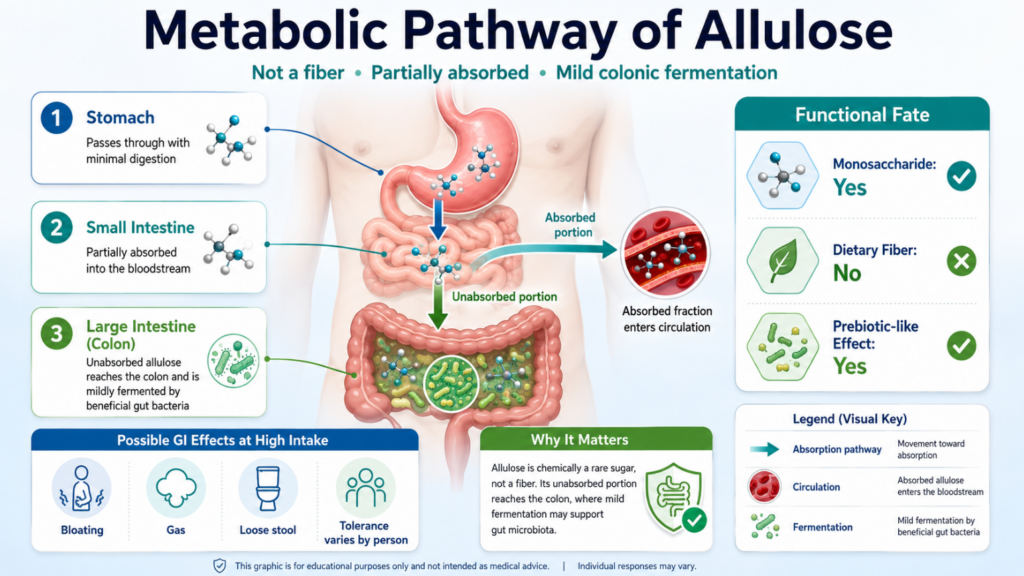
In terms of molecular structure, allulose is just 1 simple monosaccharide. So, if you ask, “Is allulose fiber?”, the biochemical answer is an absolute “no”. But if the question is changed, “Is it a prebiotic?”, from the perspective of clinical actual function, the answer is a big “yes”. Why? Because the unabsorbed part of it runs directly into your large intestine, where it’s mildly fermented and becomes a delicious ration of beneficial intestinal bacteria.
Now there are countless low-carb dieters who mistakenly eat allulose as a traditional dietary fiber, which inexplicably causes serious gastrointestinal discomfort. If you don’t know the bottom line of your gut’s tolerance to it, or mix this rare sugar with some “misfit” ingredients, the originally healthy 1 ketogenic snacks will become “powerful laxatives” in minutes “. Today’s in-depth dismantling, we will thoroughly 1 the metabolic route of allulose in the human body, find out those commercial formula traps in cheat people, and use hard core data to tell you what real impact it will have on your intestinal flora.
Straight to the core: official classification vs. actual function
The FDA’s official classification of foods strictly follows the chemical structure. As an epimer of fructose, allulose is firmly classified as a “carbohydrate” (the 1 monosaccharide) and will never be regarded as a complex carbohydrate chain of dietary fiber.
But if you look at the biology of the gut microbiome, it’s a different story altogether. There are no enzymes in the human body that can specifically break the carbon bonds of allulose. When you eat it, about 70% will enter the blood through the small intestine, but the body can’t take it and can’t convert it into energy, and it will soon be drained along the urine intact.
As for the remaining 30%, the performance in the body is exactly the same as that of prebiotic fiber. This part of the unabsorbed residual sugar will perfectly avoid the upper digestive tract and reach the colon. There, certain beneficial bacteria such as bifidobacteria will metabolize it as food. This fits perfectly with the clinical definition of a prebiotic: an ingredient 1 can be selectively fermented and targeted to alter the composition or activity of the gut microbiota.
F.A. B. Models of Intestinal Metabolism (Absorption, Bypass and Fermentation)
If you understand the specific digestive route in the stomach, you can understand why it is not fiber, but it can play a role similar to fiber. The medical community uses the F.A. B.(partial absorption, active bypass, bacterial fermentation) model to explain this peculiar metabolic paradox.
- Fractional Absorption-Avoid blood sugar spikes. When allulose enters the small intestine, certain transporters in the body (such as GLUT5) pull about 70% of the amount into the bloodstream. Because the liver can’t convert this particular stereoisomer into glucose or glycogen, your insulin levels can be as steady as a mountain, with no fluctuations at all.
- Active Bypass-the secret of the heat notch. The portion that is absorbed laps through the renal system for 1 and then is excreted in the urine within 24 hours. In this process, the body can’t squeeze even a little bit of ATP (energy), which is why it can achieve “only 0.4 calories per gram.
- Bacterial Fermentation-the engine of gut health. The real key is to escape the 30% absorbed by the small intestine, and they will push all the way to the large intestine. Here, gut microbes begin to feast on these whole allulose molecules. This fermentation process produces some gases (hydrogen and methane), along with extremely beneficial organic acids. This set of biological mechanisms, and pectin or resistant starch and other soluble fiber is almost a mold carved out.
| Metabolic Factor | Allulose | Soluble Fiber (Pectin / Resistant Starch) |
|---|---|---|
| Molekulare Struktur | Rare monosaccharide (C-3 epimer of fructose) with a unique stereoisomer structure | Complex carbohydrate polymers made of multiple sugar units |
| Small Intestine Absorption Rate | Approximately 70% partially absorbed through intestinal transporters | Minimal absorption; most passes through the digestive tract intact |
| Colon Fermentation Rate | Remaining fraction reaches the colon and is fermented by gut microbiota | High fermentation rate by beneficial gut bacteria in the colon |
| Calorie Content | About 0.4 kcal/g due to limited metabolic utilization and urinary excretion | Approximately 1.5–2.5 kcal/g depending on fiber type and fermentation level |
| Blood Glucose Response | Minimal impact; does not significantly raise blood glucose or insulin levels | Generally low impact; slows glucose absorption and improves glycemic control |
| Energy Conversion Pathway | Limited ATP production; most absorbed allulose is not converted into glucose or glycogen | Provides short-chain fatty acids (SCFAs) through microbial fermentation |
| Gut Microbiome Interaction | Acts as a fermentable substrate for selected intestinal bacteria | Serves as a primary prebiotic fuel source for diverse gut microbes |
| Digestive Role | Mimics some metabolic effects of fiber despite being a simple sugar | Functions as dietary fiber with bulking and fermentation benefits |
Frontier discovery: linkage between GLP-1 and short-chain fatty acids (SCFA)
Recent clinical studies in gastroenterology have directly hooked rare sugars and advanced endocrine reactions. Those not absorbed allulose, once in the colon, actually actively stimulate L cells to secrete GLP-1 (glucagon-like peptide -1).
What is the role of GLP-1? It is 1 powerful satiety hormone that delays the emptying of the stomach and sends a “stop eating, you’re full” signal to the brain. It is this physiological pathway that is aimed at the weight-loss needles that are currently on the market. However, allulose is activated by dietary fermentation with a 1 milder and more natural physiological dose.
At the same time, bacteria in the colon convert these undigested sugars directly into short-chain fatty acids (SCFAs), especially butyrate. Butyrate is simply the “super ration” of colon cells “. The increase in SCFA not only reduces intestinal inflammation, but also strengthens the intestinal barrier (preventing “leaky gut”). What’s more, it can lower the pH of the colon, so that those pathogenic bacteria can not survive.
The expert’s guide to avoiding the pit: beware of the “fermentation bomb” in the formula”
If you eat several difficult-to-absorb ingredients together, it will definitely lead to 1 gastrointestinal disaster. Nowadays, many manufacturers of ketogenic and low-net-carbohydrate foods especially like to mix allulose with those extremely high FODMAP (easily fermentable carbohydrates) fibers in order to press the calorie numbers on the packages to death.
The culprit is usually inulin (chicory root fiber). Inulin is the 1 prebiotic fiber that ferments extremely quickly and is particularly prone to gas production. If you think about it, if the manufacturer stuffed 10 grams of allulose and 10 grams of inulin into a ketogenic protein bar, it would force your colon to process two very different but extremely fermentable substrates at the same time.
What are the consequences of this “additive effect”? Osmotic diarrhea, severe flatulence, and abdominal cramps will come to you right away. Many people suffer from eating and confusedly buckle the pot on the head of allulose. Therefore, you must knock the ingredient list when you buy something. If allulose and chicory root fiber (or soluble corn fiber) appear in the first three ingredients of a product at the same time, don’t eat more than half of it for the first time, and first test the endurance of your intestines.
Hardcore test data: allulose PK traditional fiber
To know how strong fermentation is in the colon, a breath hydrogen test is the best evidence. In clinical trials, by measuring the concentration of exhaled hydrogen (ppm), it can directly reflect the degree of bacterial activity in the intestinal tract.
In the 1 group control test, subjects ate 15g of pure psicose alone. Within 120 minutes of eating, the exhaled hydrogen concentration reached only a mild peak of 20-25 ppm. Everyone said that there was a little exhaust, but there was no pain, and there was no urge to run to the toilet.
In other cases, the subjects were given the same 15-gram dose of inulin. During the same time period, the breath hydrogen concentration soared directly to 45-50 ppm. The subjects generally reported that the stomach was distended and even had acute discomfort. These data prove that although the 30% of allulose that goes to the colon is indeed acting as a prebiotic, its fermentation process is much milder and friendlier than the extraction of dietary fiber commonly used in commercial manufacturing.
Häufig gestellte Fragen (FAQ)
On the nutrition label, does allulose count as dietary fiber?
It doesn’t count. The FDA officially categorizes it as a carbohydrate. However, because its metabolism in the human body is very special, unlike ordinary sugar at all, FDA specially approved manufacturers to remove it from the “total sugar” and “added sugar” in the nutrition composition table.
Is allulose a prebiotic in the gut?
Calculate. Although it is only a simple sugar in structure, the 30% that is not absorbed in the small intestine will go to the colon. There, it becomes food for beneficial bacteria and is fermented into short chain fatty acids (SCFAs), which actually play a prebiotic role.
Why do some people eat allulose flatulence fart?
Because the part of the sugar that goes to the large intestine is fermented by bacteria, and the by-products of this natural process are hydrogen and methane gas. If you eat too much at one time (for example, more than 15-20 grams in a meal), the intestines can’t be processed at once, and there will be obvious flatulence and even diarrhea.
Can allulose repair “leaky gut?
Current scientific research suggests that it has great potential. Allulose is fermented in the colon to produce a 1 short-chain fatty acid called butyrate. Butyrate can not only provide energy to colon cells, but also tighten the intestinal mucosal barrier on a physical level, which is a powerful weapon against clinical “intestinal leakage” (increased intestinal permeability).
Is it safe to mix allulose with other prebiotic fibers such as inulin?
I strongly recommend not to do so. The 1 pile of easily fermented ingredients together, it is very easy to trigger a serious gastrointestinal protest. If allulose is stacked with sugar alcohols such as inulin (chicory root fiber) or erythritol, it will trigger a violent chain fermentation reaction in the colon, usually leading to sudden osmotic diarrhea.
How much allulose to eat will not make the stomach uncomfortable?
The tolerance limit for clinical testing is: no more than 0.4 grams per kilogram of body weight in a single time, and no more than 0.9 grams per kilogram of body weight throughout the day. For example, an adult weighing 150 pounds (about 68 kilograms) is absolutely safe to eat about 27 grams at a time as long as he does not consume other fermented fibers at the same time.
Verwandte Empfehlungen
-

Ist Maltodextrin ketofreundlich?
738Ist Maltodextrin Keto? Nein. Sein hoher Gi-Wert (85-105) treibt den Blutzucker in die Höhe und unterbricht die Ketose schneller als normaler Haushaltszucker.
Details anzeigen -
Erhöht resistentes Dextrin den Blutzucker?
657Nein, resistentes Dextrin erhöht den Blutzucker nicht. Es ist ein nicht verdaulicher Ballaststoff mit Null Gi, sicher für Keto und Diabetiker.
Details anzeigen -
Ist Erythritol und Stevia das Gleiche?
808Sind Erythrit und Stevia das Gleiche? Nein. Entdecken Sie hier die Hauptunterschiede in Bezug auf Herkunft, Süßkraft und Verwendung beim Backen.
Details anzeigen -
Was ist Dextrose wasserfrei?
1047Was ist Traubenzucker wasserfrei? Eine reine, feuchtigkeitsarme Glukosequelle für schnelle Energie, Fitness-Erholung und medizinische Zwecke.
Details anzeigen