 SGNUTRI


Buscar producto
Allulose comes from: Natural Sources and Production
The origin of allulose needs to be considered separately from the small amounts found in nature and the routes of raw materials produced commercially.“ The question allulose comes from” really requires confirmation of why it can be detected in food and how commercially available ingredients are made.
A small number of them exist in nature
Allulose can be found in small amounts in sources such as wheat, raisins, and dried figs, and can also be found in molasses, maple syrup, brown sugar, ketchup, Worcestershire sauce, and some baked or heated foods. Fructose-containing foods may also form small amounts of allulose through non-enzymatic reactions when heated, and the amount formed is affected by temperature, pH, fructose concentration and heating time.
The presence of trace amounts in these foods does not equate to commercially available allulose being directly extracted from fruit or a particular plant. Foods with allulose listed in the ingredient list are usually formulated foods with allulose added voluntarily. The actual amount added cannot be judged solely by the positive name of the product.
The business route starts with fructose solution
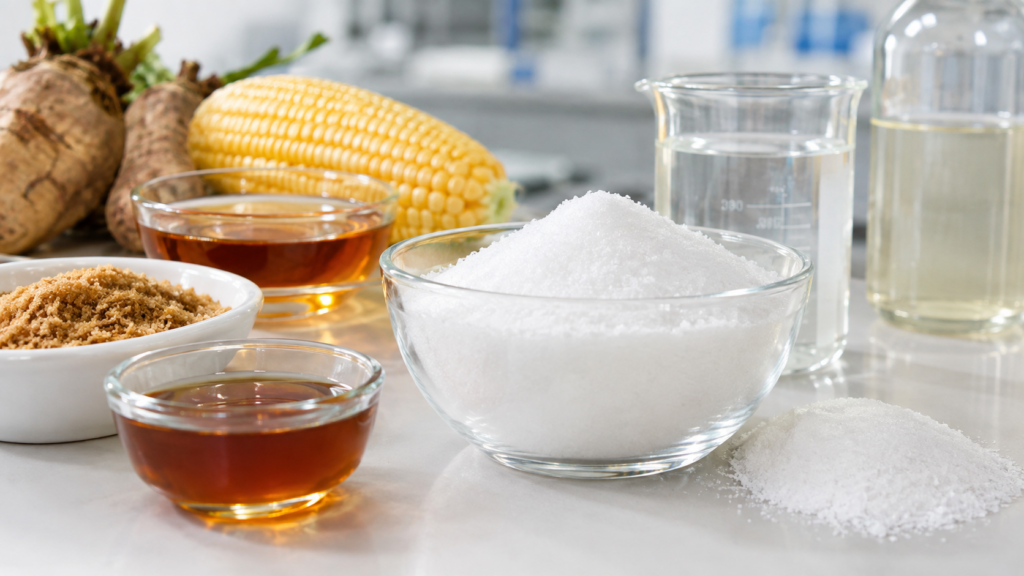
Commercial allulose is typically used as a direct reaction substrate with fructose. Fructose can come from glucose or fructose formed by saccharification and isomerization of starch, or from glucose and fructose produced by the hydrolysis of sucrose in sugarcane or sugar beets. Which raw material route different products use still depends on the raw material traceability information of the product.
In industrial materials, “separation” or “extraction” is usually done by separating allulose from enzymatically reacted sugar solutions, rather than by juicing or leaching it from fruit to obtain the finished product.
From fructose to syrup or crystallized products
A typical industrial process first prepares and adjusts a fructose solution, and then uses D-allulose 3-epimerase or D-psicose 3-epimerase to convert the configuration of the third carbon atom of fructose to produce allulose.
The enzymatic reaction yields a sugar solution containing allulose, unreacted fructose, and a small amount of other components. To prepare a syrup with a specified composition, it usually needs to undergo decolorization, filtration, ion exchange or desalination, chromatographic separation and concentration; if a crystalline product is to be obtained, further crystallization, solid-liquid separation, washing and drying are also required.
Different production processes may use free enzymes, immobilized enzymes, or immobilized cells, or they may use enzymes and production microorganisms from different sources. A single process data cannot represent the route for all allulose products.
For specific products, please refer to the source statement
If a product is to be determined to originate from corn, sugar beets, or other routes, it cannot be inferred from the name of allulose or trace amounts in natural foods. The direct sugar source and supply chain statement for the product should be verified. Raw material routes affect product-level claims such as organic, non-GMO, corn origin, allergens, and supply chain, but these attributes are not automatically given by the product name.
Recomendaciones relacionadas
-

Lactitol Monohidrato: Una alternativa limpia al azúcar
1590Sgnutri suministra lactitol y gránulos de cáscara de ispaghula para formulaciones de fibra a granel en aplicaciones alimentarias y de salud digestiva.
Ver detalles -
¿Es la glucosa una sustancia pura?
717Sí, la glucosa (C6h12o6) es una sustancia pura. Aprenda por qué se califica como un compuesto químico con propiedades fijas.
Ver detalles -
Maíz céreo frente a maltodextrina: ¿qué fortalece más?
941¿Maíz ceroso o maltodextrina? Averigüe qué carbohidrato aumenta la recuperación más rápidamente y evita la hinchazón.
Ver detalles -
Natural Isomalt Review - Un edulcorante que realmente cumple su función
1433Sepa si el isomalt es natural y descubra su color, textura y uso funcional como sustituto del azúcar bajo en calorías.
Ver detalles