 SGNUTRI



Produkt suchen
Definition of Maltodextrin: Identity, DE and Uses
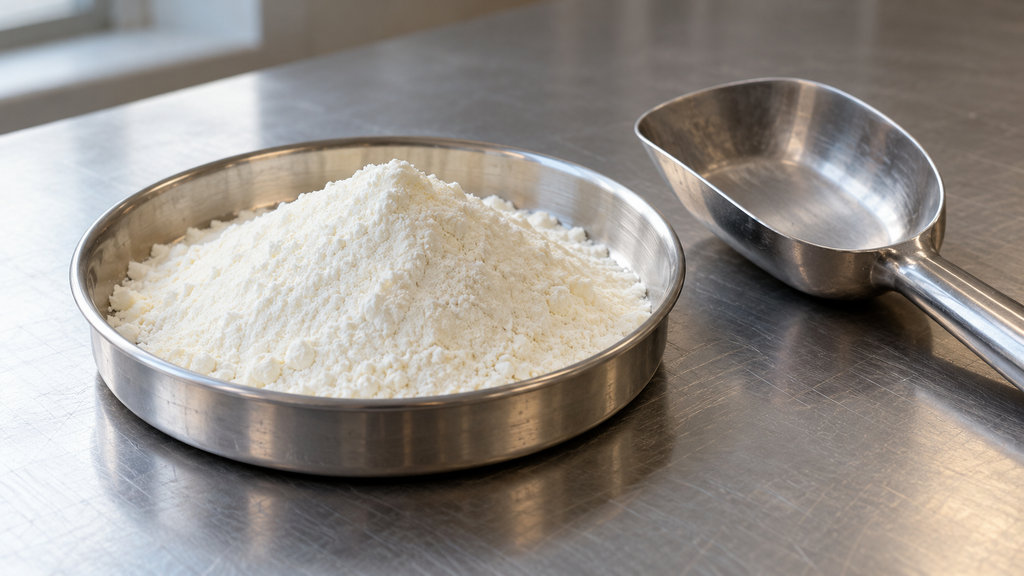
Take maltodextrin, which comes from corn and has a DE value between 10 and 15. It is usually a white or pale yellow powder that tastes with a faint sweetness. However, please note that this is only the appearance and taste of a specific model and does not represent all maltodextrin. Also, don’t look at the “malt” in its name, it actually has nothing to do with malt or malt extract.
To truly understand the definition of maltodextrin, we need to combine its raw materials, ingredients, and degree of hydrolysis. It refers to a whole class of starch hydrolysis components, rather than a single pure molecule with an absolutely fixed composition.
After local hydrolysis, what exactly was obtained
Maltodextrin “predecessor” is edible starch. After a series of “controlled local hydrolysis” operations, it becomes a mixture of a large number of D-glucose oligomers and polymers. The molecules are mainly connected by hand by α-1,4 glycosidic bonds. Because the cut sugar chains are both long and short, there is no uniform and fixed chain length in the entire finished product. From the perspective of ingredient classification, it is a carbohydrate and starch hydrolysate, and is neither a monosaccharide, disaccharide, nor sugar alcohol.
Here’s a word that’s easy to be biased about “glucose unit”. Several glucose units are connected in a string, which are completely different states of existence from free glucose alone. Although ordinary maltodextrin will contain a little bit of hydrolyzed free glucose, maltose and other short-chain sugars, you should never call the entire product glucose powder or maltose simply because of this.
It comes from a wide range of raw materials, including corn, rice, potatoes, wheat, cassava and other edible starches. Just by staring at the four words “maltodextrin”, you will never be able to guess which ingredient a specific product uses. Plants are only responsible for providing starch raw materials, and maltodextrin is processed artificially later. In other words, corn starch can be hydrolyzed into maltodextrin, but this is by no means the same as the fact that natural corn starch itself contains this substance.
As for the general production process, it generally involves selecting a suitable acid or enzyme for hydrolysis, followed by purification and concentration, and finally, depending on the requirements of the product form, either boiling it into a concentrate or spray drying it and beating it into powder. After this process, the finished product is no longer the granular raw starch it was originally. Don’t equate maltodextrin and modified starch just because they share the same root; they are not synonymous with each other.
DE values draw the line and also leave the difference
The DE value is “glucose equivalent”, which measures its reducing ability relative to anhydrous glucose. According to the US definition, the DE value of maltodextrin must be stuck below 20; as long as the DE value reaches or exceeds 20, it falls into the next-door “glucose syrup” camp in the US standard. Note that this is primarily the caliber from the US side.
There is a misconception that must be dispelled: the DE value does not refer to what percentage of glucose is contained in the product. It is affected by the average chain length and sugar composition. Generally speaking, the higher the DE value, the more severe the hydrolysis, and the shorter the average chain length. If you interpret DE10-15 directly as “containing 10% to 15% glucose”, then it’s a big joke.
Taking a step back, even if several products have exactly the same DE value and all stay within the range of maltodextrin, their sweetness, viscosity, or solubility may vary greatly. Relying solely on a DE value cannot fully depict its specific molecular weight distribution, nor can it directly package the ticket to say what effect it will definitely show in a certain food. The name can only confirm its major component categories, and the specific actual performance depends on the detailed component composition and application environment.
Why do you always put sweet food in when you can eat something that has no flavor
Ordinary low-DE maltodextrin often tastes bland and has almost no sweetness. It is definitely not a high-potency sweetener and cannot provide the same sweetness substitution as sucrose. To understand its value in a recipe, you have to put the concept of “sweetness” aside and look at what it does as a solid and carrier.
Its best use in food is to make solids and expand volume. It can also act as a carrier, dispersant, or help adjust the texture. Those retail-sized bottles of steviol glycosides or sucralose you buy at the supermarket often contain maltodextrin, purely because the amount of high-efficiency sweeteners used is extremely small. In order to facilitate daily weighing and dispersion, maltodextrin can only be used as a filler “fill”. The presence of this substance in the finished product does not mean that stevia extract or sucralose itself is naturally derived from maltodextrin.
In addition, maltodextrin does dissolve in water, but “water solubility” does not guarantee that no matter how you pour it or what concentration you use, you will be able to instantly brew a clear and lump-free solution. The size of the powder particles, the water temperature, how you stir it, and even other components coexisting in the water all affect its dispersion state. What specific effects it can exert depends on the concentration, temperature, and the condition of the food base.
The watershed moment for common maltodextrin and resistant products
Ordinary maltodextrin can be digested normally, and it is ultimately a digestible carbohydrate that can be hydrolyzed into glucose in the stomach. Don’t assume that just because it has multiple glucose units hanging in its molecular chain, you can assume that it can digest slowly or provide continuous energy. The degree of polymerization in the structure and the actual digestion rate are two completely different things.
Products on the market that use modifiers such as “organic”, “non-GMO”, or “plant-based” only explain their origin, supply chain, or main selling point. They cannot change the most basic chemical identity of maltodextrin at all, nor can they be certified based on just one name. But if you encounter “resistant products”, the nature changes, which involves core differences in ingredients and whether the human body can digest them.
“Resistant maltodextrin ”or “resistant dextrin” is processed through a specific process and contains indigestible ingredients, which completely distinguishes it from ordinary products in terms of identity and ingredients. Ordinary maltodextrin is definitely not dietary fiber; and whether resistant products can be used as dietary fiber depends strictly on whether they meet the corresponding ingredient standards and labeling regulations of the target market. You can never directly deduce the fiber content from its name alone.
Verwandte Empfehlungen
-

Gesundheitliche Vorteile von Allulose: Warum Sie jetzt Ihren Süßstoff wechseln sollten
2479Entdecken Sie die gesundheitlichen Vorteile von Allulose. Wechseln Sie jetzt zu diesem Süßungsmittel, um GLP-1-Reize auszulösen, den Anstieg des Blutzuckerspiegels abzuflachen und echte CGM-Daten zu erhalten.
Details anzeigen -
Ist Allulose ein Kohlenhydrat? Die Auswirkungen auf die Netto-Kohlenhydratmenge im Fokus
2398Ist Allulose ein Kohlenhydrat? Ja, aber mit null Netto-Kohlenhydraten. Erfahren Sie mehr über die tatsächlichen Auswirkungen auf den Blutzucker und die Keto-Makros.
Details anzeigen -
Dextrose Maltodextrin and Sucralose: Roles in a Blend
763Learn how dextrose maltodextrin and sucralose contribute sweetness, bulk and carbohydrate to a blend.
Details anzeigen -
Warum ist Glukose in Wasser löslich?
2813Entdecken Sie, warum Glukose in Wasser löslich ist. Das liegt daran, dass beide polare Moleküle sind, die starke Wasserstoffbrückenbindungen bilden können.
Details anzeigen