 SGNUTRI


Rechercher un produit
En quoi consiste le polydextrose ?
Le polydextrose est en fait un polymère synthétique de glucose très complexe et à ramifications multiples. Il est produit par polymérisation aléatoire de trois matières premières : environ 90% de glucose dérivé du maïs, 10% de sorbitol et 1% d'acide citrique.
Ce processus de synthèse se déroule dans un environnement à vide poussé et à haute température, dans lequel l'acide citrique agit comme un catalyseur acide, favorisant la condensation par déshydratation du glucose et du sorbitol, et formant finalement une structure d'hydrate de carbone aux branches très riches. Complètement différent des sucres simples, le produit résultant contient un grand nombre de liaisons 1,6-glycosidiques, que les enzymes digestives du corps humain ont du mal à dissocier. Cette composition chimique unique est à l'origine de ce qui la définit comme une “fibre alimentaire hydrosoluble” et un “extenseur hypocalorique” - elle n'apporte qu'une kcal de calories par gramme, tout en faisant preuve d'une excellente stabilité dans les aliments transformés.
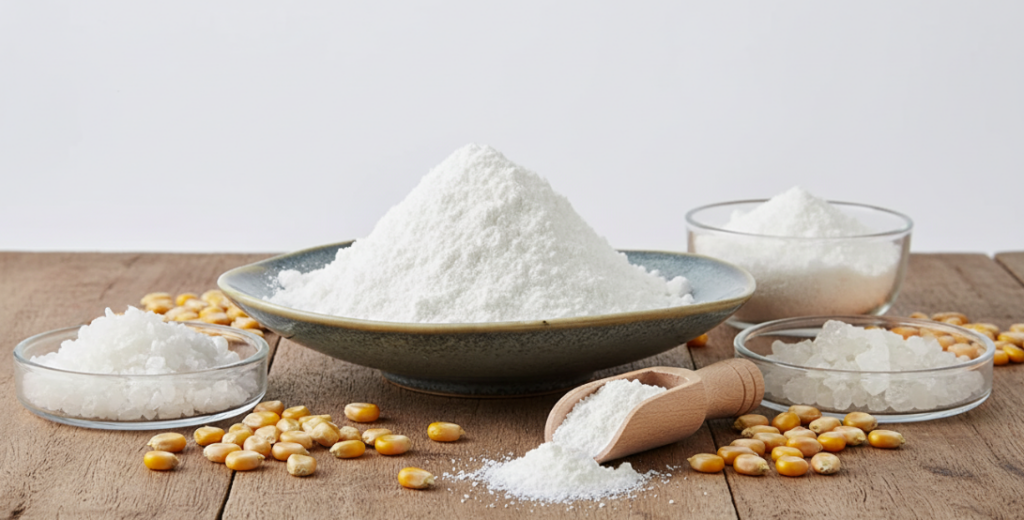
Trois matières premières
Pour bien comprendre la nature du polydextrose, il faut connaître les proportions de ces trois ingrédients et les rôles qu'ils jouent. Le glucose est l'épine dorsale de l'ensemble du polymère, fournissant les unités de glucose nécessaires à la construction de la structure. S'il n'y a que du glucose, le mieux que l'on puisse faire est de l'amidon facilement digestible ou une sorte de sirop.
Afin de le transformer en fibre non digestible, du sorbitol est ajouté à la formule à une concentration de 10%, qui agit comme un plastifiant et “coiffe” les extrémités des chaînes de polymères, garantissant que le produit final est suffisamment stable et ne cristallise pas dans le produit fini. Les derniers 1% d'acide citrique sont le “moteur” clé de la réaction ; en tant que catalyseur acide, ils déclenchent le processus de polymérisation sans être consommés en grandes quantités, ce qui permet aux molécules de glucose de se lier de manière aléatoire et désordonnée.
Processus de synthèse
Le processus de fabrication lui-même est aussi critique que les matières premières. Ces matières premières sont soumises à une polymérisation par condensation extrêmement sévère dans des conditions de vide à haute température.
Dans cet environnement contrôlé, l'acide citrique incite le glucose et le sorbitol à perdre leur humidité et à fusionner. La structure moléculaire de cette substance n'est pas une longue chaîne linéaire comme l'amidon de la farine, mais une structure sphérique à plusieurs branches. Comme ces liaisons chimiques sont générées de manière aléatoire, il en résulte des connexions que le système digestif humain ne reconnaît pas, ce qui explique que le corps ne l'utilise pas comme source d'énergie régulière.
Fibres solubles
Fibre alimentaire soluble en gros, adaptée aux compléments alimentaires, aux produits alimentaires, etc.
Prébiotique
Proposer des compléments de fibres alimentaires prébiotiques et des produits de substitution du sucre.
Amidon Sucre
Fabriqué à partir de maltodextrine et de glucose, il convient aux aliments et aux boissons.
Fibre de soja
Les fibres de soja de haute qualité fournissent des matières premières aux industries telles que les compléments alimentaires.
Protéines
Recherche de parasites ultra-faibles et d'intégrité du signal pour les applications à plus de 100 GHz.
Vitamines
Un fabricant de vitamines de haute qualité au service de l'industrie alimentaire et des compléments nutritionnels.
Le noyau chimique “indigeste
La raison pour laquelle le polydextrose est classé comme E1200 plutôt que comme sucre réside dans sa structure interne. La plupart des glucides naturels sont liés par des liaisons 1,4, et des outils tels que l'amylase salivaire de notre corps peuvent les couper en quelques minutes.
Cependant, la synthèse du polydextrose produit un grand nombre de liaisons 1,6-glycosidiques. Ces branches complexes constituent une sorte de “bouclier biologique”. Lors de l'ingestion, ces liaisons résistent de manière tenace à l'hydrolyse par les enzymes de l'intestin grêle. C'est le fondement scientifique de cette fibre alimentaire hydrosoluble : elle peut traverser complètement le tube digestif supérieur, atteindre le gros intestin en douceur et y jouer un rôle prébiotique.
De la composition à la fonction
Cette combinaison particulière d'ingrédients aboutit finalement à un ingrédient extrêmement puissant. Comme le corps humain ne peut pas métaboliser complètement ces chaînes de glucose liées par des liaisons 1,6, sa densité calorique passe de 4 kcal/g de sucre ordinaire à 1 kcal/g.
Pour les amis qui font de la recherche et du développement, cela fait du polydextrose le premier choix pour remplacer le sucre et la graisse. Lorsque vous supprimez le sucre ou la graisse de la formule afin de réduire le sucre, le “poids” et le “goût” de l'aliment s'effondrent instantanément ; et cette proportion spécifique de polydextrose peut combler ces vides physiques sans ramener le sucre.
Résumé
Lorsque vous vous demandez de quoi est fait le polydextrose, la réponse réside dans la fusion précise, catalysée par un acide, du glucose, du sorbitol et de l'acide citrique. Il s'agit en fait d'un microcosme de la science alimentaire, qui consiste à réarranger de simples ingrédients dérivés du maïs en une fibre complexe, résistante à la chaleur et pauvre en calories, afin de répondre précisément aux besoins rigoureux de l'industrie alimentaire moderne en matière de réduction de la teneur en sucre.
Auteur : Julian Miller
Tout au long de ma carrière en laboratoire et en clinique, je me suis spécialisée dans l'impact métabolique et les propriétés fonctionnelles des polymères glucidiques. Ma mission est de combler le fossé entre la synthèse chimique complexe et la transparence nutritionnelle, en aidant les professionnels de l'industrie et les consommateurs soucieux de leur santé à comprendre la science qui se cache derrière chaque ingrédient figurant sur l'étiquette.
Recommandations connexes
-

Quel est le goût de la boisson au glucose ?
627La réponse la plus directe est qu'une boisson au glucose a le goût d'un soda extrêmement sucré, sirupeux et plat. Imaginez des saveurs d'orange, de citron vert ou de punch aux fruits, mais sans carbonatation et avec une consistance lourde et épaisse. Bien qu'il s'agisse essentiellement d'une boisson sucrée...
Voir les détails -
La vitamine C aide-t-elle à lutter contre la gueule de bois ?
541Oui, la vitamine C aide à lutter contre la gueule de bois en stimulant le glutathion. Découvrez comment 1 000 mg neutralisent les toxines et accélèrent la récupération.
Voir les détails -
Prébiotiques et probiotiques : un guide complet sur la santé intestinale, l'efficacité et les tendances modernes
176Les probiotiques sont des bactéries vivantes et bénéfiques qui vivent dans l'intestin, et les prébiotiques sont des aliments riches en fibres qui nourrissent ces bactéries. Si vous considérez votre intestin comme un jardin, les probiotiques sont les graines que vous semez, tandis que les prébiotiques sont l'engrais qui...
Voir les détails -
Poudre d'oligosaccharide Isomalto : Une fibre prébiotique équilibrée pour les formulations fonctionnelles à teneur en sucre contrôlée
1526La poudre d'oligosaccharide Isomalto organique de maïs du fournisseur offre des oligosaccharides naturels pour des applications fonctionnelles à label propre
Voir les détails