SGNUTRI


Rechercher un produit
Allulose: Good or Bad for You? Is It Healthy or Not?
As long as you can control your mouth and strictly control your single intake to less than 0.4 grams per kilogram of body weight (to avoid stomach protests and diarrhea), allulose is definitely your first choice for daily sugar substitution and is beneficial to metabolism. If you are still wondering whether this thing is healthy or not, biology has long given you the correct answer: after this rare sugar enters the blood, 70% of it will be directly excreted intact through urine, and it will not be converted into glucose at all, let alone stimulate insulin. Many people who ask “whether allulose is good or bad” are actually frightened by the recent medical panic caused by erythritol and artificial sweeteners. Don’t worry, eating pure allulose is very cardiovascular safe.
AIM Safety Matrix: Deeply Understanding the Biological Logic of Alulose
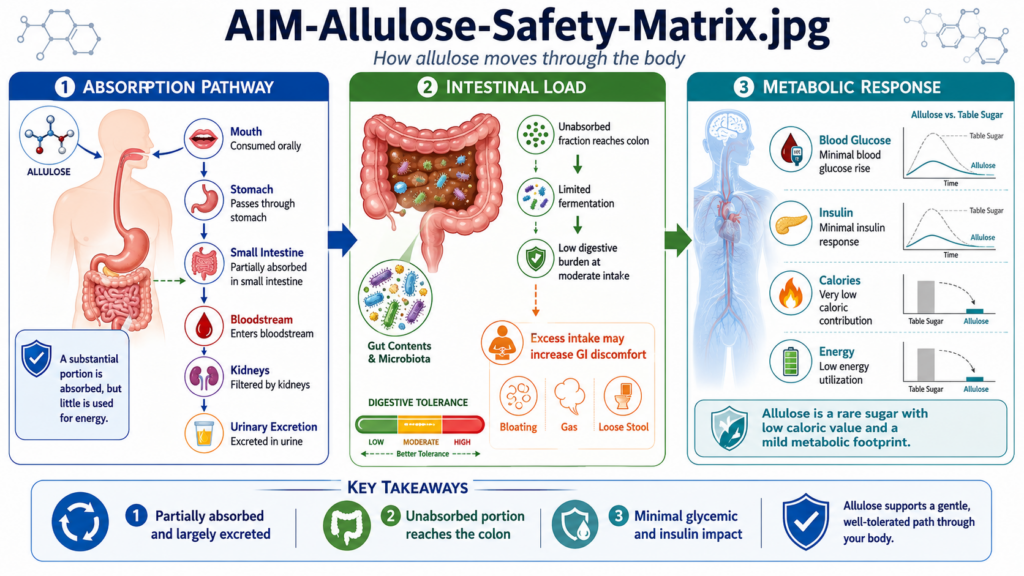
AIM The matrix (i.e., absorption rate, intestinal burden, metabolic response) clearly explains why allulose is completely different from those toxic artificial sweeteners or easily fermentable sugar alcohols. To judge whether a sweetener is good or not, you have to follow its “travel route” from mouth to kidney. Calories alone? That doesn’t show how this thing works with your gut flora “love and kill” at all.
Absorption: Direct From Kidney “Check-Out”
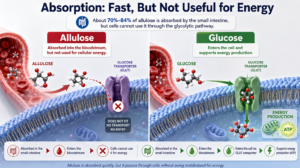
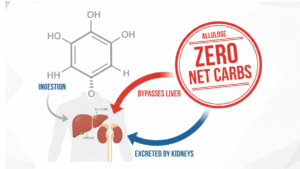
About 70% of the allulose you eat will be directly absorbed into the bloodstream by the small intestine. But the interesting thing is that the human body has no enzymes that can convert it into energy. Therefore, this batch of unmetabolized rare sugars can only be filtered by the kidneys and excreted in the urine within 24 hours. This wonderful “biological shortcut” means that it has no chance of staying in your cardiovascular system and naturally won’t cause any vascular inflammation.
Gut Burden: The Bottom Line Of The Digestive System
The remaining 30% of allulose will slip into the large intestine and meet with intestinal bacteria. However, bacteria are not very interested in it and it is difficult to ferment it. If you stuff your large intestine with more than 30 grams of allulose at once, osmotic pressure will force a lot of water into the colon. The result? Once this physiological red line is crossed, acute diarrhea, severe colic and flatulence will come to your door.
Metabolic Response: Insulin “Zero Fluctuations”
The beta cells of the pancreas don’t see allulose as glucose at all. On pure allulose, insulin is not secreted at all. Steady insulin levels like Tarzan not only prevent fat accumulation but also help you get rid of that “energy cliff-like drop” feeling of exhaustion after eating white sugar or high fructose corn syrup.
Is Allulose Healthy? Look at the 2026 erythritol “big rollover”
| Comparison Criteria | Allulose (D-psicose) | Erythritol |
| Cardiovascular Risk | Aucun (Filters through kidneys and excretes within 24 hours; does not linger to cause vascular inflammation) | Flagged in recent studies |
| GI Tolerance | Modéré (Safe up to a strict 30g threshold; exceeding this forces water into the colon via osmosis, causing acute diarrhea, cramping, and bloating) | Faible |
| Profil gustatif | Sugar-like | Cooling effect |
| Metabolic Response | Zero insulin activation (Beta cells do not recognize it as glucose; prevents fat storage and energy crashes) | Not specified in text |
Ever since medical organizations issued serious cardiovascular safety warnings about erythritol, the global food industry has been frantically replacing it with allulose. Clinical studies have found that high blood erythritol concentrations increase the risk of platelet agglutination, which can scare health-conscious people. At this time, allulose stood out with its unique molecular structure (the C-3 epimer of fructose, which does not work with platelets at all) and became the safest natural substitute.
If you ask a cardiologist if allulose is good, they will definitely compare it to older generation sugar alcohols and praise its cardiovascular safety as perfect. Now, brands are busy reworking thousands of keto snack recipes, kicking erythritol clean and then confidently printing on the front of the package: “This product is sweetened only with allulose”.
“Patented Mixture ” Trap: Consumers Avoid Pitfalls
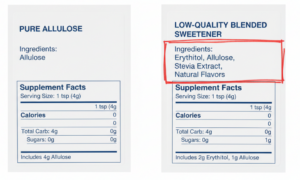
Don’t think buying a bag of something that says “alulose sweetener” is pure food. Pure crystalline allulose costs almost four times as much as synthetic sugar alcohols. Some chicken thief brands combine 10% allulose with 90% maltodextrin, maltitol or monk fruit mixture. Not only will this legally print “alulose” on the front of the package, but it will also skyrocket profits.
When buying, you can make millions of snacks and just flip to the back to see the ingredient list! Maltodextrin has a glycemic index (GI) of up to 110, which is stronger than white sugar. If you eat this maltodextrin-laced “alulose mixture”, your blood sugar will immediately spike and your ketosis will be ruined in an instant. Before paying, you must keep a close eye on the nutrition label to confirm that the only ingredient is “non-GMO allulose” (Non-GMO Allulose, and all other miscellaneous ingredients are not allowed.
Dynamic blood glucose meter (CGM) measurement: 15g alulose vs. 15g white sugar
To verify how metabolically reliable pure allulose is, we performed a fasting control test using a Dexcom G7 dynamic glucose meter. At 8 a.m., the tester drank a glass of water (about 8 ounces/240 ml) containing 15 grams of pure allulose.
The basal blood glucose was initially 85 mg/dL. In the next 120 minutes, the blood sugar value peaked at 87 mg/dL, and the entire metabolic curve was flat as a straight line. The next day, we repeated the exact same test with 15 grams of conventional sucrose. What about the results? In just 35 minutes, the tester’s blood sugar soared directly to 135 mg/dL, and then plummeted to 75 mg/dL an hour later. The cold instrumental data lay before us: pure allulose really does not cause any blood sugar fluctuations.
Everyone is asking (FAQ)
Is It Safe To Eat Allulose Every Day?
As long as you control the amount, it is absolutely safe to eat every day. The US FDA has long labeled it GRAS (Generally Recognized as Safe). You just don’t eat too much at once, split the daily amount into several meals, and your stomach won’t protest.
What Are The Negative Side Effects Of Allulose?
Its only slot is in the stomach. Taking it too hard at once can cause bloating, increased flatulence and even osmotic diarrhea. The reason is simple, those unabsorbed carbohydrates will pull water directly into your lower colon.
Does Allulose Destroy The Gut Flora?
No. Artificial sweeteners like sucralose or aspartame do mess with your bacterial community, but alulose is different; it barely ferments. It goes through the digestive tract like a “little transparent”, and your gut flora doesn’t bother to care for it.
Which Is Better Than Stevia?
If it’s for baking, allulose wins. Because it not only provides a real bulk feel, but also undergoes Maillard reactions (browning and caramelization) like real sugar when heated. Not only does stevia fail to do this, it also leaves an unpleasant metallic bitterness after eating, while allulose has a much purer taste. Of course, both brothers are reliable in terms of metabolic safety.
Can Diabetics Eat It?
It can be eaten with complete confidence. Medical data have long confirmed that allulose (D-allulose) has zero effect on blood sugar or insulin levels. For people with type 1 and type 2 diabetes, this is definitely an extremely reliable sugar control helper.
Why Is Allulose Banned In Europe?
It’s not that Europe doesn’t sell it because it’s toxic, but simply because the European Food Safety Authority’s (EFSA) Novel Foods Regulation is too strict and there is currently a lack of large-scale, long-term regional clinical trial data to complete the approval process. In the United States, Japan and South Korea, it has long been approved for full listing.
Le précédent : Is Allulose a Prebiotic Fiber? Real Gut Health Benefits
Recommandations connexes
-

Is Allulose A Sugar? Rare Monosaccharide Breakdown
21Is Allulose A Sugar? Yes, A Rare Monosaccharide. Discover Why It Bypasses Metabolism, Blocks Spikes And Boosts GLP-1.
Voir les détails -
Does Allulose Count as a Carb? Hidden Keto Diet Facts
27Does Allulose Count As Carbs On Keto? Discover Why It Has Zero Net Carbs, No Insulin Spikes, And Baking Tips.
Voir les détails -
Is Allulose A 1 To 1 Substitute For Sugar? The Truth
21Is Allulose A 1 To 1 Substitute For Sugar? No. Learn Exact Smb Conversion Ratios To Master Perfect Keto Baking Today.
Voir les détails -
L'allulose laisse-t-elle un arrière-goût ? Avis honnête sur le 100%
34Does Allulose Have An Aftertaste? Read Our 100% Honest Review To Spot Fake Blends And Learn Pro Baking Tips.
Voir les détails