 SGNUTRI


Rechercher un produit
L'allulose est-elle un édulcorant sain ? Avantages et inconvénients en matière de sécurité
Many people managing their blood sugar are asking: Is allulose safe and healthy? Clinical studies have already provided a definitive answer. This is mainly because the “way” it works in our bodies is completely different from ordinary white sugar. To understand its safety, you must not only examine its U.S. FDA GRAS (Generally Recognized as Safe) certification but also grasp its unique metabolic pathway, which causes no fluctuations in insulin levels. However, if you use it as regular white sugar during high-temperature baking, you might end up with a bitter, chemical-like taste, and it could even cause severe diarrhea after eating. Today, we’ll take a close look at the pros and cons of this rare sugar, drawing on data from continuous glucose monitors (CGMs), and offer a few tips for keto baking enthusiasts.
S.A.F.E. All-Round Assessment of Allulose
To determine whether a sweetener is good, simply tasting its sweetness is not enough. We need to determine which biological and chemical reactions it triggers once it enters the human body. The following dimensions are sufficient to demonstrate that it is indeed an excellent aid for people with diabetes and those following a ketogenic diet.
- Stability (thermal stress response): Ordinary granulated sugar naturally melts and caramelizes when heated, whereas allulose is highly sensitive to high temperatures; its Maillard reaction is exceptionally vigorous, leading to astonishingly rapid browning. Therefore, when doing keto baking, if you don’t adjust the oven temperature, you can easily ruin a batch of expensive ingredients.
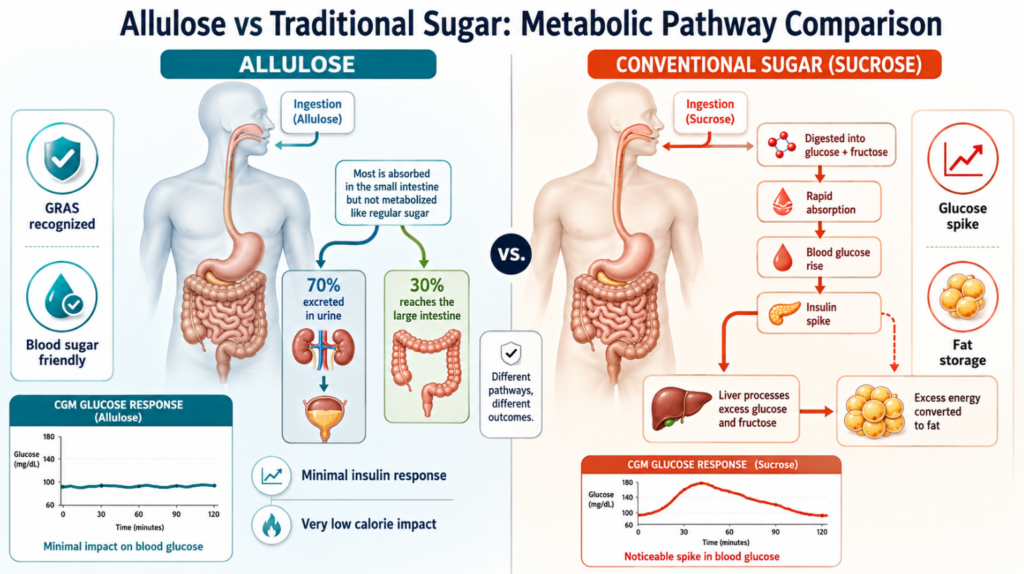
- Absorption pathway (bypassing the liver): Approximately 70% of orally ingested allulose is absorbed into the bloodstream by the small intestine. But remarkably, our liver does not recognize this particular isomer and is unable to metabolize it. Finally, the kidneys excrete it unchanged into the urine. Therefore, its actual caloric content is a mere 0.4 kcal per gram.
- Gut microbiota (probiotic supplementation): The remaining 30% that is not absorbed passes directly into the large intestine. Bifidobacteria in the gut are particularly adept at fermenting this type of intact carbohydrate, producing short-chain fatty acids (SCFAs) such as butyrate. Far from being harmful, these compounds actively help alleviate intestinal inflammation.
- Endocrine (no insulin spikes): When you consume pure allulose, your insulin levels remain completely stable. Because the β cells in the pancreas fail to recognize its molecular structure, it directly disrupts the typical post‑ingestive hormonal cascade that promotes fat storage.
| Édulcorant | Réponse à l'insuline | Caloric Value | Absorption & Metabolism Pathway | Gut Microbiota Impact | Thermal Stability / Cooking Behavior | Overall Assessment |
|---|---|---|---|---|---|---|
| Allulose | Minimal insulin response; does not trigger significant pancreatic β-cell activation | 0,4 kcal/g | Approximately 70% absorbed in the small intestine; poorly metabolized by the liver; mostly excreted unchanged through urine | Remaining 30% reaches the colon and can be fermented by beneficial bacteria, producing SCFAs such as butyrate | Highly reactive during heating; strong Maillard browning effect requires adjusted baking temperature | Excellent low-calorie sweetener for diabetes management and ketogenic diets when used correctly |
| Erythritol | Very low insulin impact; generally does not raise blood glucose significantly | 0.2 kcal/g | Mostly absorbed in the small intestine and eliminated unchanged through urine | Minimal fermentation by gut bacteria due to high absorption rate | Very stable under heat; limited browning compared with sugar | Good sugar alternative with excellent glucose control properties |
| Stévia | No significant insulin spike; sweetness comes from steviol glycosides rather than glucose metabolism | 0 kcal/g | Not absorbed as sugar; gut bacteria convert steviol glycosides into steviol, which is then processed and eliminated | Can interact with gut microbiota, but effects vary depending on individual composition | Highly heat stable; suitable for cooking and baking | Effective zero-calorie sweetener with strong sweetness intensity |
| Sucrose (Table Sugar) | Causes rapid blood glucose and insulin elevation | 4 kcal/g | Broken down into glucose and fructose; glucose enters bloodstream and fructose is mainly processed by the liver | Excess intake may negatively affect gut balance through metabolic stress | Melts and caramelizes under heat; predictable baking behavior | High-calorie sweetener with significant metabolic impact |
| Dimension | Allulose Performance | Key Biological Effect |
|---|---|---|
| S — Stability | Strong Maillard reaction during heating | Requires lower baking temperature control to prevent excessive browning |
| A — Absorption Pathway | Partially absorbed but not metabolized like glucose | Provides sweetness with extremely low energy contribution |
| F — Flora (Gut Microbiota) | Supports beneficial bacterial fermentation in the colon | Produces short-chain fatty acids linked with gut health |
| E — Endocrine Response | Minimal effect on insulin signaling | Helps maintain stable blood glucose levels |
Real-World CGM Data: The Remarkable “Glucose Sponge” Effect
Clinical endocrinology has uncovered an intriguing phenomenon: allulose “meddles” by actively interfering with the digestion of other carbohydrates. Many people wearing continuous glucose monitors (CGMs) have found that adding a bit of allulose to a high-carbohydrate meal significantly flattens the post-meal blood glucose curve.
To put it simply, it’s like a mild, natural “carb blocker.” Research has shown that allulose can inhibit α-glucosidase and α-amylase—both of which are key enzymes responsible for breaking down complex starches into glucose. To illustrate, when you eat a keto-friendly muffin made with allulose and almond flour, the allulose physically slows down the breakdown of the small amount of carbohydrates in the flour.
Many people with diabetes leverage this mechanism to keep post-meal blood sugar spikes in check. Adding just a small amount of allulose to a typical carbohydrate‑rich diet can reduce the overall glycemic impact. This has elevated allulose from a mere “zero-calorie underdog” to a powerful tool for blood‑glucose management.
![Insert a dynamic data video here showing two groups of patients consuming carbohydrates while wearing CGMs [continuous glucose monitors]; the blood glucose curve of the group that included allulose is noticeably flattened. The video should feature professional, medically accurate graphs.](https://www.sgnutri.com/wp-content/uploads/2026/08/image-1-1024x573.png)
Baking Pit Avoidance Guide: Hidden Danger of HMF Produced by High Temperature
If you use allulose as white sugar in the oven, not only will the food roll over, but it will also produce unpleasant chemical by-products. At high temperatures, the degradation of sugars accelerates the production of hydroxymethylfurfural (HMF).
Allulose discoloration is much lower and faster than ordinary white sugar. If you still bake an ordinary cake at 175°C (350 °F), the inside is not ripe yet, the skin will have been burnt into black charcoal, and it will have an extremely strong pungent and bitter taste. This “fake cooked” appearance often deceives novice bakers into bringing out half-baked desserts out of the oven in advance.
The solution is simple: lower the oven temperature by 15°C (25 °F) and cover the baking sheet with tin foil. Blocking the direct radiation of heat can effectively delay the Maillard reaction. This small action can not only prevent premature scorching of the surface and avoid bitterness, but also greatly reduce the chemical substances produced by high temperature.
Gastrointestinal tolerance limit: Never overindulge.
No matter how safe sugar substitutes are, they don’t give you free rein to eat as much as you want. Consuming too much allulose in one sitting will undoubtedly send your digestive system into overdrive, with osmotic diarrhea and painful bloating being the most common symptoms.
As mentioned earlier, approximately 30% of unabsorbed allulose enters the large intestine and undergoes rapid fermentation. If you consume a massive amount in one go, the sudden surge of hydrogen produced by your gut bacteria could easily overwhelm your digestive tract’s capacity and cause it to rupture. What’s worse, if the sugar concentration in the intestines becomes too high, it will rapidly draw all the water from the surrounding tissues into the intestinal lumen.
The clinically recommended safety threshold is: a single intake should not exceed 0.4 grams per kilogram of body weight. In other words, for a 68-kilogram (150-pound) adult, consuming more than 27 grams in one sitting will very likely send them running to the bathroom. The upper limit for the entire day is approximately 0.9 grams per kilogram of body weight. So, when you’re eating those commercially available keto protein bars, if you plan to have several in a row, it’s best to check the back of the package for the exact grams per bar first.
Pet Warning: Can Dogs Eat?
Dog owners know that xylitol is a deadly poison that triggers massive insulin release and liver failure within hours. Fortunately, the biochemical route of allulose in dogs is completely different.
Veterinary studies confirm that allulose does not cause a fatal hypoglycemic shock like xylitol. If a dog accidentally eats a piece of allulose biscuit that falls on the ground, it will not face the life danger of acute liver toxicity
However, the dog’s digestive system is simply unable to process this rare sugar. Even if only a little bit of it, it will definitely cause very serious ejection diarrhea. Although it is not fatal, dehydration and severe intestinal irritation caused by diarrhea also need to be sent to the pet hospital immediately for supportive treatment. Therefore, all ketogenic baked goods in the home must be placed out of the reach of the children.
Questions fréquentes (FAQ)
Is allulose healthy for people with diabetes?
It is very healthy. It does not trigger an insulin response, nor does it raise blood sugar levels. What’s more, clinical data shows that it actively inhibits digestive enzymes; if you take a small amount with your meal, it can also help slow down the glycaemic response caused by other carbohydrates in that meal.
Is it safe to take allulose daily over the long term?
Yes, it is safe. Based on extensive toxicological testing, the US FDA has granted it GRAS (Generally Recognised as Safe) status. It is not carcinogenic, does not cause genetic mutations, and does not damage the liver or kidneys. As long as you do not exceed the gastrointestinal tolerance limit (approximately 0.9 grams per kilogram of body weight) each day, long-term daily consumption is perfectly safe.
Does allulose have any side effects?
Its main side effects are gastrointestinal. Consuming too much at once can lead to flatulence, wind, abdominal cramps and osmotic diarrhoea. Furthermore, when used in baking, if the temperature is too high (above 160°C/325°F), it can produce bitter-tasting chemical compounds.
Is allulose an artificial sweetener?
No, it is a naturally occurring rare sugar. Trace amounts of allulose are found in maple syrup, figs and raisins. Although commercial products on the market are mass-produced using a natural enzymatic process that converts fructose from maize into allulose, its chemical structure is identical to that found in nature.
Does allulose disrupt the gut microbiota?
Far from it; in fact, it is beneficial to the gut microbiota. The portion of allulose that reaches the large intestine is fermented, serving as ‘food’ for beneficial bifidobacteria. This fermentation process produces short-chain fatty acids (such as butyrate), which nourish colon cells and reduce intestinal inflammation.
Why has allofructose been banned in Europe?
Europe has not banned it due to ‘safety concerns’; this is actually a regulatory procedural issue. It falls under the EU’s ‘Novel Food’ regulations. Any new ingredient seeking to be placed on the market in the EU must undergo a very lengthy and cumbersome bureaucratic approval process. Several companies have already submitted safety dossiers, and the EU is currently processing them; they are simply waiting their turn.
Will allulose poison dogs in the same way as xylitol?
No, it does not cause the kind of fatal insulin spikes and liver failure associated with xylitol. However, it is extremely irritating to a dog’s digestive system and can lead to very severe diarrhoea and dehydration. Therefore, it is best to keep it out of reach of your pets.
Recommandations connexes
-

L'allulose est-il considéré comme un glucide ? Ce qu'on ignore souvent sur le régime cétogène
65L'allulose est-elle considérée comme un glucide dans le régime cétogène ? Découvrez pourquoi elle ne contient aucun glucide net, ne provoque pas de pics d'insuline, et retrouvez des conseils de pâtisserie.
Voir les détails -
Comment fabrique-t-on l'édulcorant à base d'allulose ? Le véritable procédé dévoilé
89Découvrez la vérité sur la production d'allulose. Découvrez comment ce substitut de sucre adapté au régime cétogène est fabriqué à partir d'amidon, et non de fruits.
Voir les détails -
Bienfaits de l'allulose pour la santé : pourquoi changer d'édulcorant dès maintenant ?
69Découvrez les bienfaits de l'allulose pour la santé. Changez dès maintenant d'édulcorant pour stimuler la sécrétion de GLP-1, atténuer l'effet des glucides et obtenir des données réelles grâce à la CGM.
Voir les détails -
L'allulose est-elle un bon substitut du sucre ? À lire avant utilisation
63L'allulose est-elle un bon substitut du sucre ? Maîtrisez la formule de pâtisserie S.R.C. pour éviter que vos desserts ne brûlent et que la levure ne manque de nutriments.
Voir les détails