 SGNUTRI


Rechercher un produit
L'allulose est-elle un bon substitut du sucre ? À lire avant utilisation
For this question, nutritionists and professional desserts will definitely nod, but the premise is-you have to understand its “violent temper” in the high temperature “.
If you look at it from a chemical point of view, its taste and coloring effect are almost the same as ordinary white sugar, and it will not cause an insulin spike. But if you don’t care, pour a cup of allulose directly into the ancestral cake recipe, I can assure you that what you bake is definitely a hard lump with blackened skin and lifeless skin.
This article is about 1 the “hidden chemistry” behind the use of this rare sugar in baking “. I will teach you a set of exclusive formula conversion formula, so that your dead expensive ketogenic desserts will no longer become regular customers in the garbage can.
To put it bluntly: physiological effects are one thing, baking performance is another.
To evaluate 1 sugar substitute, you have to look at its physiological effects separately from its actual performance in the kitchen.
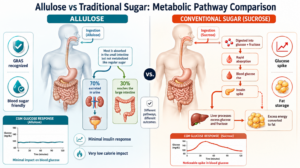
From the point of view of the impact on the body, allulose is simply the perfect stand-in. It tastes pure white sugar, but only 0.4 calories per gram, and it doesn’t go through liver metabolism at all.
But to use it well in the kitchen, the threshold is not low. Erythritol will always have a lingering cool feeling in the mouth after eating, and will form a hard “glass residue” after cooling. In contrast, psicose is much better. It can keep the baked dessert soft and smooth even if it is melted into cold water, without any graininess. However, its sweetness is only 70% of that of ordinary white sugar. Therefore, don’t do “one-to-one replacement” with your eyes closed in the kitchen. You must readjust the moisture and temperature parameters in the whole formula 1 times.
Home Baking Must-See “S.R.C. Law Of Substitution”
If you want to transform the traditional high-carbon-water recipe into the perfect ketogenic dessert, you can’t do it alone. This set of “S.R.C.(sweetness, water lock, caramelization) rules” gives a set of precise mathematical logic that can help you replace the sugar while preserving the original perfect structure of the snack.
S-sweetness ratio (1.3 times rule)
Since the sweetness has been reduced by 70%, the quantity will naturally have to be made up. For example, if the old prescription for baking cookies is to use 1 cup of white sugar, you have to replace it with 1 and 1/3 cups of allulose to achieve the same flavor. If you are reluctant to add more, the baked dessert will be bland and even eat a 1 strange salty taste.
R-Water-locking capacity (moisture control)
If the moisture in the batter is not well controlled, the finished product will be wet. Allulose is particularly hygroscopic. It not only absorbs moisture in the air crazily, but also has a much stronger ability to lock liquid in the batter than ordinary sugar. So when making a cake, you have to reduce the extra liquid (such as milk or water) in the recipe by about 10%. Otherwise, even if the appearance has been completely baked, the cake core is still sticky and wet.
C- Caramel adjustment (anti-paste big battle)
The temperature of the oven is controlled to prevent snacks from turning black instantly. Allulose has a much lower Maillard reaction (I. e., coloring) temperature than regular white sugar. At this time, you must make a hard rule for yourself: lower the standard baking temperature by 25 degrees Fahrenheit (about 15 degrees Celsius), and be sure to stare at the oven for the last 10 minutes. If you are afraid of baking on the surface, cover it with a layer of tin foil halfway through the baking, which can help you block the heat radiation and keep the perfect skin.
The S.R.C. Conversion Cheat Sheet
| Baking Scenario | Traditional Recipe (White Sugar) | Adjusted Allulose Recipe (S.R.C.) & Temp Drop |
| Cakes | Sugar: 1 cup white sugar Liquids: Standard amount (e.g., milk/water) Temp: Standard baking temp | Sugar: 1 1/3 cups allulose (1.3x volume) Liquids: Reduce added liquids by 10% Temp Drop: Decrease by 25°F (15°C) & cover with aluminum foil halfway through |
| Cookies | Sugar: 1 cup white sugar Liquids: Standard amount Temp: Standard baking temp | Sugar: 1 1/3 cups allulose (1.3x volume) Liquids: No adjustment needed Temp Drop: Decrease by 25°F (15°C) & closely monitor the final 10 minutes |
| Caramel / Browning | Sugar: 1 cup white sugar Temp: Standard baking temp | Sugar: 1 1/3 cups allulose (1.3x volume) Temp Drop: Decrease by 25°F (15°C) to prevent immediate burning; cover pan with aluminum foil to block radiant heat |
Expert Guide To Avoiding The Pit: “Starving Yeast” Tragedy
Using only pure psicose to bake low-carb bread often ends up with a hard “brick”. Many home baking enthusiasts take it for granted that since allulose is also a monosaccharide chemically, the yeast can definitely eat it and spit out carbon dioxide to make the dough start.
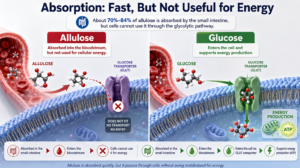
Wrong! Yeast can’t ferment allulose at all. The yeast used in baking (Saccharomyces cerevisiae) is completely devoid of the enzymes that can cleave the molecular bonds of this rare sugar. If you feed it to yeast, you will starve the strain to death, and the noodle process will strike directly and completely.
So what do you do? You gotta give the yeast a little “bio-start capital”. In a mixture of warm water and yeast, honestly add just a teaspoon of real honey, maple syrup or plain white sugar. Don’t worry, during the fermentation stage, the yeast will eat up this real sugar and release the gas needed to make the bread expand. In the bread baked at the end, the net carbohydrate is basically zero.
Measured Comparison: “Rollover” And Magic Under Alternating Hot And Cold.
As long as the temperature changes, the gap between sugar alcohol and rare sugar is completely exposed. Recently, there was a test of boiling syrup comparing erythritol and allulose. After reading it, you will understand why candy manufacturers are abandoning the traditional ketogenic sugar substitute.
Boil the erythritol into a syrup and look perfect in the pan. But once it is cooled to room temperature, it will undergo severe recrystallization, and the originally smooth caramel sauce will instantly become a crunchy and useless “glass slag”. This is because as long as the heat source is 1 removed, the solubility of erythritol will fall to the bottom.
And allulose? It’s totally anti-crystallization. The caramel sauce made with allulose and light cream and butter is very rich and chewy, and even if it stays in the refrigerator for weeks, it is still soft and waxy. In this respect, it behaves exactly like high-fructose corn syrup. It is definitely the best solution to make homemade ketogenic ice cream, marshmallows and sticky noodles for this “anti-crystallization” skill.
New Trends In The Industry: Siraitia Grosvenor Compound Sugar Substitute
If you make a dessert with that delicate texture, counting on allulose will seem a bit cumbersome. After all, in order to make up enough sweetness, you have to add 30% more volume. If you pour so much allulose into the light sponge cake batter, you will definitely press the batter down and destroy the air that is finally sent in.
Commercial ketogenic brands are now playing “synergistic compounding”. The developers mixed pure psicose with highly concentrated Luo Han Guo extract. Luo Han Guo can reach 250 times the sweetness of white sugar, but it just doesn’t have the physical volume needed for baking.
The combination of these two 1 is a perfect solution to the problem of excessive volume. Allulose is responsible for propping up the skeleton, coloring and locking water, while the tiny amount of Luo Han Guo just makes up for the missing 30% sweetness. For those who usually do baking at home, it is definitely a wise choice to buy the sugar substitute marked “allulose + Luo Han Guo compound” on the package. With it, you can safely replace it at 1:1 without worrying about the collapse of the batter.
Foire aux questions (FAQ)
Does allulose really taste exactly like real sugar?
The taste is super close to real sugar. There is absolutely no bitter chemical aftertaste, but its sweetness is only 70% of that of white sugar. Moreover, it does not have the lingering strong “mint-like” cooling feeling of erythritol. Whether it is used for making coffee or baking, the flavor is much purer.
Can I change 1:1 sugar to allulose when baking?
If you use pure allulose, the 1:1 dessert is definitely not sweet enough. For every cup of white sugar, you need about 1 and 1/3 cups of allulose. However, if you buy “allulose + Luo Han Guo compound sugar substitute”, it can be safely replaced 1:1.
Why did I use allulose to bake a cake and it turned out to be burnt?
Because allulose accelerates the Maillard reaction when exposed to heat, coloring is much faster than ordinary white sugar. To prevent paste, you must lower the oven temperature in the recipe by at least 25 degrees Fahrenheit and check the baking 5 to 10 minutes earlier than the time written on the recipe.
Is it safe for diabetics to eat allulose? Can you control sugar?
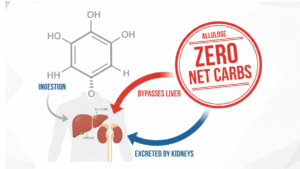
Very safe. Allulose is not metabolized into glucose in the human body. It bypasses the liver directly and is excreted through the urine. In other words, it hardly triggers an insulin response, does not raise blood sugar, and is very effective for diabetic diets.
Can I make hard candy with allulose?
I can’t do it. The anti-crystallization ability of allulose is too strong. While this makes it a perfect match for soft caramel, soft cookies and ice cream, it also means it doesn’t solidify into hard candy at all. To make ketogenic hard candy, you have to use a sugar substitute that crystallizes easily, such as isomalt or erythritol.
Can eating allulose cause gastrointestinal discomfort or flatulence?
As long as you eat in moderation (one-time intake is controlled within 25 grams), most people’s intestines and stomach can handle it. However, if you eat too much and too fast, the unabsorbed part will ferment in the large intestine, causing bloating and even osmotic diarrhea.
Recommandations connexes
-

Quelle quantité de maltodextrine peut-on consommer sans risque chaque jour ? Quelle est la limite maximale ?
66Quelle quantité de maltodextrine peut-on consommer sans risque chaque jour ? Découvrez votre limite maximale exacte en fonction de votre niveau d'activité physique et de votre santé intestinale.
Voir les détails -
L'allulose est-elle un édulcorant sain ? Avantages et inconvénients en matière de sécurité
62L'allulose est-elle un édulcorant sain ? Découvrez ses avantages et ses inconvénients en matière de sécurité, ses bienfaits pour la glycémie continue (CGM) et les pièges cachés en pâtisserie.
Voir les détails -
L'allulose est-elle un sucre ? Analyse d'un monosaccharide rare
58L'allulose est-elle un sucre ? Oui, c'est un monosaccharide rare. Découvrez pourquoi elle contourne le métabolisme, empêche les pics glycémiques et stimule le GLP-1.
Voir les détails -
L'allulose est-il considéré comme un glucide ? Ce qu'on ignore souvent sur le régime cétogène
70L'allulose est-elle considérée comme un glucide dans le régime cétogène ? Découvrez pourquoi elle ne contient aucun glucide net, ne provoque pas de pics d'insuline, et retrouvez des conseils de pâtisserie.
Voir les détails