 SGNUTRI



Rechercher un produit
How Does Allulose Affect Net Carbs? Starting From The Us Nutrition Label
Allulose (allulose) is included in the total carbohydrates on the U.S. nutrition label. When calculating net carbohydrates according to common standards, the number of grams of allulose per serving is deducted from the total carbohydrates. For example, if a serving of food contains 14 grams of total carbohydrates, 3 grams of dietary fiber, and 6 grams of allulose, and does not contain sugar alcohols, the net carbohydrate count is 5 grams. The U.S. Food and Drug Administration (FDA) has clear labeling requirements for total carbohydrates, but there is no uniform legal definition for net carbohydrates. FDA Allulose Labeling Guidelines - American Diabetes Association’s Instructions for Net Carbonated Water
Why can we deduct total carbohydrates when calculating net carbohydrates?
Total carbohydrates are calculated based on the carbohydrates in food. Allulose is a monosaccharide in chemistry and is therefore included in total carbohydrates. According to FDA enforcement discretionary guidelines, manufacturers can exclude allulose from the labeled grams of **total sugars (Total Sugars) and added sugars (Added Sugars)** and calculate its contribution to label calories at 0.4 kcal per gram. Therefore, even if the packaging says “0 grams of added sugar”, the total carbohydrate column can still contain allulose. FDA Allulose Labeling Guidelines
The deduction of net carbon water takes into account how the human body uses this part of carbohydrates. A human study found that at the three intake doses tested, approximately 70% of allulose was excreted in the urine. After reviewing the relevant evidence, the FDA concluded that allulose itself causes very little blood sugar and insulin response. This is also the basis for some brands to deduct allulose when calculating net carbohydrates. The starch and other sugars in the finished product still need to be calculated in grams. Human Metabolism Research - FDA Allulose Labeling Guidelines
How do you calculate net carbs when you get an American nutrition label?
First, look at the serving size (serving size) and unify the values involved in the calculation into the same serving. For foods containing allulose and without sugar alcohols, estimates can be made according to the following criteria.
Net carbs per serving = Total carbs per serving − Dietary fiber per serving − Allulose per serving
| Objet | Grams per serving (example) | How to use it |
|---|---|---|
| Total Carbohydrate | 14 g | Start here |
| Fibres alimentaires | 3 g | Subtract from total carbs |
| Allulose | 6 g | Subtract once from total carbs |
| Sucres totaux | 2 g | Keep these 2 grams in the result |
According to this example, 14 − 3 − 6 = 5 grams of net carbohydrates. Eat two servings, and the total is 10 grams. If the front of the package already says “5 grams of net carbs per serving,” read the calculation instructions next to it first. If the brand has already deducted allulose, use this result directly.
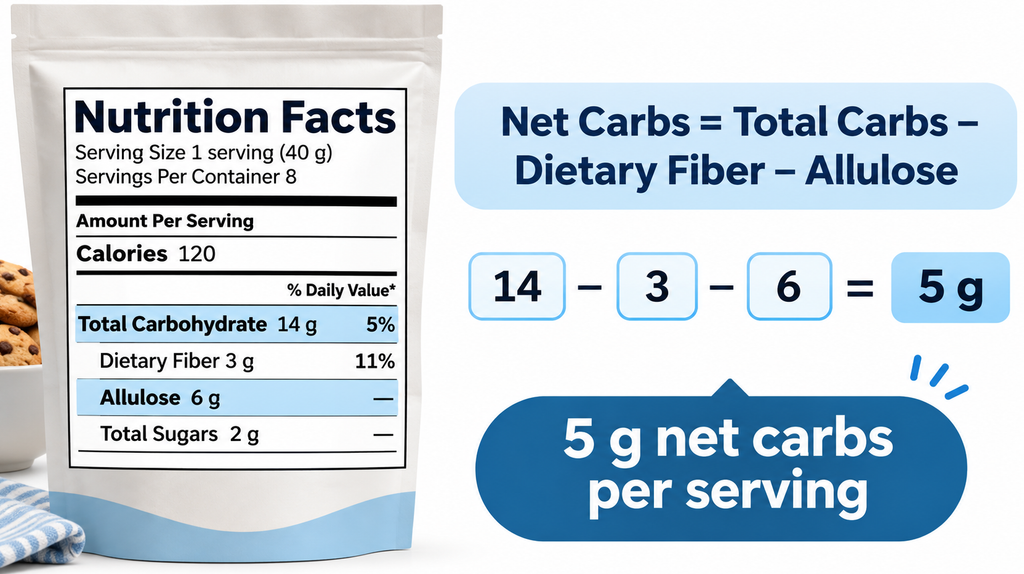
This also explains why, with the change in sweetener, the total carbohydrate count may not show any change. Assume that each serving of the formula replaces 6 grams of sucrose with 6 grams of pure allulose, the remaining ingredients and weight per serving are the same, and the total carbohydrates of the two formulas are the same. Following the algorithm above, the new formula has 6 grams less net carbohydrates.
The ingredient list says allulose, but the packaging doesn’t specify the gram count. What should I do?
Based solely on the ingredient list, it can only be confirmed that the product uses allulose. It is also impossible to pour out the number of grams using “total carbohydrates − dietary fiber − total sugar” because there may be starch in the difference. First, look at the calculation instructions next to the net carbohydrate statement on the packaging. Still unable to find the number, confirm with the brand how many grams of allulose are in each finished product. If a compound sweetener is used, the actual content of allulose should be checked, and the amount of compound ingredients added cannot be directly substituted. FDA Allulose Labelling Guidelines - U.S. Nutrition Labelling Regulations 21 CFR 101.9
Le précédent : Allulose and Migraines: What Headache Reports Tell Us
Recommandations connexes
-

Allulose ou stévia : Quel est votre choix d'édulcorant le plus sain ?
2654Comparez l'allulose et la stévia en ce qui concerne le pouvoir sucrant, les effets sur la santé, la perte de poids et la sécurité des dents. Découvrez quel édulcorant répond le mieux à vos besoins.
Voir les détails -
Dextrose Maltodextrin and Sucralose: Roles in a Blend
763Learn how dextrose maltodextrin and sucralose contribute sweetness, bulk and carbohydrate to a blend.
Voir les détails -
Combien de temps les vitamines B restent-elles dans l'organisme ?
2980La plupart des vitamines B restent dans votre système pendant 24 à 48 heures. Apprenez comment vos reins éliminent l'excès et l'exception B12.
Voir les détails -
Alternatives à la maltodextrineDes substituts naturels pour une alimentation plus saine
2695Guide professionnel des alternatives naturelles à la maltodextrine. Trouver des substituts sains pour la gestion de la glycémie et du poids.
Voir les détails