SGNUTRI


Rechercher un produit
Can Maltodextrin Be Organic
Yes, maltodextrin can absolutely be organic, and for a health-conscious consumer, the distinction is crucial.
Although most of the common maltodextrins on the market come from genetically modified corn, and synthetic acids or chemical catalysts are used in the processing process, “certified organic maltodextrins” must be hard-hitting standards. This means that it must be made 100% from non-GMO crops-such as organic cassava, organic corn or rice-and must be grown without synthetic pesticides, herbicides or sewage sludge. The extraction process of the organic version is obviously more “civilized”: it does not use those strong chemical solvents, but uses natural enzymatic hydrolysis technology to convert plant starch into functional powder. When you see “organic maltodextrin” on the label, it is not only a thickener or carrier, but also means that it is free of chemical residues and bioengineered DNA.
Conventional Vs Organic Sources
The fundamental difference between organic maltodextrin and ordinary goods actually starts from the soil. Ordinary maltodextrin is a regular customer of the food industry, but it is often a by-product of large-scale industrial agriculture that is largely inextricably linked to genetic modification. Maltodextrin, which can be named “organic”, must be derived from 100 percent non-GMO crops.
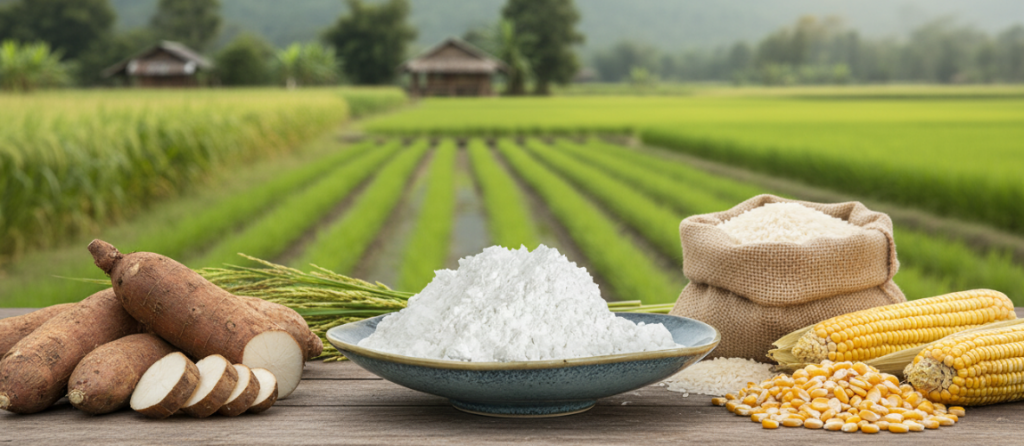
Common sources of organic maltodextrin include:
- Organic cassava: Because of its neutral taste and natural non-GMO qualities.
- Organic corn: must be grown under strict organic farming protocols.
- Organic rice: often found in low-sensitivity or specific health formulas.
By choosing organic, manufacturers avoid synthetic fertilizers, banned herbicides or those with neurotoxic pesticides at the source, ensuring the purity of the raw material.
Natural Enzymatic Hydrolysis
The production of ordinary maltodextrin often uses some “violent” means, including the use of synthetic acids or chemical catalysts to forcibly decompose plant starch.
Certified organic maltodextrins use a much milder method: natural enzymatic hydrolysis. This process mimics natural biological reactions, replacing powerful chemical solvents with natural enzymes. This treatment method can not only better maintain the integrity of the ingredients, but most importantly, it can ensure that there is no chemical residue in the finished product. This kind of “gentle treatment” of raw materials is actually the premium of organic products.
Compliance With Standards
À la pointe de la nutrition
Fibres solubles
La fibre soluble est un ingrédient alimentaire très stable et indigeste qui favorise le contrôle du poids en augmentant la satiété et en réduisant la prise alimentaire. D'application polyvalente, elle est largement utilisée pour améliorer le profil nutritionnel et la texture des aliments, des boissons et des produits de santé.
Fibres solubles
Prébiotique
Un prébiotique fonctionne comme un facteur de prolifération qui est dégradé et utilisé de manière sélective par des bactéries intestinales bénéfiques, telles que Bifidobactéries. Ce processus exerce un effet positif sur la santé humaine en général, souvent accompagné d'avantages métaboliques tels qu'un faible impact calorique et des fluctuations minimes de la glycémie en raison de leur stabilité digestive unique.
Prébiotique
Vitamines
Les vitamines sont des micronutriments organiques essentiels, classés en formes hydrosolubles et liposolubles, qui régulent des processus physiologiques essentiels tels que le métabolisme, l'immunité et la coagulation. En raison de leur sensibilité à la lumière, à la chaleur et à l'humidité,
Vitamines
The Local National Organic Program standards act as a safety net, providing consumers with several core guarantees:
- No bioengineered DNA: Closely monitored to ensure no genetically modified ingredients.
- Prohibit the use of prohibited substances: The land on which the crops are grown must not have been sprayed with synthetic pesticides or used sewage sludge for at least 3 years.
- Rigorous ledger audits: From the farm to the spray drying plant, every step along the supply chain is audited to prevent organic and common ingredients from mixing together.
Why “Organic Maltodextrins” Are Essential For Clean Labels
In the modern food industry, “clean label” is not just a marketing gimmick, it represents transparency. Even though maltodextrin is usually only added as a small amount of excipients, carriers or thickeners, its “origin” is still very important for consumers who pursue health.
- Residue-free: The natural enzymatic process combined with organic farming means you have a very low risk of eating traces of synthetic chemicals.
- Transparency: For those who shy away from “bioengineering”, this can provide a real sense of peace of mind.
- The function is not discounted: it can provide the same taste improvement, shelf life stability or desiccant function.
Author: Marcus Mike
“Hi, I’m a food formulation specialist with years of experience in clean-label ingredient sourcing, I am passionate about bridging the gap between industrial processing and natural nutrition. I’ve spent much of my career analyzing how small additives—like organic maltodextrin—can make a massive difference in product transparency and consumer trust. “
Le précédent : Can I Substitute Erythritol For Sugar
Recommandations connexes
-

Le dextrose est-il du sucre anhydre ?
234Oui, le dextrose anhydre est du sucre pur 100% avec un Gi de 100. Découvrez son impact sur l'insuline, les diabétiques et le régime céto.
Voir les détails -
L'érythritol et la stévia sont-ils identiques ?
270L'érythritol et la stévia sont-ils identiques ? Non. Découvrez ici les principales différences en termes d'origine, de pouvoir sucrant et d'utilisation en pâtisserie.
Voir les détails -
Maltodextrine Boissons pour sportifs
481Commune sur le marché, Gatorade, Pocari Sweat et bien d'autres marques connues, sa formule ne contient pas moins de maltodextrine. Il existe aussi des gels énergétiques et des boissons de récupération destinés aux sportifs professionnels ou aux entraînements de haute intensité, et la maltodextrine...
Voir les détails -
Poudre d'oligosaccharide Isomalto : Une fibre prébiotique équilibrée pour les formulations fonctionnelles à teneur en sucre contrôlée
1226La poudre d'oligosaccharide Isomalto organique de maïs du fournisseur offre des oligosaccharides naturels pour des applications fonctionnelles à label propre
Voir les détails