 SGNUTRI


Rechercher un produit
Xylitol material selection to avoid pitfalls: How to choose between 20 mesh and 100 mesh?
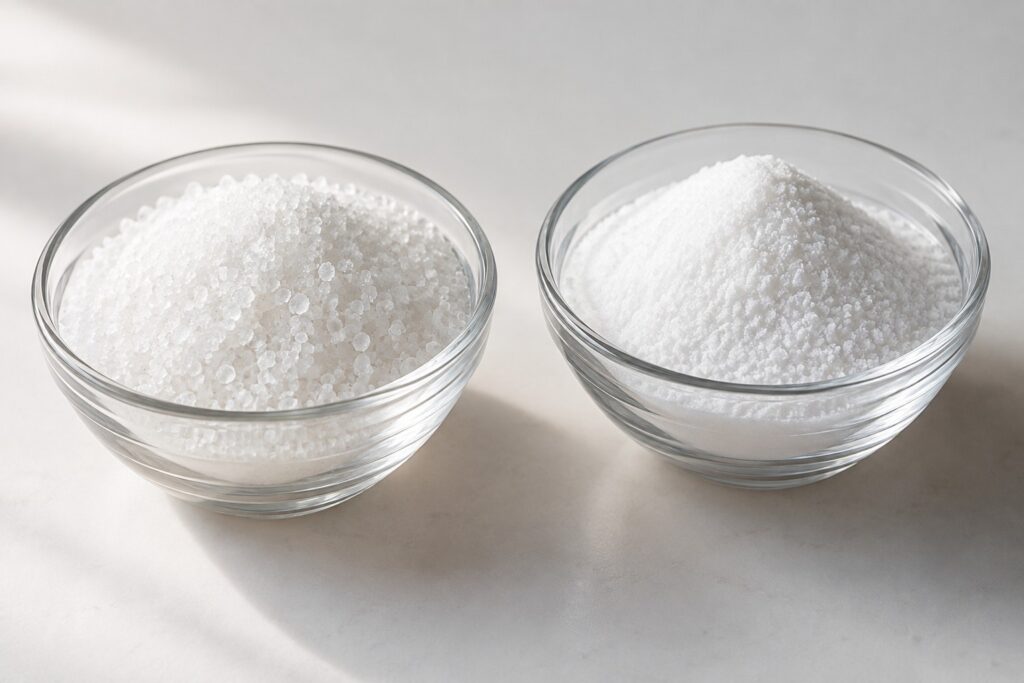
Everyone calls it xylitol, but the actual crystalline particles and micronized powder you get can feel very different when you actually use them on the production line. When purchasing or developing, if you only focus on the name and purity, and don’t care about the mismatch in particle size (that is, mesh size), the mismatch may become apparent during feeding, mixing, or in the final product’s taste. Take xylitol from Saigao (Saigao) as an example. The two main specifications are “20 mesh crystals” and “100 mesh micronized powder”. How to choose? You have to work backwards from what state your final product needs to be.
Don’t think too much about “20 mesh” and “100 mesh” yet, think of it as a sieve between sections
What the industry calls “mesh count” is actually the size of the mesh of the screen, which has nothing to do with the purity of xylitol. To put it simply and roughly: 20-mesh crystals are relatively coarse particles, and 100-mesh micropowders are very fine powders. The thickness of the ingredients directly determines whether they spread well in the recipe, whether they melt quickly, and the taste of the food in your mouth. But don’t get too caught up in the horns. You can’t assume that this batch of ingredients will perform exactly the same in all your recipes based on just one mesh size.
There’s a detail to note here. According to Saigao’s 20-mesh crystal specification, people’s screening standard is: the coarse material remaining on the 850-micron (20-mesh) screen cannot exceed 10%, and the fine powder leaking through the 150-micron (100-mesh) screen cannot exceed 5%. The requirement for 100-mesh micron powder is that the residue remaining on the 150-micron sieve cannot exceed 20%. You see, the detection caliber and limited range of these two specifications are not the same thing at all. When we compare, we have to follow our respective testing standards. Don’t naively think that “20 mesh” or “100 mesh” means that all particles grow to an average size; it is actually a distribution range.
Determine which material to choose based on the final state of your finished product
The type of material you use depends on what you want your product to be made of. If your product requires that noticeable grainy texture in your mouth, then take the 20-mesh crystals directly to the machine for testing to see if the resulting condition meets expectations. On the contrary, if the formula requires xylitol to be mixed with other powders so that even one’s mother cannot recognize it, or absolutely cannot have the abrupt feeling of chewing large particles, then taking 100-mesh micron powder as the starting test will definitely be more correct. However, on the other hand, the number of items selected has only passed the first level. Whether it works or not depends on whether it can run smoothly in your actual recipe, feeding order and workshop environment.
Both specifications are printed in the instruction manual “easily soluble in water, slightly soluble in ethanol”. But we need to have some common sense: the finer the powder, it only means that it melts water quickly, which does not mean that its final solubility is higher, let alone expect it to dissolve “in seconds” no matter how much you pour in it. Therefore, when testing water, the conditions must be stuck —— the number of ingredients to add, the water temperature, how to stir, and the observation time must all be fixed. What should we focus on? Check whether it will clump into a big lump, whether there are any unmelted residues, and taste the taste of the finished product. In addition, xylitol will have a very obvious cooling sensation when it melts in water. Whether this feeling is comfortable or uncomfortable when added to your specific formula must be tested in real time to know.
Core mental indicators are also indispensable
It’s not enough to just focus on thickness; the core hard indicators also need to be considered. Whether it is 20 mesh or 100 mesh, the core data of these two xylitol products from Saigao are actually flat in a bowl of water: the purity is between 98.5% and 101.0%, the moisture content does not exceed 0.5%, other (dry-based) polyols do not exceed 1.0%, and reducing sugars do not exceed 0.2%. It appears entirely as white or white-like crystalline powder or crystals, with a melting point in the range of 92 ℃to 96℃.
Many novices are prone to making a mistake. When they see the words “micron powder” or “crystallization” printed on the packaging bag, they are too lazy to look at the full set of physical and chemical indicators. This is absolutely a big no-no! No matter how straightforward the product name is, it cannot replace real quality inspection data.
Finally, to be more practical, when setting up a contract with a supplier, don’t just talk about it. It must be written in black and white on the purchase order: what is the target particle size, what range the screening requirements are stuck in, what is the content and moisture content, and the corresponding quality inspection report must be included. Don’t rush to make a decision when you receive the sample. Just do a small test according to the craftsmanship of your workshop and compare the coarse and fine materials under the same conditions. Only xylitol, which is carefully calculated and refined, is a good material that can truly break in perfectly with your production line, rather than a cold code on the purchase order.
Le précédent : Sweetener Xylitol: Choosing 20 Mesh or 100 Mesh
Recommandations connexes
-

L'allulose aide-t-elle à perdre du poids ? Comment fonctionne-t-elle réellement ?
353Découvrez comment l'allulose favorise la perte de poids en stimulant l'oxydation des graisses et en activant le GLP-1. Retrouvez ici les conseils d'experts sur le dosage.
Voir les détails -
Une faible teneur en vitamine D provoque-t-elle des vertiges ?
808Une carence en vitamine D peut-elle provoquer des vertiges ? Oui. Elle affecte les cristaux de l'oreille interne (Bppv) et l'équilibre. Découvrez ici les symptômes et les traitements.
Voir les détails -
La maltodextrine peut-elle être biologique ?
479Découvrez les avantages de la maltodextrine biologique, les sources sans OGM et les normes d'un véritable régime alimentaire "clean label".
Voir les détails -
Le sirop de maltitol est-il exempt de gluten ? Un guide complet
1840Le sirop de maltitol est un édulcorant sans gluten utilisé dans les aliments sans sucre. Découvrez ce qu'il est et pourquoi Sgnutri le recommande.
Voir les détails