 SGNUTRI


Ricerca prodotto
Composition of allulose: Molecules and products
When it comes to “the ingredients of allulose”, it usually contains two completely different meanings: one is what the chemical molecule allulose itself is made of; the other is what ingredients are contained in the jars of commercially available products labeled “allulose”. Simply put, the former talks about pure chemical properties, while the latter is much more complicated ——you also have to consider its purity, residue, and even whether the manufacturer has mixed other ingredients (compounding) into it.
The true appearance of the aloxone sugar molecule
The scientific name of the allulose we usually talk about is D-allulose (also called D-psicose in English). According to the chemistry “ID card”, its molecular formula is C6H12O6, its molecular weight is 180.16, and its CAS registration number is 551-68-8. If you ask the bottom line, it is a pentulose, a monosaccharide, and a relatively scarce type of sugar in nature. To clarify: it is neither a sugar alcohol nor has anything to do with dietary fiber.
Coincidentally, allulose is the same as the familiar D-fructose “which hits the face”, and the molecular formulas and molecular weights of the two are exactly the same. However, because of the difference in the spatial arrangement on the third carbon atom, they are destined to be two completely different monosaccharides. Although today’s factories often use fructose as raw material to react and produce allulose during mass production, this does not mean that pure allulose molecules still contain fructose.
Production substrate ≠ finished product ingredients
The main process for commercial production of allulose is to use fructose as a substrate and utilize enzymatic epimerization reaction to produce it. However, the liquid that had just reacted was actually a “hodgepodge”, which contained not only allulose, but also unreacted fructose and other impurities. To turn it into the syrup or crystalline sugar we see on the market, it must undergo extremely rigorous separation and purification steps. Therefore, the “fructose” mentioned here is merely a raw material used in the production route and has nothing to do with the final composition of pure allulose molecules.
When looking at commercial products, we must also keep a close eye on specifications and indicators
In theory, pure D-allulose is an extremely single chemical substance. But the situation is different if the goods want to be canned from the factory. To judge whether a product is good or not, you need to look at its actual allulose content and how much fructose, glucose, water or other miscellaneous sugars are left in it.
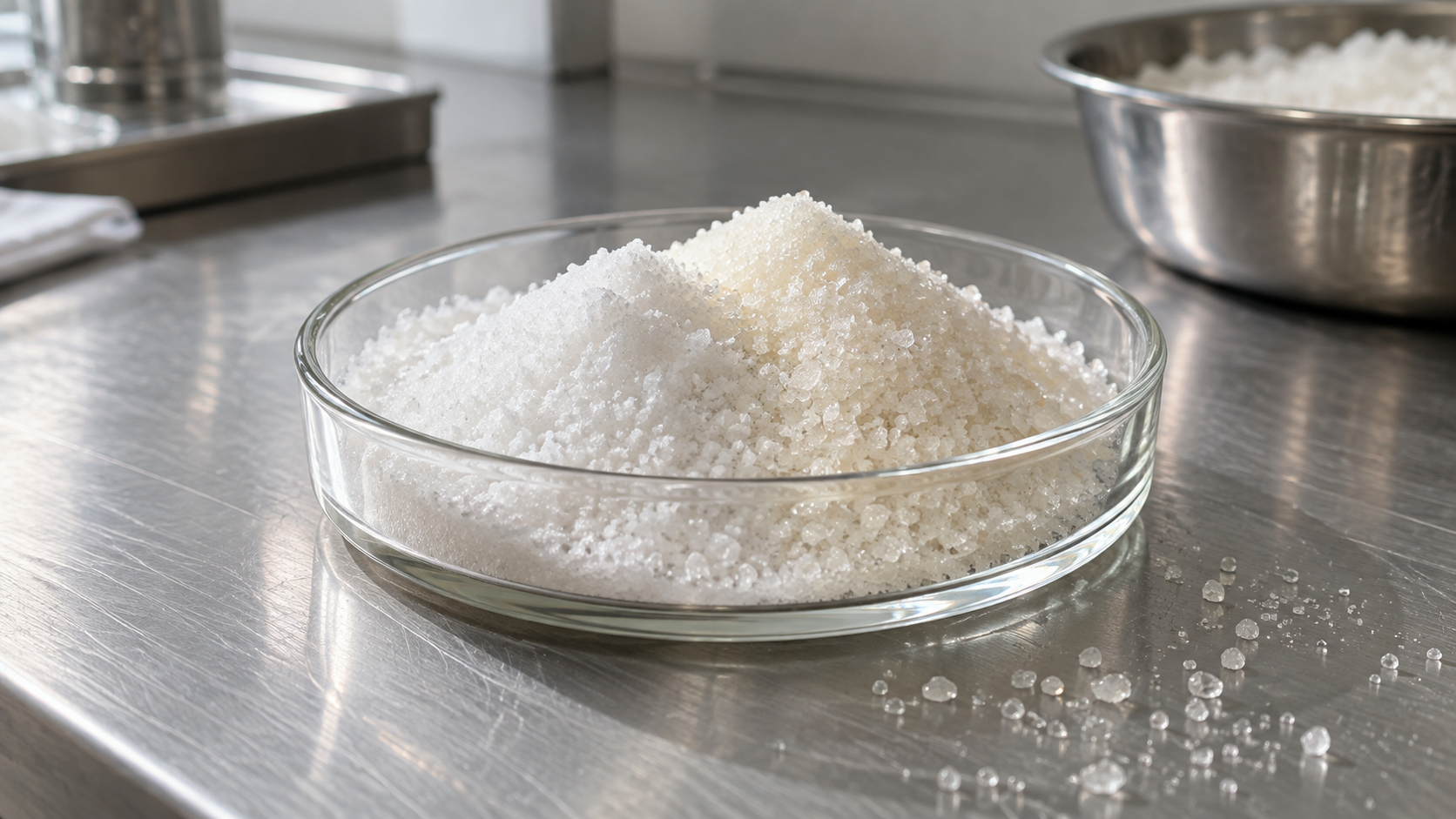
Take the common factory specifications of crystalline allulose: it usually appears as white or slightly yellow crystalline particles (or powder), has no odor, and is extremely soluble in water. In terms of hard technical indicators, the dry basis content must not be lower than 98.5%, the weight loss during drying must be controlled within 1.0%, the ash content must not exceed 0.1%, the pH value must be maintained between 3.0 and 7.0, and the protein and fat content must not exceed the red line of 1.0%. You see, these densely packed numbers define the qualification standards for the product, rather than redefining the chemical formula C6H12O6.
Confirm ingredients: Don’t be fooled by product packaging
From now on, whenever you see the words “allulose sweetener” on the packaging, don’t take it for granted that it contains 100% pure allulose. It may indeed be a single ingredient, but it is also very likely to be a blend with natural flavors, steviol glycosides, monk fruit extract, or other sweeteners “combination blend”.
The most reliable way to find out its true details is to honestly look at the complete ingredient list and product technical specifications on the back of the packaging. The ingredient list can help you clear the mine at a glance and confirm whether it is a compound; while the technical specifications can give you a bottom line, telling you how high the pure allulose content is and what proportion of residual ingredients have not been purified.
Il precedente: Allulose vs. White Sugar: Differences in FormulationIl prossimo: Allulose Condensed Milk: Formula, Texture and Safety
Raccomandazioni correlate
-

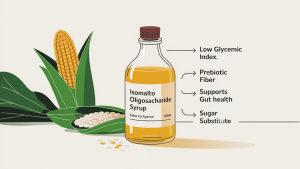
Sciroppo di oligosaccaridi Isomalto: Prebiotico versatile
1826Sostenete la digestione e il benessere con lo sciroppo Imo di Sgnutri - ideale per alimenti salutari e bevande funzionali.
Visualizza i dettagli -
Di cosa è fatto il polidestrosio
857Scoprite gli ingredienti e la sintesi del polidestrosio in questa analisi di uno scienziato alimentare esperto.
Visualizza i dettagli -
Allulose vs. White Sugar: Differences in Formulation
213Learn how allulose compared to sugar differs in sweetness, calories, labeling, and food formulation.
Visualizza i dettagli -
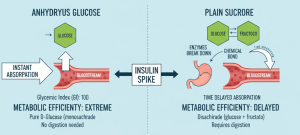
Che cos'è il destrosio anidro
1459Che cos'è il destrosio anidro? Una fonte di glucosio pura e poco umida per l'energia rapida, il recupero della forma fisica e l'uso medico.
Visualizza i dettagli